

606
consciousness, even in a process of evanescence?”
8
In the case of Easter Islanders,
one might surmise that a “creeping normalcy” or “landscape amnesia” (as Jared
Diamond utilized the expressions)
9
insulated those invested in the Bird Cults and
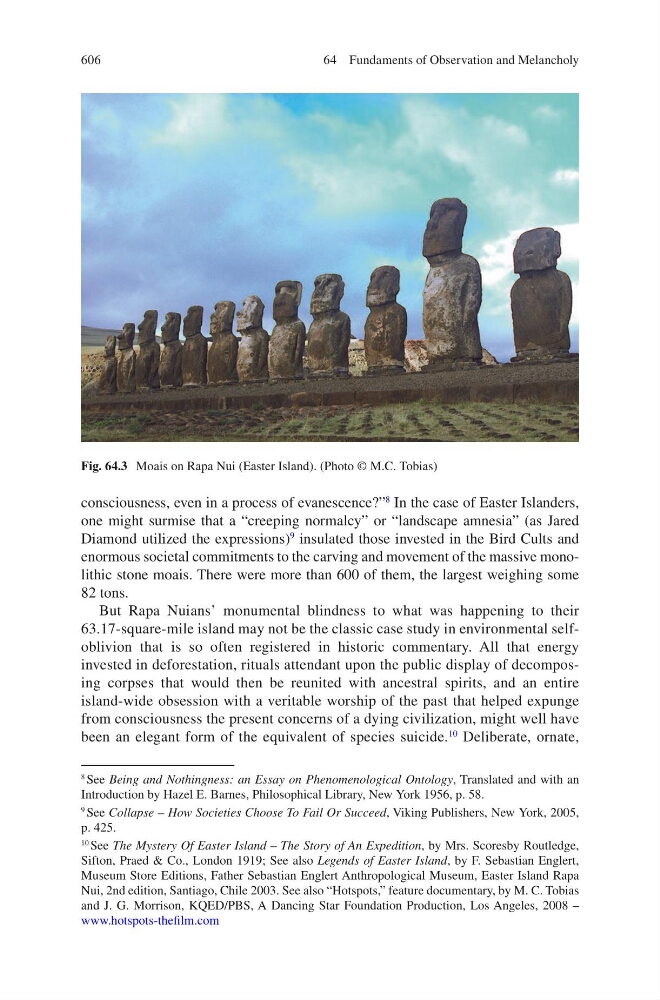
enormous societal commitments to the carving and movement of the massive monolithic stone moais. There were more than 600 of them, the largest weighing some
82 tons.
But Rapa Nuians’ monumental blindness to what was happening to their
63.17-square-mile island may not be the classic case study in environmental selfoblivion that is so often registered in historic commentary. All that energy
invested in deforestation, rituals attendant upon the public display of decomposing corpses that would then be reunited with ancestral spirits, and an entire
island-wide obsession with a veritable worship of the past that helped expunge
from consciousness the present concerns of a dying civilization, might well have
been an elegant form of the equivalent of species suicide.
10
Deliberate, ornate,
8 See Being and Nothingness: an Essay on Phenomenological Ontology, Translated and with an
Introduction by Hazel E. Barnes, Philosophical Library, New York 1956, p. 58.
9 See Collapse – How Societies Choose To Fail Or Succeed, Viking Publishers, New York, 2005,
p. 425.
10 See The Mystery Of Easter Island – The Story of An Expedition, by Mrs. Scoresby Routledge,
Sifton, Praed & Co., London 1919; See also Legends of Easter Island, by F. Sebastian Englert,
Museum Store Editions, Father Sebastian Englert Anthropological Museum, Easter Island Rapa
Nui, 2nd edition, Santiago, Chile 2003. See also “Hotspots,” feature documentary, by M. C. Tobias
and J. G. Morrison, KQED/PBS, A Dancing Star Foundation Production, Los Angeles, 2008 –
www.hotspots-thefilm.com
Fig. 64.3 Moais on Rapa Nui (Easter Island). (Photo © M.C. Tobias)
64 Fundaments of Observation and Melancholy
consciousness, even in a process of evanescence?”
8
In the case of Easter Islanders,
one might surmise that a “creeping normalcy” or “landscape amnesia” (as Jared
Diamond utilized the expressions)
9
insulated those invested in the Bird Cults and
enormous societal commitments to the carving and movement of the massive monolithic stone moais. There were more than 600 of them, the largest weighing some
82 tons.
But Rapa Nuians’ monumental blindness to what was happening to their
63.17-square-mile island may not be the classic case study in environmental selfoblivion that is so often registered in historic commentary. All that energy
invested in deforestation, rituals attendant upon the public display of decomposing corpses that would then be reunited with ancestral spirits, and an entire
island-wide obsession with a veritable worship of the past that helped expunge
from consciousness the present concerns of a dying civilization, might well have
been an elegant form of the equivalent of species suicide.
10
Deliberate, ornate,
8 See Being and Nothingness: an Essay on Phenomenological Ontology, Translated and with an
Introduction by Hazel E. Barnes, Philosophical Library, New York 1956, p. 58.
9 See Collapse – How Societies Choose To Fail Or Succeed, Viking Publishers, New York, 2005,
p. 425.
10 See The Mystery Of Easter Island – The Story of An Expedition, by Mrs. Scoresby Routledge,
Sifton, Praed & Co., London 1919; See also Legends of Easter Island, by F. Sebastian Englert,
Museum Store Editions, Father Sebastian Englert Anthropological Museum, Easter Island Rapa
Nui, 2nd edition, Santiago, Chile 2003. See also “Hotspots,” feature documentary, by M. C. Tobias
and J. G. Morrison, KQED/PBS, A Dancing Star Foundation Production, Los Angeles, 2008 –
www.hotspots-thefilm.com
Fig. 64.3 Moais on Rapa Nui (Easter Island). (Photo © M.C. Tobias)
64 Fundaments of Observation and Melancholy