

382
42.3 Ecological Legacies in Mortar and Stone
Hence, the architect takes on a moderator’s role between physical and mental evolution. There are huge leaps in these many assertions; but who has not obsessed upon,
not just death, but the act of dying, and its precise location? To similar effect, the act
of living and its geography are a subject of intense, indeed the ultimate locus for,
contemplation. Few architects have ever found themselves in so politically and aesthetically charged an environment as the Austrian architect and historian Johann
Bernhard Fischer von Erlach (1656–1723), whose lavishly baroque commissions
would result in many of the Habsburg Empire’s most elaborate images of power
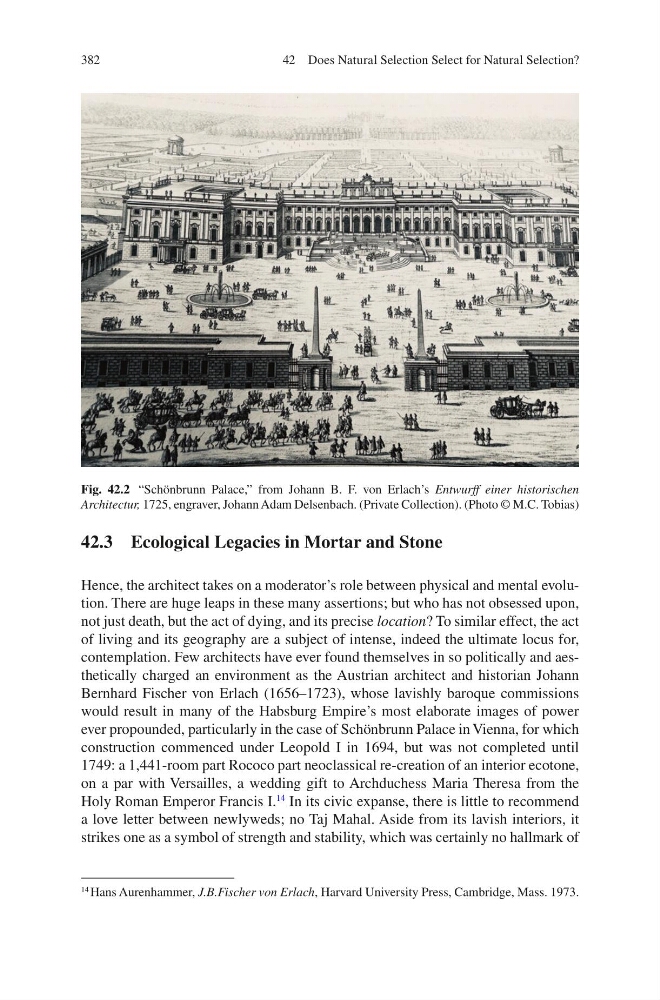
ever propounded, particularly in the case of Schönbrunn Palace in Vienna, for which
construction commenced under Leopold I in 1694, but was not completed until
1749: a 1,441-room part Rococo part neoclassical re-creation of an interior ecotone,
on a par with Versailles, a wedding gift to Archduchess Maria Theresa from the
Holy Roman Emperor Francis I.
14
In its civic expanse, there is little to recommend
a love letter between newlyweds; no Taj Mahal. Aside from its lavish interiors, it
strikes one as a symbol of strength and stability, which was certainly no hallmark of
14 Hans Aurenhammer, J.B.Fischer von Erlach, Harvard University Press, Cambridge, Mass. 1973.
Fig. 42.2 “Schönbrunn Palace,” from Johann B. F. von Erlach’s Entwurff einer historischen
Architectur, 1725, engraver, Johann Adam Delsenbach. (Private Collection). (Photo © M.C. Tobias)
42 Does Natural Selection Select for Natural Selection?
42.3 Ecological Legacies in Mortar and Stone
Hence, the architect takes on a moderator’s role between physical and mental evolution. There are huge leaps in these many assertions; but who has not obsessed upon,
not just death, but the act of dying, and its precise location? To similar effect, the act
of living and its geography are a subject of intense, indeed the ultimate locus for,
contemplation. Few architects have ever found themselves in so politically and aesthetically charged an environment as the Austrian architect and historian Johann
Bernhard Fischer von Erlach (1656–1723), whose lavishly baroque commissions
would result in many of the Habsburg Empire’s most elaborate images of power
ever propounded, particularly in the case of Schönbrunn Palace in Vienna, for which
construction commenced under Leopold I in 1694, but was not completed until
1749: a 1,441-room part Rococo part neoclassical re-creation of an interior ecotone,
on a par with Versailles, a wedding gift to Archduchess Maria Theresa from the
Holy Roman Emperor Francis I.
14
In its civic expanse, there is little to recommend
a love letter between newlyweds; no Taj Mahal. Aside from its lavish interiors, it
strikes one as a symbol of strength and stability, which was certainly no hallmark of
14 Hans Aurenhammer, J.B.Fischer von Erlach, Harvard University Press, Cambridge, Mass. 1973.
Fig. 42.2 “Schönbrunn Palace,” from Johann B. F. von Erlach’s Entwurff einer historischen
Architectur, 1725, engraver, Johann Adam Delsenbach. (Private Collection). (Photo © M.C. Tobias)
42 Does Natural Selection Select for Natural Selection?