

327
But most arresting of all, within the sagas of paradise that one will be tempted to
search out in a life, was the Shogun himself, Yoshimasa, Plato’s and Plotinus’ true
philosopher-king who, in his late 40s, renounced his political title not once, but
twice, and its duties, retreating instead to a life of silent esthetics and gardens and
rigorous, contemplative tea ceremonies. There is much more to his personal story of
course: adoptions, childlessness, and then a child. But after all the infernal squabbles and horrors of human violence had died away, it is Yoshimasa’s legacy of the
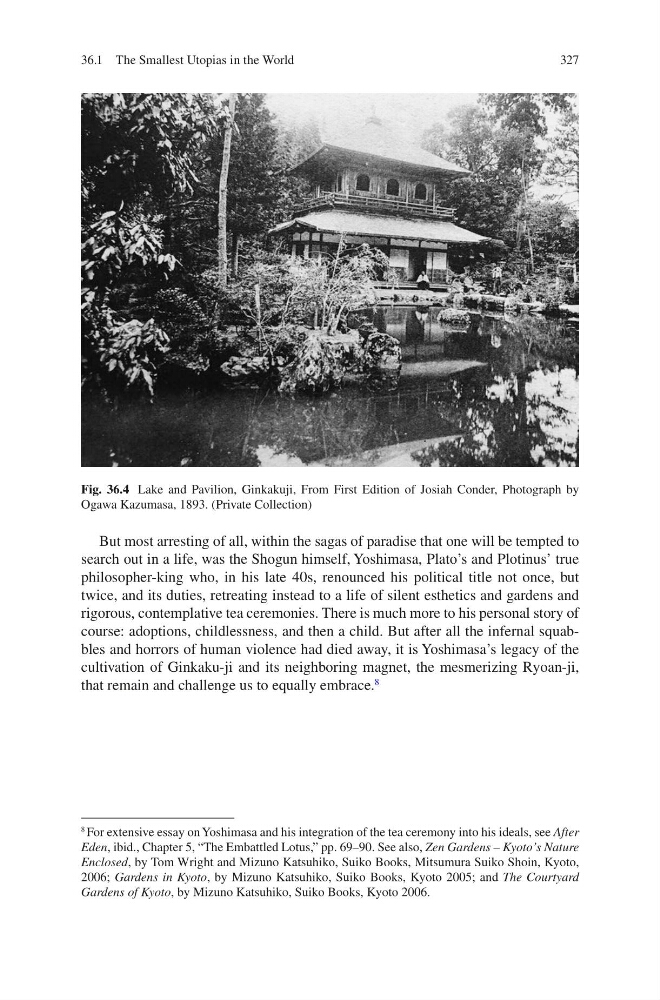
cultivation of Ginkaku-ji and its neighboring magnet, the mesmerizing Ryoan-ji,
that remain and challenge us to equally embrace.
8
8 For extensive essay on Yoshimasa and his integration of the tea ceremony into his ideals, see After
Eden, ibid., Chapter 5, “The Embattled Lotus,” pp. 69–90. See also, Zen Gardens – Kyoto’s Nature
Enclosed, by Tom Wright and Mizuno Katsuhiko, Suiko Books, Mitsumura Suiko Shoin, Kyoto,
2006; Gardens in Kyoto, by Mizuno Katsuhiko, Suiko Books, Kyoto 2005; and The Courtyard
Gardens of Kyoto, by Mizuno Katsuhiko, Suiko Books, Kyoto 2006.
Fig. 36.4 Lake and Pavilion, Ginkakuji, From First Edition of Josiah Conder, Photograph by
Ogawa Kazumasa, 1893. (Private Collection)
36.1 The Smallest Utopias in the World
But most arresting of all, within the sagas of paradise that one will be tempted to
search out in a life, was the Shogun himself, Yoshimasa, Plato’s and Plotinus’ true
philosopher-king who, in his late 40s, renounced his political title not once, but
twice, and its duties, retreating instead to a life of silent esthetics and gardens and
rigorous, contemplative tea ceremonies. There is much more to his personal story of
course: adoptions, childlessness, and then a child. But after all the infernal squabbles and horrors of human violence had died away, it is Yoshimasa’s legacy of the
cultivation of Ginkaku-ji and its neighboring magnet, the mesmerizing Ryoan-ji,
that remain and challenge us to equally embrace.
8
8 For extensive essay on Yoshimasa and his integration of the tea ceremony into his ideals, see After
Eden, ibid., Chapter 5, “The Embattled Lotus,” pp. 69–90. See also, Zen Gardens – Kyoto’s Nature
Enclosed, by Tom Wright and Mizuno Katsuhiko, Suiko Books, Mitsumura Suiko Shoin, Kyoto,
2006; Gardens in Kyoto, by Mizuno Katsuhiko, Suiko Books, Kyoto 2005; and The Courtyard
Gardens of Kyoto, by Mizuno Katsuhiko, Suiko Books, Kyoto 2006.
Fig. 36.4 Lake and Pavilion, Ginkakuji, From First Edition of Josiah Conder, Photograph by
Ogawa Kazumasa, 1893. (Private Collection)
36.1 The Smallest Utopias in the World