

305
merged with ethnography and laid out in the Florentine Codex – (A) General History
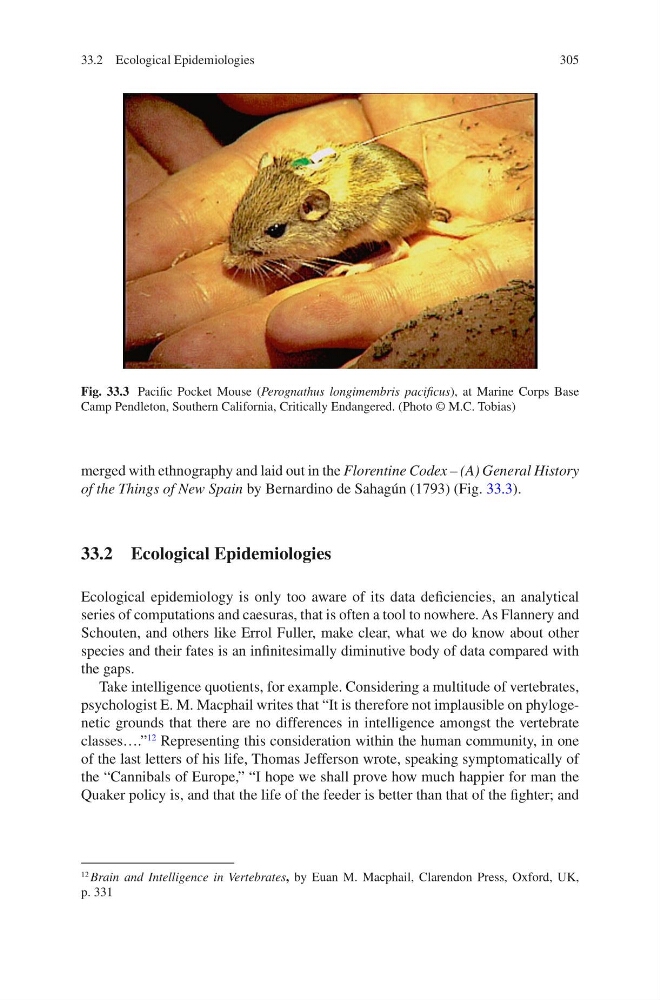
of the Things of New Spain by Bernardino de Sahagún (1793) (Fig. 33.3).
33.2 Ecological Epidemiologies
Ecological epidemiology is only too aware of its data deficiencies, an analytical
series of computations and caesuras, that is often a tool to nowhere. As Flannery and
Schouten, and others like Errol Fuller, make clear, what we do know about other
species and their fates is an infinitesimally diminutive body of data compared with
the gaps.
Take intelligence quotients, for example. Considering a multitude of vertebrates,
psychologist E. M. Macphail writes that “It is therefore not implausible on phylogenetic grounds that there are no differences in intelligence amongst the vertebrate
classes….”
12
Representing this consideration within the human community, in one
of the last letters of his life, Thomas Jefferson wrote, speaking symptomatically of
the “Cannibals of Europe,” “I hope we shall prove how much happier for man the
Quaker policy is, and that the life of the feeder is better than that of the fighter; and
12 Brain and Intelligence in Vertebrates, by Euan M. Macphail, Clarendon Press, Oxford, UK,
p. 331
Fig. 33.3 Pacific Pocket Mouse (Perognathus longimembris pacificus), at Marine Corps Base
Camp Pendleton, Southern California, Critically Endangered. (Photo © M.C. Tobias)
33.2 Ecological Epidemiologies
merged with ethnography and laid out in the Florentine Codex – (A) General History
of the Things of New Spain by Bernardino de Sahagún (1793) (Fig. 33.3).
33.2 Ecological Epidemiologies
Ecological epidemiology is only too aware of its data deficiencies, an analytical
series of computations and caesuras, that is often a tool to nowhere. As Flannery and
Schouten, and others like Errol Fuller, make clear, what we do know about other
species and their fates is an infinitesimally diminutive body of data compared with
the gaps.
Take intelligence quotients, for example. Considering a multitude of vertebrates,
psychologist E. M. Macphail writes that “It is therefore not implausible on phylogenetic grounds that there are no differences in intelligence amongst the vertebrate
classes….”
12
Representing this consideration within the human community, in one
of the last letters of his life, Thomas Jefferson wrote, speaking symptomatically of
the “Cannibals of Europe,” “I hope we shall prove how much happier for man the
Quaker policy is, and that the life of the feeder is better than that of the fighter; and
12 Brain and Intelligence in Vertebrates, by Euan M. Macphail, Clarendon Press, Oxford, UK,
p. 331
Fig. 33.3 Pacific Pocket Mouse (Perognathus longimembris pacificus), at Marine Corps Base
Camp Pendleton, Southern California, Critically Endangered. (Photo © M.C. Tobias)
33.2 Ecological Epidemiologies