

133
teleology and the dialectics of human purpose, to the basics of a biological metaphysics that today is enthusiastically debated like never before. It encompasses the
nature of evolutionary progress—so-called, animal behavior—and plasticity within
the realms of cellular discourse.
10
Most crucially, the breakdown into logical types
and accompanying mathematical notations initiate suggestion that Homo sapiens,
certainly in recent generations, has as a species become so irrationally destructive as
to render a most fitting paradoxical category in which they are the sole occupants.
The problem with this logical type is that it does not obey the population that solely
inhabits its mathematical space. That dimension is the entire earth and the type goes
to a single word, the Anthropocene (Fig. 14.3).
14.3 EPR Paradox
In any sobering ecological context, transposing one paradox into another almost
seems to be part of the evolution of human consciousness. No other set of earthly
circumstances has ever so blatantly elicited a confirmation of this hypothesis, than
that presented in a short paper published in 1935 by Albert Einstein, Boris Podolsky,
and Nathan Rosen, known as the Einstein-Podolsky-Rosen (EPR) paradox. The current extinction event makes manifest the logic of combinatorial antinomies, posited
by a lifeform that is destroying itself.
11
This condition underscores an irrefutable
10 See Hladký, V. & Havlíček, J. (2013). Was Tinbergen an Aristotelian? Comparison of Tinbergen’s
Four Whys and Aristotle’s Four Causes. Human Ethology Bulletin, 28(4), 3–11.
11 See “Can Quantum Mechanical Description of Physical Reality Be Considered Complete?” by
Albert Einstein, Boris Podolsky and Nathan Rosen, Physical Review. 47 (10): 777–780, Bibcode:
1935PhRv…47..777E; doi:10.1103/PhysRev.47.777. See also John S. Bell, “On the Einstein
Podolsky Rosen Paradeox,” Physics, 1 (3): 195–200, doi:10.1103/PhysicsPhysiqueFizika.1.195,
November 4, 1964. See also, Bohm, D. (1952). “A Suggested Interpretation of the Quantum
Theory in Terms of “Hidden” Variables. I”. Physical Review. 85 (2): 166. Bibcode:1952PhRv...85
..166B. doi:https://doi.org/10.1103/PhysRev.85.166
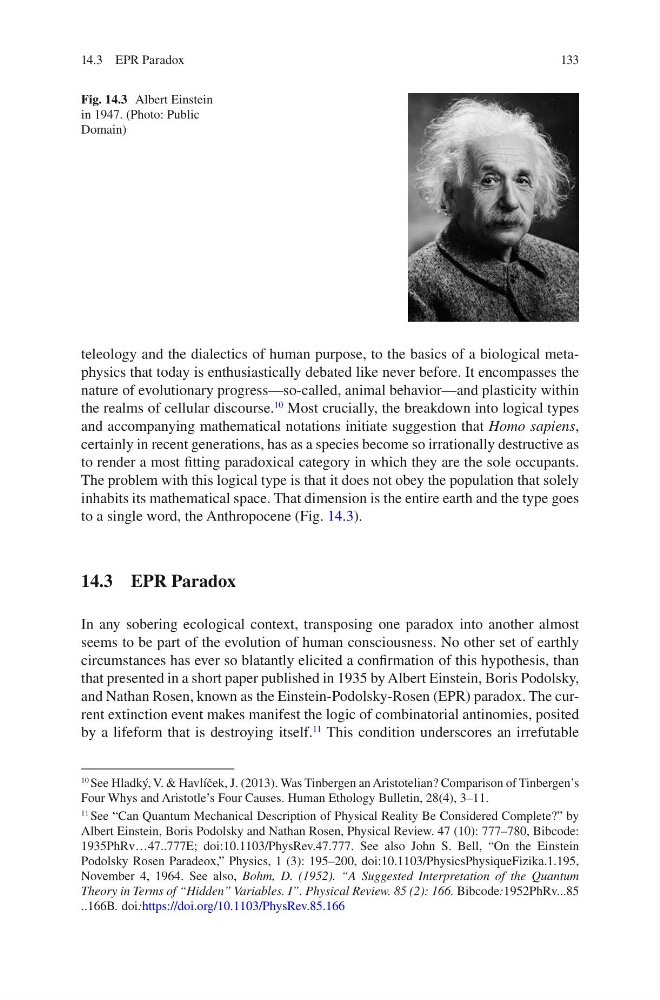
Fig. 14.3 Albert Einstein
in 1947. (Photo: Public
Domain)
14.3 EPR Paradox
teleology and the dialectics of human purpose, to the basics of a biological metaphysics that today is enthusiastically debated like never before. It encompasses the
nature of evolutionary progress—so-called, animal behavior—and plasticity within
the realms of cellular discourse.
10
Most crucially, the breakdown into logical types
and accompanying mathematical notations initiate suggestion that Homo sapiens,
certainly in recent generations, has as a species become so irrationally destructive as
to render a most fitting paradoxical category in which they are the sole occupants.
The problem with this logical type is that it does not obey the population that solely
inhabits its mathematical space. That dimension is the entire earth and the type goes
to a single word, the Anthropocene (Fig. 14.3).
14.3 EPR Paradox
In any sobering ecological context, transposing one paradox into another almost
seems to be part of the evolution of human consciousness. No other set of earthly
circumstances has ever so blatantly elicited a confirmation of this hypothesis, than
that presented in a short paper published in 1935 by Albert Einstein, Boris Podolsky,
and Nathan Rosen, known as the Einstein-Podolsky-Rosen (EPR) paradox. The current extinction event makes manifest the logic of combinatorial antinomies, posited
by a lifeform that is destroying itself.
11
This condition underscores an irrefutable
10 See Hladký, V. & Havlíček, J. (2013). Was Tinbergen an Aristotelian? Comparison of Tinbergen’s
Four Whys and Aristotle’s Four Causes. Human Ethology Bulletin, 28(4), 3–11.
11 See “Can Quantum Mechanical Description of Physical Reality Be Considered Complete?” by
Albert Einstein, Boris Podolsky and Nathan Rosen, Physical Review. 47 (10): 777–780, Bibcode:
1935PhRv…47..777E; doi:10.1103/PhysRev.47.777. See also John S. Bell, “On the Einstein
Podolsky Rosen Paradeox,” Physics, 1 (3): 195–200, doi:10.1103/PhysicsPhysiqueFizika.1.195,
November 4, 1964. See also, Bohm, D. (1952). “A Suggested Interpretation of the Quantum
Theory in Terms of “Hidden” Variables. I”. Physical Review. 85 (2): 166. Bibcode:1952PhRv...85
..166B. doi:https://doi.org/10.1103/PhysRev.85.166
Fig. 14.3 Albert Einstein
in 1947. (Photo: Public
Domain)
14.3 EPR Paradox