

132
certain principles, all couched in ambiguous sets and subsets, ideas and ideals,
each contingent upon the reality of human perception. Russell says he came upon
this peculiar function of mathematical circularity while working on his Principles
of Mathematics. Others, most notably logician, mathematician Ernst Friedrich
Ferdinand Zermelo (1871–1953), would also formulate a similar mind experiment.
Moreover, as early as December 1873, the brilliant Russian-born mathematician
Georg Cantor had written of the crisis of logic necessitating some heuristic revisioning of those differences between classes and sets, categories and types, semantics
and true meaning, summary and schematic. He writes from Halle in southern
Germany on December 9 of that year, “…the totality (x) cannot be correlated oneto- one with the totality (u); and I infer that there exist essential differences among
totalities and value-sets that I was until recently unable to fathom…”
7
Russell’s great philosophical tease, which has (surprisingly) been lauded by both
mathematicians and logicians, is quite a simple deduction, in fact; metaphysics has
shown its extraordinary evolutionary implications by way of far less fanfare. PreSocratics Heraclitus and Parmenides both had grasped the essentials of the distinctions
8
and Aristotle
9
had fundamentally apprehended a through-story leading from
7 See “The Nature of Infinity — and Beyond, An introduction to Georg Cantor and his transfinite
paradise,” by Jørgen Veisdal, https://medium.com/cantors-paradise/the-nature-of-infinity-andbeyond-a05c146df02c, December 17, 2018; Ann., 65 (1908), pp. 261–281.
8 See “Stepping Into the Same River Every Week: Parmenides, Heraclitus, Chaos Theory, and the
Nature of Change in Group Psychotherapy,” Michael P. Frank, Group, Vol. 36, No. 2, Philosophy
and Group Psychotherapy (SUMMER 2012), pp. 121–134.
9 See “How Bertrand Russell discovered his paradox,”Grattan-Guinness, Historia Mathematica,
Volume 5, Issue 2, May 1978, Pages 127–137, https://doi.org/10.1016/0315-0860(78)90046-0,
Science Direct, Elsevier, https://www.sciencedirect.com/science/article/pii/0315086078900460,
Accessed March 16, 2019.
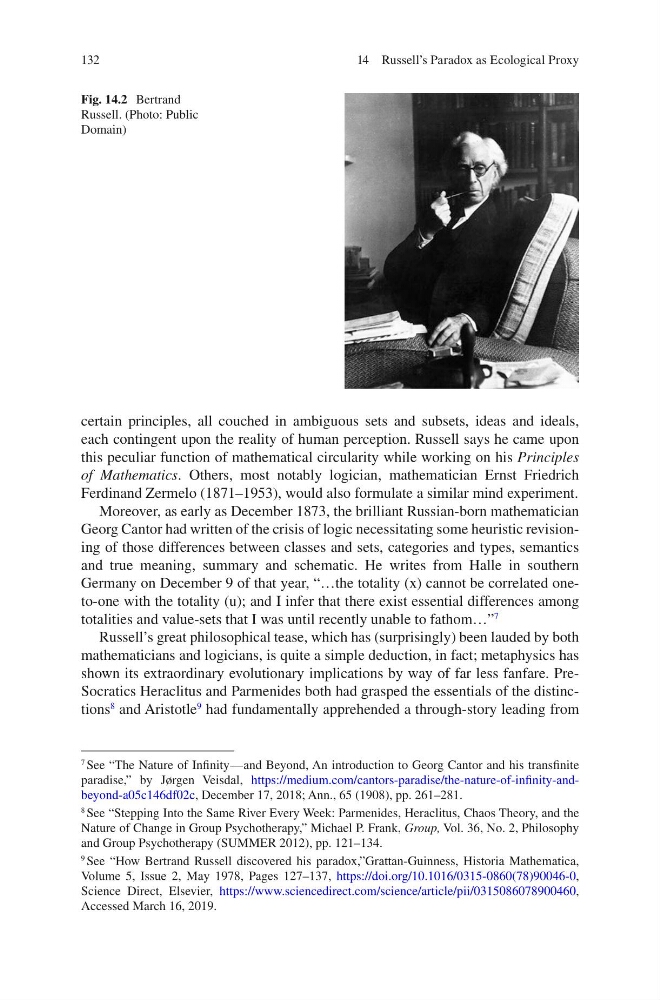
Fig. 14.2 Bertrand
Russell. (Photo: Public
Domain)
14 Russell’s Paradox as Ecological Proxy
certain principles, all couched in ambiguous sets and subsets, ideas and ideals,
each contingent upon the reality of human perception. Russell says he came upon
this peculiar function of mathematical circularity while working on his Principles
of Mathematics. Others, most notably logician, mathematician Ernst Friedrich
Ferdinand Zermelo (1871–1953), would also formulate a similar mind experiment.
Moreover, as early as December 1873, the brilliant Russian-born mathematician
Georg Cantor had written of the crisis of logic necessitating some heuristic revisioning of those differences between classes and sets, categories and types, semantics
and true meaning, summary and schematic. He writes from Halle in southern
Germany on December 9 of that year, “…the totality (x) cannot be correlated oneto- one with the totality (u); and I infer that there exist essential differences among
totalities and value-sets that I was until recently unable to fathom…”
7
Russell’s great philosophical tease, which has (surprisingly) been lauded by both
mathematicians and logicians, is quite a simple deduction, in fact; metaphysics has
shown its extraordinary evolutionary implications by way of far less fanfare. PreSocratics Heraclitus and Parmenides both had grasped the essentials of the distinctions
8
and Aristotle
9
had fundamentally apprehended a through-story leading from
7 See “The Nature of Infinity — and Beyond, An introduction to Georg Cantor and his transfinite
paradise,” by Jørgen Veisdal, https://medium.com/cantors-paradise/the-nature-of-infinity-andbeyond-a05c146df02c, December 17, 2018; Ann., 65 (1908), pp. 261–281.
8 See “Stepping Into the Same River Every Week: Parmenides, Heraclitus, Chaos Theory, and the
Nature of Change in Group Psychotherapy,” Michael P. Frank, Group, Vol. 36, No. 2, Philosophy
and Group Psychotherapy (SUMMER 2012), pp. 121–134.
9 See “How Bertrand Russell discovered his paradox,”Grattan-Guinness, Historia Mathematica,
Volume 5, Issue 2, May 1978, Pages 127–137, https://doi.org/10.1016/0315-0860(78)90046-0,
Science Direct, Elsevier, https://www.sciencedirect.com/science/article/pii/0315086078900460,
Accessed March 16, 2019.
Fig. 14.2 Bertrand
Russell. (Photo: Public
Domain)
14 Russell’s Paradox as Ecological Proxy