

110
There has never been a more splendid example of a closed statistical system
yielding revelatory windows on every form of human and nonhuman behavior. Litla
Dimun is the quintessential final mathematical verdict on the intersection of species.
By the 1860s the population of Litla Dimun Ovis aries were extinct, replaced by
local domesticated Faroe cousins. Why would people feel compelled to kill them?
Sheepherders have their own excuses.
Other annual roundups of sheep each June on St. Kilda, Soay, Hirta, Boreray, and
the Dun, in the Outer Hebrides, continue to occur. It, too, is frequently a deadly
roundup known as Ruagadh, and while it says much about the hunters, what stands
out most about the sheep is the fact many of them commit suicide by leaping off
cliffs into the sea, rather than letting the men and their dogs get them. So much for
the touted Utopic circumstances of these Hebridean isles, as first written up by one
Martin Martin in his 1697 account, A Late Voyage to St. Kilda. And notwithstanding
all of the vacuous panegyrics of poets for centuries that lavished romantic praise on
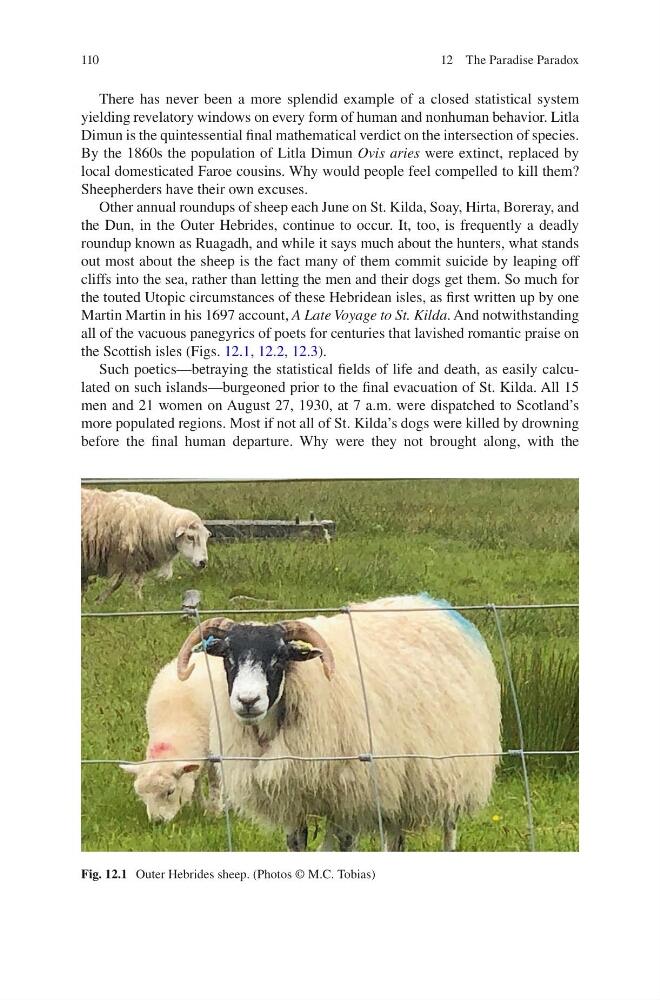
the Scottish isles (Figs. 12.1, 12.2, 12.3).
Such poetics—betraying the statistical fields of life and death, as easily calculated on such islands—burgeoned prior to the final evacuation of St. Kilda. All 15
men and 21 women on August 27, 1930, at 7 a.m. were dispatched to Scotland’s
more populated regions. Most if not all of St. Kilda’s dogs were killed by drowning
before the final human departure. Why were they not brought along, with the
Fig. 12.1 Outer Hebrides sheep. (Photos © M.C. Tobias)
12 The Paradise Paradox
There has never been a more splendid example of a closed statistical system
yielding revelatory windows on every form of human and nonhuman behavior. Litla
Dimun is the quintessential final mathematical verdict on the intersection of species.
By the 1860s the population of Litla Dimun Ovis aries were extinct, replaced by
local domesticated Faroe cousins. Why would people feel compelled to kill them?
Sheepherders have their own excuses.
Other annual roundups of sheep each June on St. Kilda, Soay, Hirta, Boreray, and
the Dun, in the Outer Hebrides, continue to occur. It, too, is frequently a deadly
roundup known as Ruagadh, and while it says much about the hunters, what stands
out most about the sheep is the fact many of them commit suicide by leaping off
cliffs into the sea, rather than letting the men and their dogs get them. So much for
the touted Utopic circumstances of these Hebridean isles, as first written up by one
Martin Martin in his 1697 account, A Late Voyage to St. Kilda. And notwithstanding
all of the vacuous panegyrics of poets for centuries that lavished romantic praise on
the Scottish isles (Figs. 12.1, 12.2, 12.3).
Such poetics—betraying the statistical fields of life and death, as easily calculated on such islands—burgeoned prior to the final evacuation of St. Kilda. All 15
men and 21 women on August 27, 1930, at 7 a.m. were dispatched to Scotland’s
more populated regions. Most if not all of St. Kilda’s dogs were killed by drowning
before the final human departure. Why were they not brought along, with the
Fig. 12.1 Outer Hebrides sheep. (Photos © M.C. Tobias)
12 The Paradise Paradox