

are always present, the rare green ones will only make an appearance when one has
given up all hope of ever seeing their re-occurrence and is thus entirely unprepared to
tackle them experimentally. We found one during a 2019 visit with the International
Geobiology Course, but alas were unprepared to conduct any additional research on
this subject.
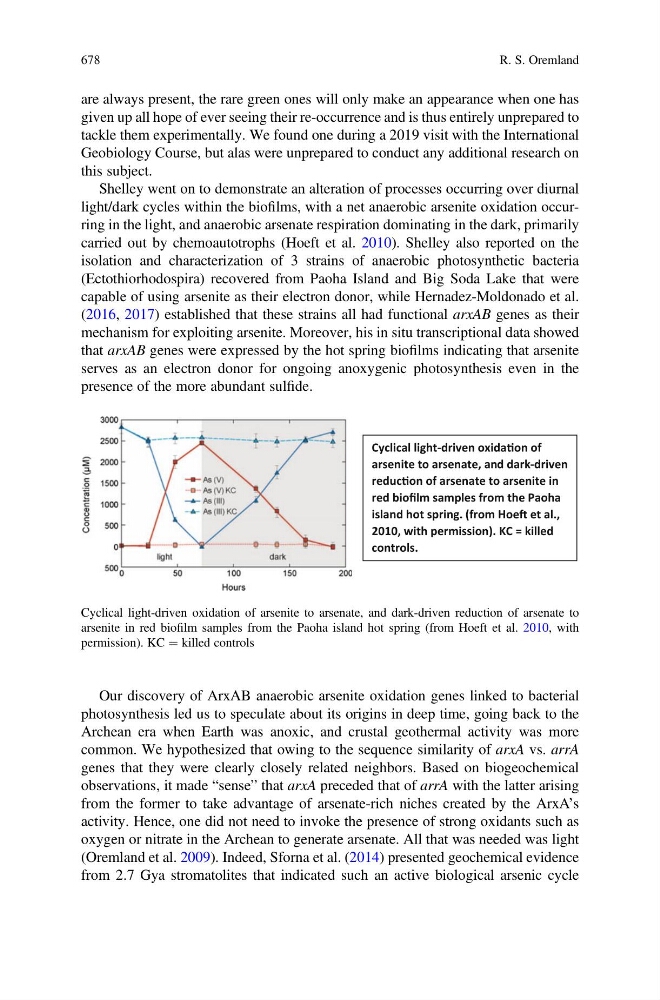
Shelley went on to demonstrate an alteration of processes occurring over diurnal
light/dark cycles within the biofilms, with a net anaerobic arsenite oxidation occurring in the light, and anaerobic arsenate respiration dominating in the dark, primarily
carried out by chemoautotrophs (Hoeft et al. 2010). Shelley also reported on the
isolation and characterization of 3 strains of anaerobic photosynthetic bacteria
(Ectothiorhodospira) recovered from Paoha Island and Big Soda Lake that were
capable of using arsenite as their electron donor, while Hernadez-Moldonado et al.
(2016, 2017) established that these strains all had functional arxAB genes as their
mechanism for exploiting arsenite. Moreover, his in situ transcriptional data showed
that arxAB genes were expressed by the hot spring biofilms indicating that arsenite
serves as an electron donor for ongoing anoxygenic photosynthesis even in the
presence of the more abundant sulfide.
Cyclical light-driven oxidaon of
arsenite to arsenate, and dark-driven
reducon of arsenate to arsenite in
red biofilm samples from the Paoha
island hot spring. (from Hoe et al.,
2010, with permission). KC = killed
controls.
Cyclical light-driven oxidation of arsenite to arsenate, and dark-driven reduction of arsenate to
arsenite in red biofilm samples from the Paoha island hot spring (from Hoeft et al. 2010, with
permission). KC ¼ killed controls
Our discovery of ArxAB anaerobic arsenite oxidation genes linked to bacterial
photosynthesis led us to speculate about its origins in deep time, going back to the
Archean era when Earth was anoxic, and crustal geothermal activity was more
common. We hypothesized that owing to the sequence similarity of arxA vs. arrA
genes that they were clearly closely related neighbors. Based on biogeochemical
observations, it made “sense” that arxA preceded that of arrA with the latter arising
from the former to take advantage of arsenate-rich niches created by the ArxA’s
activity. Hence, one did not need to invoke the presence of strong oxidants such as
oxygen or nitrate in the Archean to generate arsenate. All that was needed was light
(Oremland et al. 2009). Indeed, Sforna et al. (2014) presented geochemical evidence
from 2.7 Gya stromatolites that indicated such an active biological arsenic cycle
678
R. S. Oremland