

photosynthesis in the biofilm. So we set out on a field trip specifically devoted to
determining whether or not arsenite could function in this manner. We brought along
an HPLC in our lab truck, thereby allowing us to run arsenic speciation incubation
results from our makeshift field locale, headquartered in the back of the Lakeview
Lodge.
2
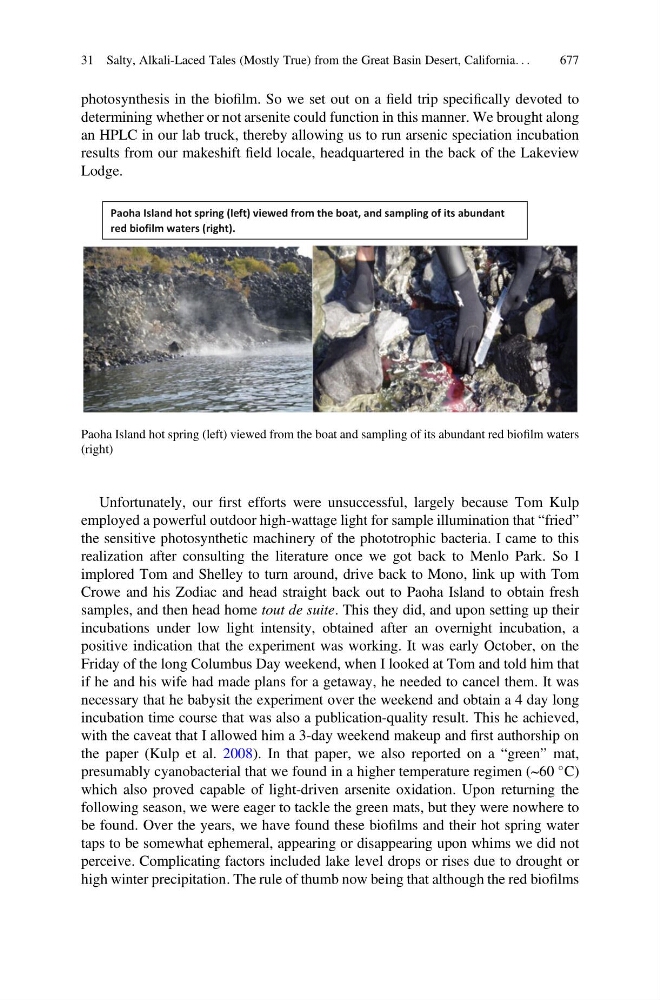
Paoha Island hot spring (left) viewed from the boat, and sampling of its abundant
red biofilm waters (right).
Paoha Island hot spring (left) viewed from the boat and sampling of its abundant red biofilm waters
(right)
Unfortunately, our first efforts were unsuccessful, largely because Tom Kulp
employed a powerful outdoor high-wattage light for sample illumination that “fried”
the sensitive photosynthetic machinery of the phototrophic bacteria. I came to this
realization after consulting the literature once we got back to Menlo Park. So I
implored Tom and Shelley to turn around, drive back to Mono, link up with Tom
Crowe and his Zodiac and head straight back out to Paoha Island to obtain fresh
samples, and then head home tout de suite. This they did, and upon setting up their
incubations under low light intensity, obtained after an overnight incubation, a
positive indication that the experiment was working. It was early October, on the
Friday of the long Columbus Day weekend, when I looked at Tom and told him that
if he and his wife had made plans for a getaway, he needed to cancel them. It was
necessary that he babysit the experiment over the weekend and obtain a 4 day long
incubation time course that was also a publication-quality result. This he achieved,
with the caveat that I allowed him a 3-day weekend makeup and first authorship on
the paper (Kulp et al. 2008). In that paper, we also reported on a “green” mat,
presumably cyanobacterial that we found in a higher temperature regimen (~60
C)
which also proved capable of light-driven arsenite oxidation. Upon returning the
following season, we were eager to tackle the green mats, but they were nowhere to
be found. Over the years, we have found these biofilms and their hot spring water
taps to be somewhat ephemeral, appearing or disappearing upon whims we did not
perceive. Complicating factors included lake level drops or rises due to drought or
high winter precipitation. The rule of thumb now being that although the red biofilms
31 Salty, Alkali-Laced Tales (Mostly True) from the Great Basin Desert, California. . .
677