

interestingly, some other bacterial strains seemed to fix nitrogen without the formation of root nodules. Crook et al. (2012) eventually discovered that a naturally
existing plasmid can result in rhizobial strains that have enhanced competitiveness
for nodule occupancy but impair nitrogen fixation, resulting in reduced benefit to the
host plant.
Coba de la Peña et al. (2018) have presented a question of whether the symbiosis
of rhizobia and legumes could result in coevolution that produces a nitrogen-fixing
organelle.
Legumes can form a tripartite symbiosis which includes both Rhizobium bacteria
which serve by fixing nitrogen, and arbuscular mycorrhizal fungi which help the
plant to acquire phosphorus (Scheublin et al. 2004). I will mention arbuscular
mycorrhizal associations later in this essay.
Rhizobium have an association with duckweeds that occurs without forming
nodules (Kittiwongwattana and Thawai 2013). Duckweeds, as mentioned above,
also have a nitrogen fixing association with cyanobacteria.
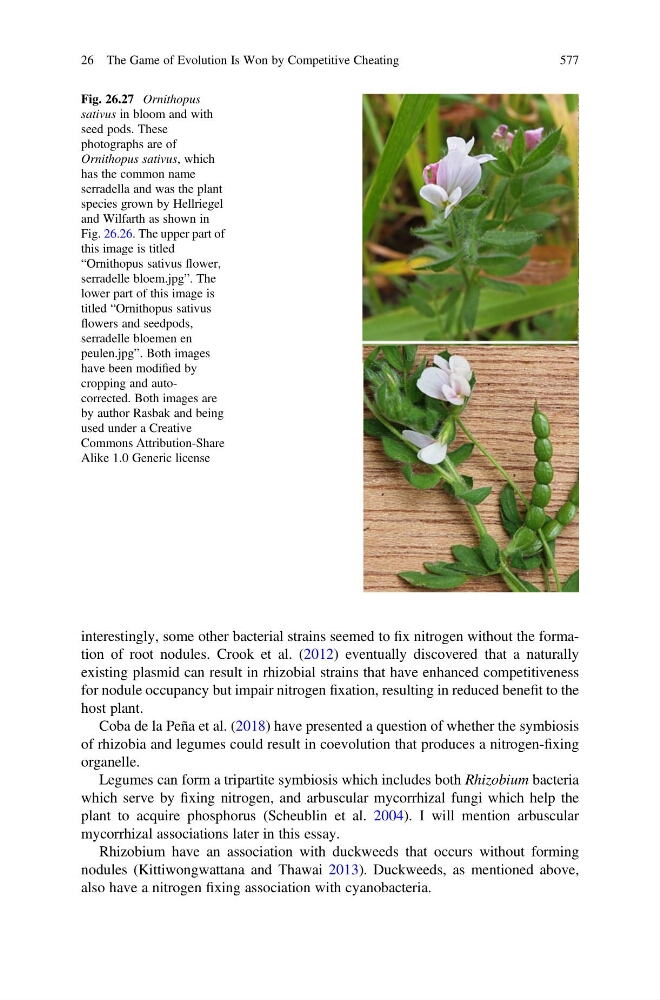
Fig. 26.27 Ornithopus
sativus in bloom and with
seed pods. These
photographs are of
Ornithopus sativus, which
has the common name
serradella and was the plant
species grown by Hellriegel
and Wilfarth as shown in
Fig. 26.26. The upper part of
this image is titled
“Ornithopus sativus flower,
serradelle bloem.jpg”. The
lower part of this image is
titled “Ornithopus sativus
flowers and seedpods,
serradelle bloemen en
peulen.jpg”. Both images
have been modified by
cropping and autocorrected. Both images are
by author Rasbak and being
used under a Creative
Commons Attribution-Share
Alike 1.0 Generic license
26 The Game of Evolution Is Won by Competitive Cheating
577
existing plasmid can result in rhizobial strains that have enhanced competitiveness
for nodule occupancy but impair nitrogen fixation, resulting in reduced benefit to the
host plant.
Coba de la Peña et al. (2018) have presented a question of whether the symbiosis
of rhizobia and legumes could result in coevolution that produces a nitrogen-fixing
organelle.
Legumes can form a tripartite symbiosis which includes both Rhizobium bacteria
which serve by fixing nitrogen, and arbuscular mycorrhizal fungi which help the
plant to acquire phosphorus (Scheublin et al. 2004). I will mention arbuscular
mycorrhizal associations later in this essay.
Rhizobium have an association with duckweeds that occurs without forming
nodules (Kittiwongwattana and Thawai 2013). Duckweeds, as mentioned above,
also have a nitrogen fixing association with cyanobacteria.
Fig. 26.27 Ornithopus
sativus in bloom and with
seed pods. These
photographs are of
Ornithopus sativus, which
has the common name
serradella and was the plant
species grown by Hellriegel
and Wilfarth as shown in
Fig. 26.26. The upper part of
this image is titled
“Ornithopus sativus flower,
serradelle bloem.jpg”. The
lower part of this image is
titled “Ornithopus sativus
flowers and seedpods,
serradelle bloemen en
peulen.jpg”. Both images
have been modified by
cropping and autocorrected. Both images are
by author Rasbak and being
used under a Creative
Commons Attribution-Share
Alike 1.0 Generic license
26 The Game of Evolution Is Won by Competitive Cheating
577