

Hermann Hellriegel and Hermann Wilfarth also were studying barley and oats,
which belong to the family Poaceae and do not form root nodules.
Legumes include the genus Lotus whose members commonly are called trefoils,
the genus Ornithopus which contains some species commonly called bird’s-foot and
other species commonly called serradellas, and the genus Vigna many of whose
members are called beans or peas. Some additional legume genera are:
Aeschynomene, Discolobium, Neptunia, and Sesbania.
The formation of rhizobial root nodules on legumes is a complicated process,
involving interactions that include the bacteria suppressing the plants innate immune
system. The plant limits the supply of nutrients to the nodules and seems to limit the
number of nodules (Cao et al. 2017). The symbiosis which creates root nodules of
legumes is in fact only one aspect of a complicated community of microorganisms
that reside in and around plant roots (Zgadzaj et al. 2016). Rhizobial bacteria also
can produce stem nodules, and those nodules occur at the site of dormant root
primordia on some aquatic legumes and on legumes whose roots grow in
flooded soil.
Figure 26.26 is a photograph which shows results from Hellriegel and Wilfarth’s
1887 comparative cultivation of the plant species serradella, whose taxonomic name
is Ornithopus sativus. The goal of this experiment was to determine if a microbe was
responsible for the formation of root nodules which suppy nitrogen for use by these
plants. Hellriegel and Wilfarth were particularly concerned about the possibility of
their plant cultivation experiments being contaminated by fungal spores, because
they believed that a fungus was responsible for inducing root nodule formation. The
conclusion of Hellriegel and Wilfarth was that a microbe naturally present in soil did
induce formation of those root nodules. We have come to learn that the root nodules
are caused by Rhizobium, which is a name that now represents a genus and also a
more general group of bacteria. The dominant rhizobial species found in the root
nodules of lupines and serradella growing in europe are Bradyrhizobium canariense
and Bradyrhizobium japonicum. Figure 26.27 shows Ornithopus sativus in bloom
and with seed pods. Figure 26.28 shows examples of rhizobially induced root
nodules on two different species of legumes. Figure 26.29 shows the appearance
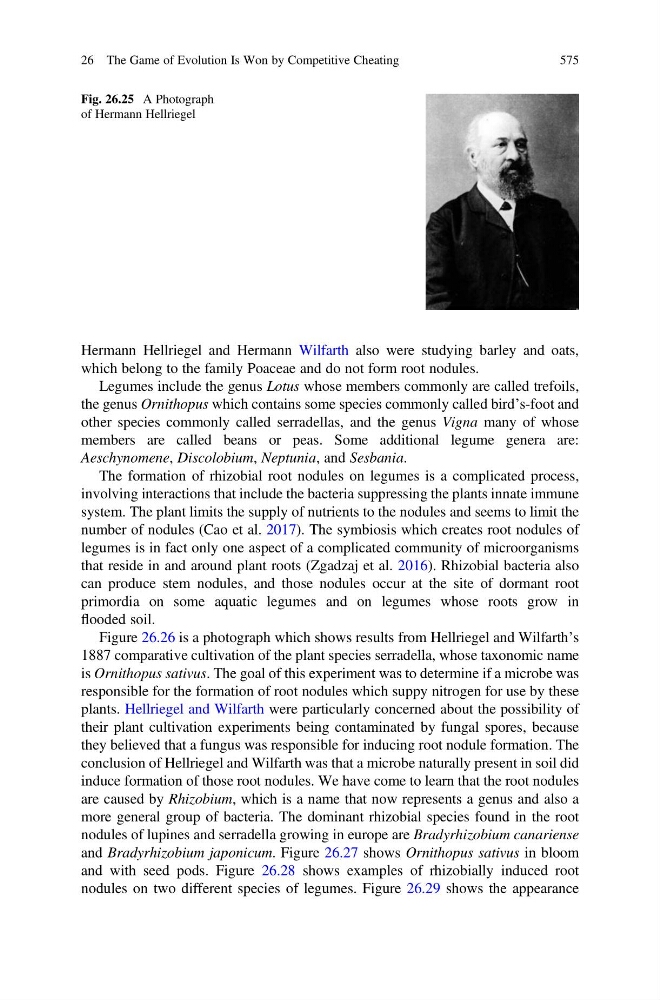
Fig. 26.25 A Photograph
of Hermann Hellriegel
26 The Game of Evolution Is Won by Competitive Cheating
575
which belong to the family Poaceae and do not form root nodules.
Legumes include the genus Lotus whose members commonly are called trefoils,
the genus Ornithopus which contains some species commonly called bird’s-foot and
other species commonly called serradellas, and the genus Vigna many of whose
members are called beans or peas. Some additional legume genera are:
Aeschynomene, Discolobium, Neptunia, and Sesbania.
The formation of rhizobial root nodules on legumes is a complicated process,
involving interactions that include the bacteria suppressing the plants innate immune
system. The plant limits the supply of nutrients to the nodules and seems to limit the
number of nodules (Cao et al. 2017). The symbiosis which creates root nodules of
legumes is in fact only one aspect of a complicated community of microorganisms
that reside in and around plant roots (Zgadzaj et al. 2016). Rhizobial bacteria also
can produce stem nodules, and those nodules occur at the site of dormant root
primordia on some aquatic legumes and on legumes whose roots grow in
flooded soil.
Figure 26.26 is a photograph which shows results from Hellriegel and Wilfarth’s
1887 comparative cultivation of the plant species serradella, whose taxonomic name
is Ornithopus sativus. The goal of this experiment was to determine if a microbe was
responsible for the formation of root nodules which suppy nitrogen for use by these
plants. Hellriegel and Wilfarth were particularly concerned about the possibility of
their plant cultivation experiments being contaminated by fungal spores, because
they believed that a fungus was responsible for inducing root nodule formation. The
conclusion of Hellriegel and Wilfarth was that a microbe naturally present in soil did
induce formation of those root nodules. We have come to learn that the root nodules
are caused by Rhizobium, which is a name that now represents a genus and also a
more general group of bacteria. The dominant rhizobial species found in the root
nodules of lupines and serradella growing in europe are Bradyrhizobium canariense
and Bradyrhizobium japonicum. Figure 26.27 shows Ornithopus sativus in bloom
and with seed pods. Figure 26.28 shows examples of rhizobially induced root
nodules on two different species of legumes. Figure 26.29 shows the appearance
Fig. 26.25 A Photograph
of Hermann Hellriegel
26 The Game of Evolution Is Won by Competitive Cheating
575