

secondary symbiosis the plastid would have been retained in a form that was
surrounded by the existant quadruple membrane. Euglena, as also shown in
Fig. 26.13, have secondary chloroplasts that interestingly are bounded by three
membranes. Some dinoflagellates similarly have chloroplasts that are surrounded
by three membranes.
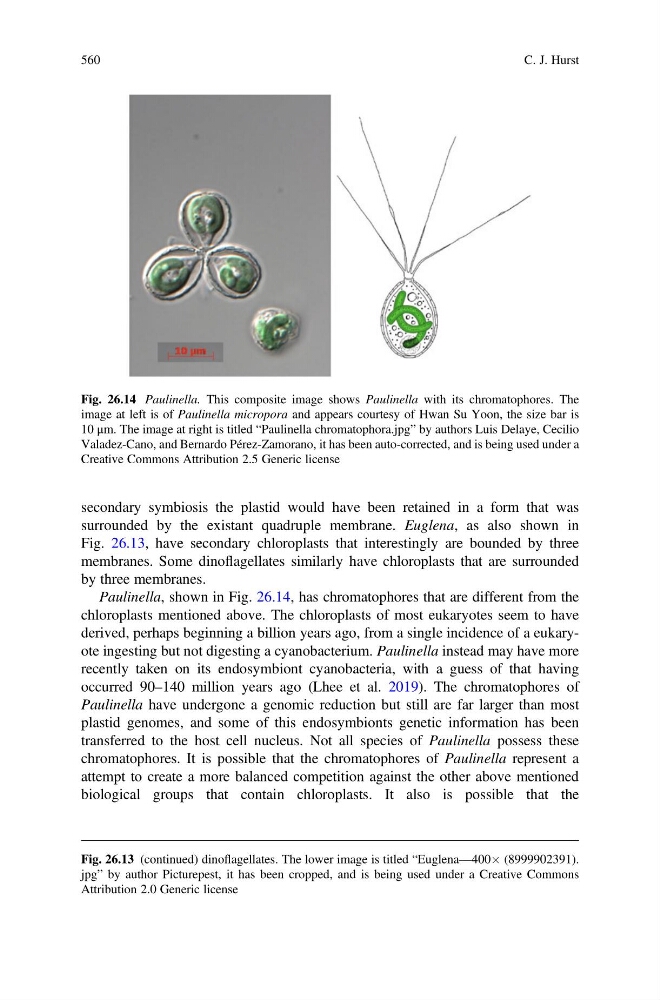
Paulinella, shown in Fig. 26.14, has chromatophores that are different from the
chloroplasts mentioned above. The chloroplasts of most eukaryotes seem to have
derived, perhaps beginning a billion years ago, from a single incidence of a eukaryote ingesting but not digesting a cyanobacterium. Paulinella instead may have more
recently taken on its endosymbiont cyanobacteria, with a guess of that having
occurred 90–140 million years ago (Lhee et al. 2019). The chromatophores of
Paulinella have undergone a genomic reduction but still are far larger than most
plastid genomes, and some of this endosymbionts genetic information has been
transferred to the host cell nucleus. Not all species of Paulinella possess these
chromatophores. It is possible that the chromatophores of Paulinella represent a
attempt to create a more balanced competition against the other above mentioned
biological groups that contain chloroplasts. It also is possible that the
Fig. 26.13 (continued) dinoflagellates. The lower image is titled “Euglena—400Â (8999902391).
jpg” by author Picturepest, it has been cropped, and is being used under a Creative Commons
Attribution 2.0 Generic license
Fig. 26.14 Paulinella. This composite image shows Paulinella with its chromatophores. The
image at left is of Paulinella micropora and appears courtesy of Hwan Su Yoon, the size bar is
10 μm. The image at right is titled “Paulinella chromatophora.jpg” by authors Luis Delaye, Cecilio
Valadez-Cano, and Bernardo Pérez-Zamorano, it has been auto-corrected, and is being used under a
Creative Commons Attribution 2.5 Generic license
560
C. J. Hurst
surrounded by the existant quadruple membrane. Euglena, as also shown in
Fig. 26.13, have secondary chloroplasts that interestingly are bounded by three
membranes. Some dinoflagellates similarly have chloroplasts that are surrounded
by three membranes.
Paulinella, shown in Fig. 26.14, has chromatophores that are different from the
chloroplasts mentioned above. The chloroplasts of most eukaryotes seem to have
derived, perhaps beginning a billion years ago, from a single incidence of a eukaryote ingesting but not digesting a cyanobacterium. Paulinella instead may have more
recently taken on its endosymbiont cyanobacteria, with a guess of that having
occurred 90–140 million years ago (Lhee et al. 2019). The chromatophores of
Paulinella have undergone a genomic reduction but still are far larger than most
plastid genomes, and some of this endosymbionts genetic information has been
transferred to the host cell nucleus. Not all species of Paulinella possess these
chromatophores. It is possible that the chromatophores of Paulinella represent a
attempt to create a more balanced competition against the other above mentioned
biological groups that contain chloroplasts. It also is possible that the
Fig. 26.13 (continued) dinoflagellates. The lower image is titled “Euglena—400Â (8999902391).
jpg” by author Picturepest, it has been cropped, and is being used under a Creative Commons
Attribution 2.0 Generic license
Fig. 26.14 Paulinella. This composite image shows Paulinella with its chromatophores. The
image at left is of Paulinella micropora and appears courtesy of Hwan Su Yoon, the size bar is
10 μm. The image at right is titled “Paulinella chromatophora.jpg” by authors Luis Delaye, Cecilio
Valadez-Cano, and Bernardo Pérez-Zamorano, it has been auto-corrected, and is being used under a
Creative Commons Attribution 2.5 Generic license
560
C. J. Hurst