

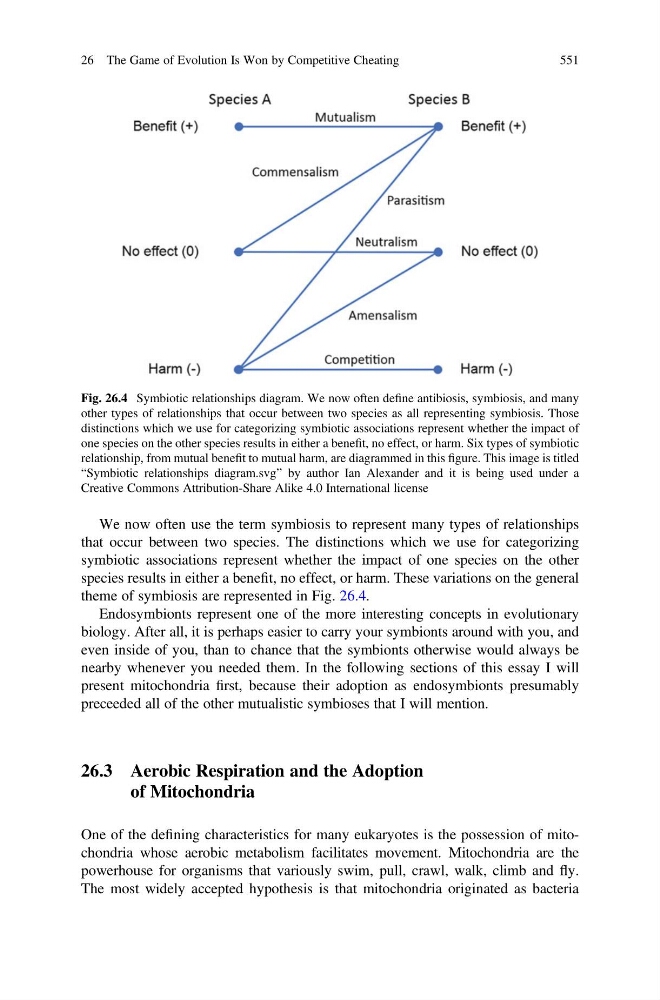
We now often use the term symbiosis to represent many types of relationships
that occur between two species. The distinctions which we use for categorizing
symbiotic associations represent whether the impact of one species on the other
species results in either a benefit, no effect, or harm. These variations on the general
theme of symbiosis are represented in Fig. 26.4.
Endosymbionts represent one of the more interesting concepts in evolutionary
biology. After all, it is perhaps easier to carry your symbionts around with you, and
even inside of you, than to chance that the symbionts otherwise would always be
nearby whenever you needed them. In the following sections of this essay I will
present mitochondria first, because their adoption as endosymbionts presumably
preceeded all of the other mutualistic symbioses that I will mention.
26.3 Aerobic Respiration and the Adoption
of Mitochondria
One of the defining characteristics for many eukaryotes is the possession of mitochondria whose aerobic metabolism facilitates movement. Mitochondria are the
powerhouse for organisms that variously swim, pull, crawl, walk, climb and fly.
The most widely accepted hypothesis is that mitochondria originated as bacteria
Fig. 26.4 Symbiotic relationships diagram. We now often define antibiosis, symbiosis, and many
other types of relationships that occur between two species as all representing symbiosis. Those
distinctions which we use for categorizing symbiotic associations represent whether the impact of
one species on the other species results in either a benefit, no effect, or harm. Six types of symbiotic
relationship, from mutual benefit to mutual harm, are diagrammed in this figure. This image is titled
“Symbiotic relationships diagram.svg” by author Ian Alexander and it is being used under a
Creative Commons Attribution-Share Alike 4.0 International license
26 The Game of Evolution Is Won by Competitive Cheating
551
that occur between two species. The distinctions which we use for categorizing
symbiotic associations represent whether the impact of one species on the other
species results in either a benefit, no effect, or harm. These variations on the general
theme of symbiosis are represented in Fig. 26.4.
Endosymbionts represent one of the more interesting concepts in evolutionary
biology. After all, it is perhaps easier to carry your symbionts around with you, and
even inside of you, than to chance that the symbionts otherwise would always be
nearby whenever you needed them. In the following sections of this essay I will
present mitochondria first, because their adoption as endosymbionts presumably
preceeded all of the other mutualistic symbioses that I will mention.
26.3 Aerobic Respiration and the Adoption
of Mitochondria
One of the defining characteristics for many eukaryotes is the possession of mitochondria whose aerobic metabolism facilitates movement. Mitochondria are the
powerhouse for organisms that variously swim, pull, crawl, walk, climb and fly.
The most widely accepted hypothesis is that mitochondria originated as bacteria
Fig. 26.4 Symbiotic relationships diagram. We now often define antibiosis, symbiosis, and many
other types of relationships that occur between two species as all representing symbiosis. Those
distinctions which we use for categorizing symbiotic associations represent whether the impact of
one species on the other species results in either a benefit, no effect, or harm. Six types of symbiotic
relationship, from mutual benefit to mutual harm, are diagrammed in this figure. This image is titled
“Symbiotic relationships diagram.svg” by author Ian Alexander and it is being used under a
Creative Commons Attribution-Share Alike 4.0 International license
26 The Game of Evolution Is Won by Competitive Cheating
551