

Thus, a developed and maintained microbial community can easily and occasionally collapse due to various accidents caused by both naturally occurring
environmental changes and artificial activities. Under such circumstances, resilience
of the microbial community can be assessed based on the potential to start a
re-establishment of the structure. Such a restart happens spontaneously, and it is
very likely to occur. The ability to initiate a restart is potentially widely distributed to
many microbial cells. Autonomous distribution is another aspect fundamental to the
persistence of the microbial community and pertinent to survival of the ecosystem
supported by the community.
Network formation based on self-organization and autonomous distribution
offers both great rigidity and simultaneous flexibility to the organization. In the
case of an organization based on the leadership of a specific leader, the accidental
loss of the leader causes great damage to the order of the community. In contrast, an
autonomous distribution system, which does not depend on a specific leader, adapts
rapidly to any accidental situation.
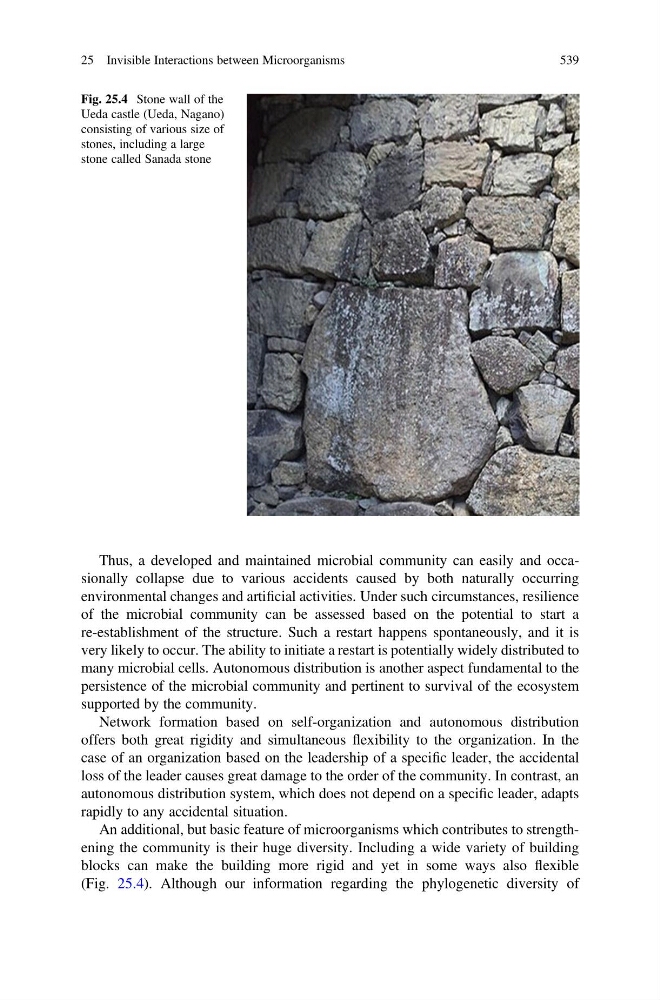
An additional, but basic feature of microorganisms which contributes to strengthening the community is their huge diversity. Including a wide variety of building
blocks can make the building more rigid and yet in some ways also flexible
(Fig. 25.4). Although our information regarding the phylogenetic diversity of
Fig. 25.4 Stone wall of the
Ueda castle (Ueda, Nagano)
consisting of various size of
stones, including a large
stone called Sanada stone
25 Invisible Interactions between Microorganisms
539
environmental changes and artificial activities. Under such circumstances, resilience
of the microbial community can be assessed based on the potential to start a
re-establishment of the structure. Such a restart happens spontaneously, and it is
very likely to occur. The ability to initiate a restart is potentially widely distributed to
many microbial cells. Autonomous distribution is another aspect fundamental to the
persistence of the microbial community and pertinent to survival of the ecosystem
supported by the community.
Network formation based on self-organization and autonomous distribution
offers both great rigidity and simultaneous flexibility to the organization. In the
case of an organization based on the leadership of a specific leader, the accidental
loss of the leader causes great damage to the order of the community. In contrast, an
autonomous distribution system, which does not depend on a specific leader, adapts
rapidly to any accidental situation.
An additional, but basic feature of microorganisms which contributes to strengthening the community is their huge diversity. Including a wide variety of building
blocks can make the building more rigid and yet in some ways also flexible
(Fig. 25.4). Although our information regarding the phylogenetic diversity of
Fig. 25.4 Stone wall of the
Ueda castle (Ueda, Nagano)
consisting of various size of
stones, including a large
stone called Sanada stone
25 Invisible Interactions between Microorganisms
539