

sequestration, (4) enzymatic detoxification of HMs, (5) active transport or efflux
system of HMs and (6) reduction in HM sensitivity of cellular targets.
However, the details of many heavy metal resistance mechanisms used by PGPR
are still to be fully explored, and we will have to unravel the genetic mysteries
behind metal-PGPR interactions to effectively apply them for HM-bioremediation.
22.7 Constraints in the Application of Plant
Growth-Promoting Rhizobacteria
Although the PGPR strains far discovered have proven promising in controlled
laboratory conditions, their efficacy in reality is contingent on how they act in
field conditions. During the last few decades, a number of PGPR strains have been
discovered around the world but few reached the ultimate goal of having utility for
farmers. In contrast to the laboratory, the reality of field work is one of non-optimal
conditions that may or may not be favouarbale for the survival and proliferation of
the PGPR strains (Glick 2020). The existence and growth of field-applied PGPR
strains indeed depends on a vast range of adverse environmental factors that need to
be overcome so that the microbes take part in assisting plant growth-promotion
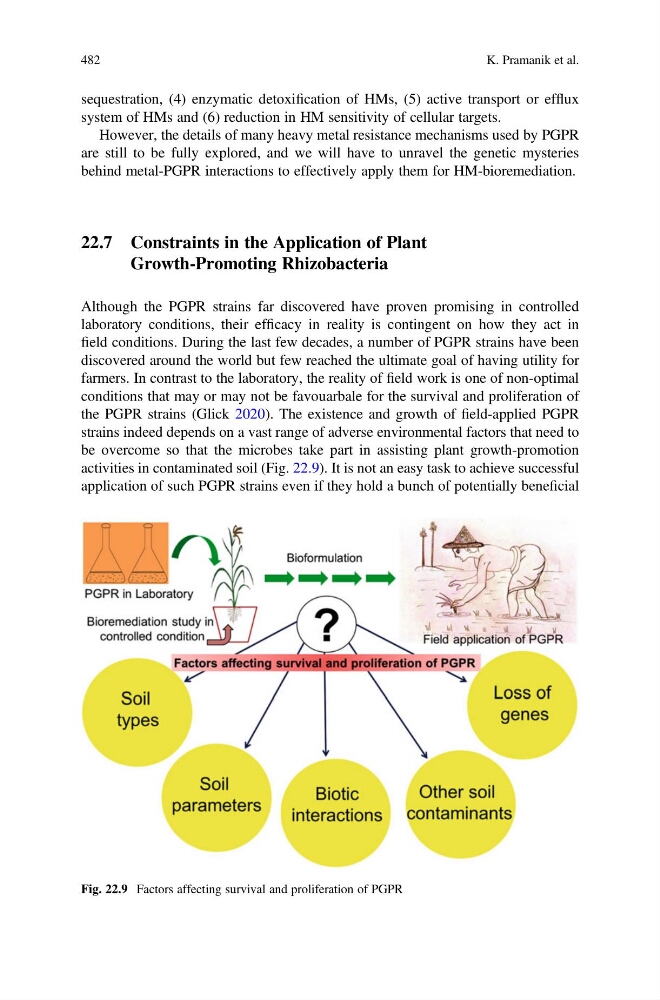
activities in contaminated soil (Fig. 22.9). It is not an easy task to achieve successful
application of such PGPR strains even if they hold a bunch of potentially beneficial
Fig. 22.9 Factors affecting survival and proliferation of PGPR
482
K. Pramanik et al.
system of HMs and (6) reduction in HM sensitivity of cellular targets.
However, the details of many heavy metal resistance mechanisms used by PGPR
are still to be fully explored, and we will have to unravel the genetic mysteries
behind metal-PGPR interactions to effectively apply them for HM-bioremediation.
22.7 Constraints in the Application of Plant
Growth-Promoting Rhizobacteria
Although the PGPR strains far discovered have proven promising in controlled
laboratory conditions, their efficacy in reality is contingent on how they act in
field conditions. During the last few decades, a number of PGPR strains have been
discovered around the world but few reached the ultimate goal of having utility for
farmers. In contrast to the laboratory, the reality of field work is one of non-optimal
conditions that may or may not be favouarbale for the survival and proliferation of
the PGPR strains (Glick 2020). The existence and growth of field-applied PGPR
strains indeed depends on a vast range of adverse environmental factors that need to
be overcome so that the microbes take part in assisting plant growth-promotion
activities in contaminated soil (Fig. 22.9). It is not an easy task to achieve successful
application of such PGPR strains even if they hold a bunch of potentially beneficial
Fig. 22.9 Factors affecting survival and proliferation of PGPR
482
K. Pramanik et al.