

metal resistance can be localised either in chromosomal or extrachromosomal
genetic elements.
Heavy metals most commonly exist in the form of cations which can form many
unspecific complexes. Among all these, a few HM cations are important biological
trace elements (such as Mn
2+ , Zn
2+ , Cu
2+ , Ni
2+ , Mo
2+ , Co
2+ ) used in regulating
several important biochemical reactions. The intracellular passage of different HMs
is, in fact, governed by two opposite types of uptake systems. The first of these
systems is constitutively expressed, fast, unspecific and uses a variety of substrates,
while the second system is inducible, slow and highly specific for substrates (Nies
1999). The main driving force for the first system is an electrochemical gradient
across the plasma membrane, and for the second system it is the energy generated by
ATP hydrolysis (Nies and Silver 1995). The constitutive and unspecific nature of the
first kind of system causes most of the HM-toxicity in bacteria as it continuously
accumulates a heavy metal even if the cell already contains a high concentration of
that same HM (Nies and Silver 1995). After a metal has been accumulated beyond
threshold levels, HMs impart several toxic effects such as inhibition of enzyme
actions due to the binding of Hg
2+ , Cd
2+ and Ag
2+ to -SH groups, generation of
oxidative stress and inhibition of the activity of sulphate and phosphate compounds
by structurally related chromate and arsenate, respectively. Briefly, there are six
widely known heavy metal resistance mechanisms in bacteria, they are: (1) exclusion
of HMs by permeability barriers, (2) extracellular sequestration, (3) intracellular
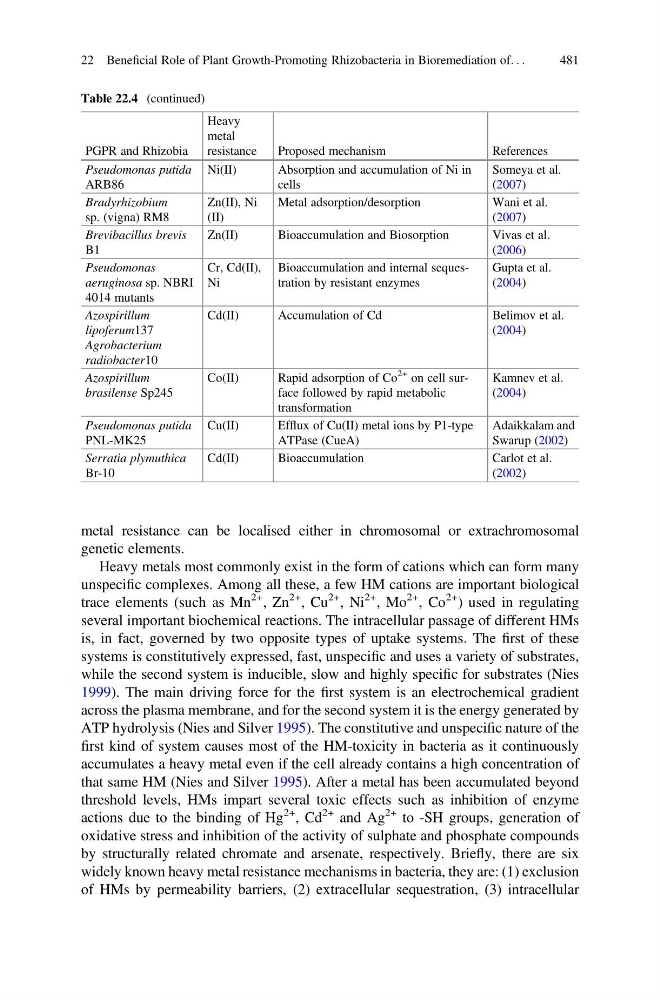
Table 22.4 (continued)
PGPR and Rhizobia
Heavy
metal
resistance
Proposed mechanism
References
Pseudomonas putida
ARB86
Ni(II)
Absorption and accumulation of Ni in
cells
Someya et al.
(2007)
Bradyrhizobium
sp. (vigna) RM8
Zn(II), Ni
(II)
Metal adsorption/desorption
Wani et al.
(2007)
Brevibacillus brevis
B1
Zn(II)
Bioaccumulation and Biosorption
Vivas et al.
(2006)
Pseudomonas
aeruginosa sp. NBRI
4014 mutants
Cr, Cd(II),
Ni
Bioaccumulation and internal sequestration by resistant enzymes
Gupta et al.
(2004)
Azospirillum
lipoferum137
Agrobacterium
radiobacter10
Cd(II)
Accumulation of Cd
Belimov et al.
(2004)
Azospirillum
brasilense Sp245
Co(II)
Rapid adsorption of Co
2+ on cell surface followed by rapid metabolic
transformation
Kamnev et al.
(2004)
Pseudomonas putida
PNL-MK25
Cu(II)
Efflux of Cu(II) metal ions by P1-type
ATPase (CueA)
Adaikkalam and
Swarup (2002)
Serratia plymuthica
Br-10
Cd(II)
Bioaccumulation
Carlot et al.
(2002)
22 Beneficial Role of Plant Growth-Promoting Rhizobacteria in Bioremediation of. . .
481
genetic elements.
Heavy metals most commonly exist in the form of cations which can form many
unspecific complexes. Among all these, a few HM cations are important biological
trace elements (such as Mn
2+ , Zn
2+ , Cu
2+ , Ni
2+ , Mo
2+ , Co
2+ ) used in regulating
several important biochemical reactions. The intracellular passage of different HMs
is, in fact, governed by two opposite types of uptake systems. The first of these
systems is constitutively expressed, fast, unspecific and uses a variety of substrates,
while the second system is inducible, slow and highly specific for substrates (Nies
1999). The main driving force for the first system is an electrochemical gradient
across the plasma membrane, and for the second system it is the energy generated by
ATP hydrolysis (Nies and Silver 1995). The constitutive and unspecific nature of the
first kind of system causes most of the HM-toxicity in bacteria as it continuously
accumulates a heavy metal even if the cell already contains a high concentration of
that same HM (Nies and Silver 1995). After a metal has been accumulated beyond
threshold levels, HMs impart several toxic effects such as inhibition of enzyme
actions due to the binding of Hg
2+ , Cd
2+ and Ag
2+ to -SH groups, generation of
oxidative stress and inhibition of the activity of sulphate and phosphate compounds
by structurally related chromate and arsenate, respectively. Briefly, there are six
widely known heavy metal resistance mechanisms in bacteria, they are: (1) exclusion
of HMs by permeability barriers, (2) extracellular sequestration, (3) intracellular
Table 22.4 (continued)
PGPR and Rhizobia
Heavy
metal
resistance
Proposed mechanism
References
Pseudomonas putida
ARB86
Ni(II)
Absorption and accumulation of Ni in
cells
Someya et al.
(2007)
Bradyrhizobium
sp. (vigna) RM8
Zn(II), Ni
(II)
Metal adsorption/desorption
Wani et al.
(2007)
Brevibacillus brevis
B1
Zn(II)
Bioaccumulation and Biosorption
Vivas et al.
(2006)
Pseudomonas
aeruginosa sp. NBRI
4014 mutants
Cr, Cd(II),
Ni
Bioaccumulation and internal sequestration by resistant enzymes
Gupta et al.
(2004)
Azospirillum
lipoferum137
Agrobacterium
radiobacter10
Cd(II)
Accumulation of Cd
Belimov et al.
(2004)
Azospirillum
brasilense Sp245
Co(II)
Rapid adsorption of Co
2+ on cell surface followed by rapid metabolic
transformation
Kamnev et al.
(2004)
Pseudomonas putida
PNL-MK25
Cu(II)
Efflux of Cu(II) metal ions by P1-type
ATPase (CueA)
Adaikkalam and
Swarup (2002)
Serratia plymuthica
Br-10
Cd(II)
Bioaccumulation
Carlot et al.
(2002)
22 Beneficial Role of Plant Growth-Promoting Rhizobacteria in Bioremediation of. . .
481