

kinds of organisms and opened new worlds to microbiology. This, then, presented
many new species that further challenged taxonomic efforts. Vinogradskii did not
explicitly study bacterial taxonomy, but his later work with native cultures cultivated
in their native material, principally soils, gave rise to the concept of ecologically
defined species (Stanier 1951). This concept has arisen again in recent years (Cohan
2002).
Cohn’s work developed out of the botanical microbiology tradition espoused by
Schleiden. He was influenced by Schleiden’s cell theories and began studies on
cryptogamic plants. During the course of his investigations, he became aware that
bacteria are unlike the other cryptograms and that they should be considered as
belonging to a separate taxonomic group among the plants. He was bothered by the
loose terminology that authors used when referring to bacteria and even took Pasteur
to task when he wrote in 1872 (quoted in Matta 2007):
. . .great confusion has been introduced by the vague use of names and the introduction of
new terms. Especially Pasteur, whose researches are greatly lessened in value by want of
knowledge, has, on his part, made confusion of the terminology and methods of biology.
Cohn attempted to develop a consistent nomenclature and taxonomy for bacteria. He
credited Ehrenberg with attempting the first classification scheme in the 1830s. In
1872 he published his taxonomy and named six genera: Micrococcus, Bacterium,
Bacillus, Vibrio, Spirillum, and Spirochaeta (Cohn 1872). He emphasized that
having observed the development of bacteria, one could show that species were
stable and so could be subject to taxonomic arrangement. He also posited that
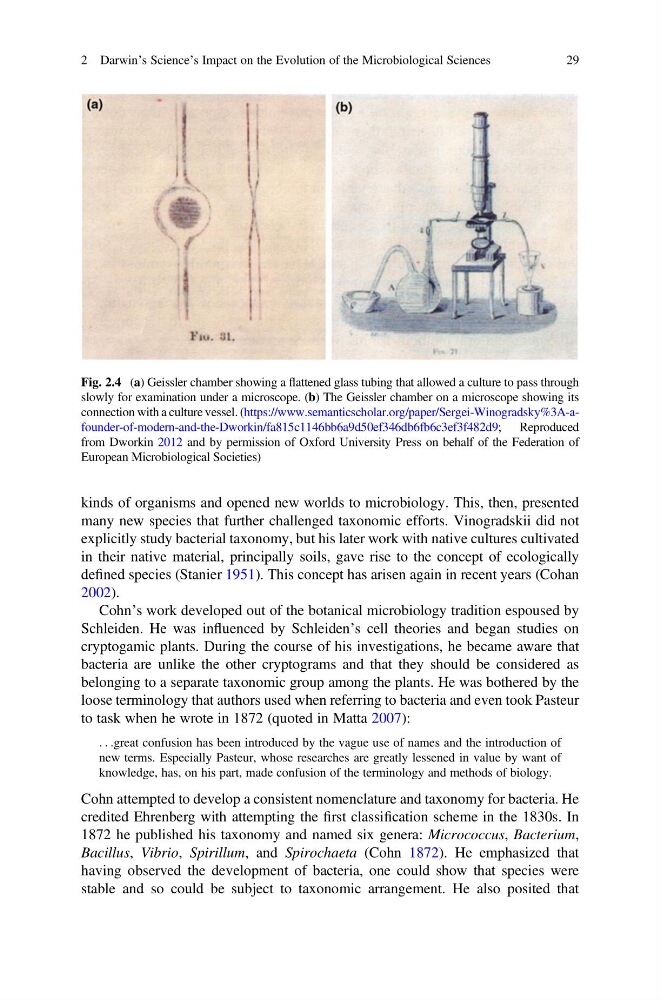
Fig. 2.4 (a) Geissler chamber showing a flattened glass tubing that allowed a culture to pass through
slowly for examination under a microscope. (b) The Geissler chamber on a microscope showing its
connection with a culture vessel. (https://www.semanticscholar.org/paper/Sergei-Winogradsky%3A-afounder-of-modern-and-the-Dworkin/fa815c1146bb6a9d50ef346db6fb6c3ef3f482d9; Reproduced
from Dworkin 2012 and by permission of Oxford University Press on behalf of the Federation of
European Microbiological Societies)
2 Darwin’s Science’s Impact on the Evolution of the Microbiological Sciences
29
many new species that further challenged taxonomic efforts. Vinogradskii did not
explicitly study bacterial taxonomy, but his later work with native cultures cultivated
in their native material, principally soils, gave rise to the concept of ecologically
defined species (Stanier 1951). This concept has arisen again in recent years (Cohan
2002).
Cohn’s work developed out of the botanical microbiology tradition espoused by
Schleiden. He was influenced by Schleiden’s cell theories and began studies on
cryptogamic plants. During the course of his investigations, he became aware that
bacteria are unlike the other cryptograms and that they should be considered as
belonging to a separate taxonomic group among the plants. He was bothered by the
loose terminology that authors used when referring to bacteria and even took Pasteur
to task when he wrote in 1872 (quoted in Matta 2007):
. . .great confusion has been introduced by the vague use of names and the introduction of
new terms. Especially Pasteur, whose researches are greatly lessened in value by want of
knowledge, has, on his part, made confusion of the terminology and methods of biology.
Cohn attempted to develop a consistent nomenclature and taxonomy for bacteria. He
credited Ehrenberg with attempting the first classification scheme in the 1830s. In
1872 he published his taxonomy and named six genera: Micrococcus, Bacterium,
Bacillus, Vibrio, Spirillum, and Spirochaeta (Cohn 1872). He emphasized that
having observed the development of bacteria, one could show that species were
stable and so could be subject to taxonomic arrangement. He also posited that
Fig. 2.4 (a) Geissler chamber showing a flattened glass tubing that allowed a culture to pass through
slowly for examination under a microscope. (b) The Geissler chamber on a microscope showing its
connection with a culture vessel. (https://www.semanticscholar.org/paper/Sergei-Winogradsky%3A-afounder-of-modern-and-the-Dworkin/fa815c1146bb6a9d50ef346db6fb6c3ef3f482d9; Reproduced
from Dworkin 2012 and by permission of Oxford University Press on behalf of the Federation of
European Microbiological Societies)
2 Darwin’s Science’s Impact on the Evolution of the Microbiological Sciences
29