

The idea of cycles of life was picked up by plant physiologist Andrei Famintsyn
who began an examination of the physiology of fungi. This project was taken on by
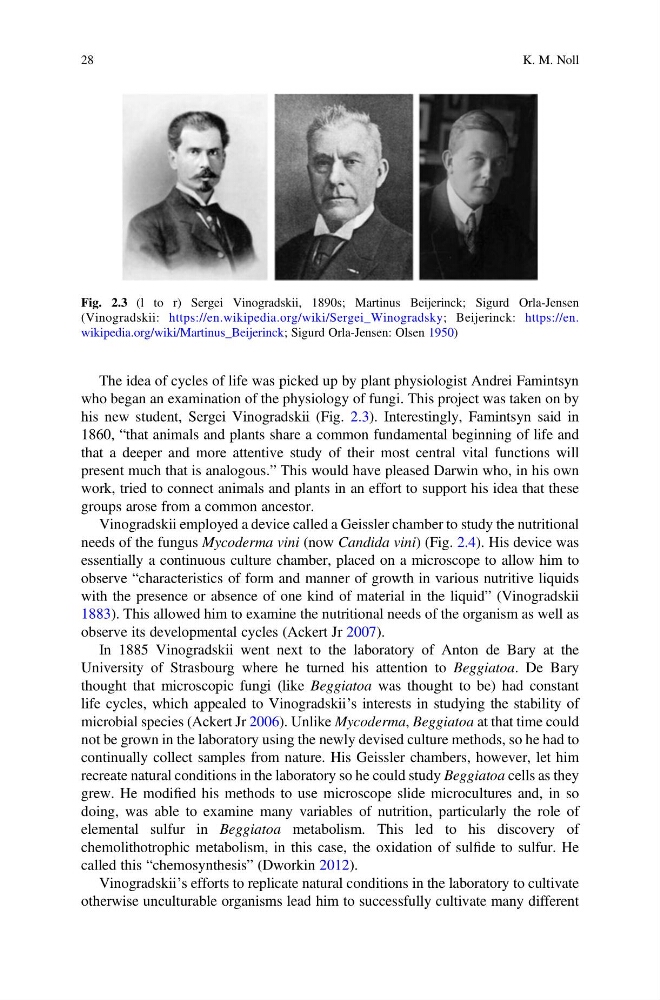
his new student, Sergei Vinogradskii (Fig. 2.3). Interestingly, Famintsyn said in
1860, “that animals and plants share a common fundamental beginning of life and
that a deeper and more attentive study of their most central vital functions will
present much that is analogous.” This would have pleased Darwin who, in his own
work, tried to connect animals and plants in an effort to support his idea that these
groups arose from a common ancestor.
Vinogradskii employed a device called a Geissler chamber to study the nutritional
needs of the fungus Mycoderma vini (now Candida vini) (Fig. 2.4). His device was
essentially a continuous culture chamber, placed on a microscope to allow him to
observe “characteristics of form and manner of growth in various nutritive liquids
with the presence or absence of one kind of material in the liquid” (Vinogradskii
1883). This allowed him to examine the nutritional needs of the organism as well as
observe its developmental cycles (Ackert Jr 2007).
In 1885 Vinogradskii went next to the laboratory of Anton de Bary at the
University of Strasbourg where he turned his attention to Beggiatoa. De Bary
thought that microscopic fungi (like Beggiatoa was thought to be) had constant
life cycles, which appealed to Vinogradskii’s interests in studying the stability of
microbial species (Ackert Jr 2006). Unlike Mycoderma, Beggiatoa at that time could
not be grown in the laboratory using the newly devised culture methods, so he had to
continually collect samples from nature. His Geissler chambers, however, let him
recreate natural conditions in the laboratory so he could study Beggiatoa cells as they
grew. He modified his methods to use microscope slide microcultures and, in so
doing, was able to examine many variables of nutrition, particularly the role of
elemental sulfur in Beggiatoa metabolism. This led to his discovery of
chemolithotrophic metabolism, in this case, the oxidation of sulfide to sulfur. He
called this “chemosynthesis” (Dworkin 2012).
Vinogradskii’s efforts to replicate natural conditions in the laboratory to cultivate
otherwise unculturable organisms lead him to successfully cultivate many different
Fig. 2.3 (l to r) Sergei Vinogradskii, 1890s; Martinus Beijerinck; Sigurd Orla-Jensen
(Vinogradskii: https://en.wikipedia.org/wiki/Sergei_Winogradsky; Beijerinck: https://en.
wikipedia.org/wiki/Martinus_Beijerinck; Sigurd Orla-Jensen: Olsen 1950)
28
K. M. Noll
who began an examination of the physiology of fungi. This project was taken on by
his new student, Sergei Vinogradskii (Fig. 2.3). Interestingly, Famintsyn said in
1860, “that animals and plants share a common fundamental beginning of life and
that a deeper and more attentive study of their most central vital functions will
present much that is analogous.” This would have pleased Darwin who, in his own
work, tried to connect animals and plants in an effort to support his idea that these
groups arose from a common ancestor.
Vinogradskii employed a device called a Geissler chamber to study the nutritional
needs of the fungus Mycoderma vini (now Candida vini) (Fig. 2.4). His device was
essentially a continuous culture chamber, placed on a microscope to allow him to
observe “characteristics of form and manner of growth in various nutritive liquids
with the presence or absence of one kind of material in the liquid” (Vinogradskii
1883). This allowed him to examine the nutritional needs of the organism as well as
observe its developmental cycles (Ackert Jr 2007).
In 1885 Vinogradskii went next to the laboratory of Anton de Bary at the
University of Strasbourg where he turned his attention to Beggiatoa. De Bary
thought that microscopic fungi (like Beggiatoa was thought to be) had constant
life cycles, which appealed to Vinogradskii’s interests in studying the stability of
microbial species (Ackert Jr 2006). Unlike Mycoderma, Beggiatoa at that time could
not be grown in the laboratory using the newly devised culture methods, so he had to
continually collect samples from nature. His Geissler chambers, however, let him
recreate natural conditions in the laboratory so he could study Beggiatoa cells as they
grew. He modified his methods to use microscope slide microcultures and, in so
doing, was able to examine many variables of nutrition, particularly the role of
elemental sulfur in Beggiatoa metabolism. This led to his discovery of
chemolithotrophic metabolism, in this case, the oxidation of sulfide to sulfur. He
called this “chemosynthesis” (Dworkin 2012).
Vinogradskii’s efforts to replicate natural conditions in the laboratory to cultivate
otherwise unculturable organisms lead him to successfully cultivate many different
Fig. 2.3 (l to r) Sergei Vinogradskii, 1890s; Martinus Beijerinck; Sigurd Orla-Jensen
(Vinogradskii: https://en.wikipedia.org/wiki/Sergei_Winogradsky; Beijerinck: https://en.
wikipedia.org/wiki/Martinus_Beijerinck; Sigurd Orla-Jensen: Olsen 1950)
28
K. M. Noll