

technology is not intended to be applied only in the case of agricultural crops that are
consumed by humans, cattle or other animals to reduce the high chances of HM
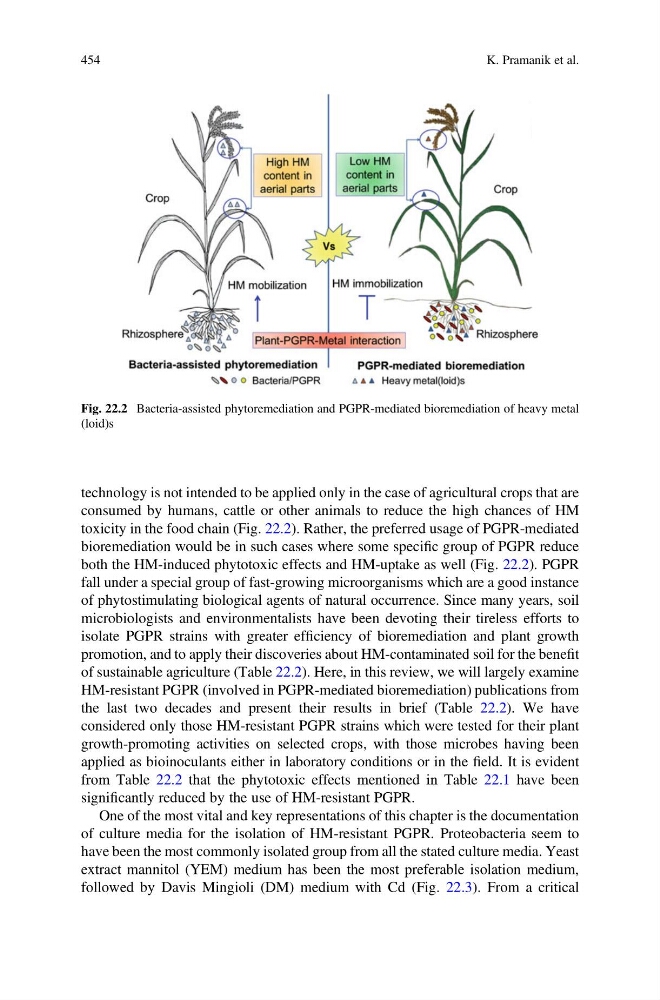
toxicity in the food chain (Fig. 22.2). Rather, the preferred usage of PGPR-mediated
bioremediation would be in such cases where some specific group of PGPR reduce
both the HM-induced phytotoxic effects and HM-uptake as well (Fig. 22.2). PGPR
fall under a special group of fast-growing microorganisms which are a good instance
of phytostimulating biological agents of natural occurrence. Since many years, soil
microbiologists and environmentalists have been devoting their tireless efforts to
isolate PGPR strains with greater efficiency of bioremediation and plant growth
promotion, and to apply their discoveries about HM-contaminated soil for the benefit
of sustainable agriculture (Table 22.2). Here, in this review, we will largely examine
HM-resistant PGPR (involved in PGPR-mediated bioremediation) publications from
the last two decades and present their results in brief (Table 22.2). We have
considered only those HM-resistant PGPR strains which were tested for their plant
growth-promoting activities on selected crops, with those microbes having been
applied as bioinoculants either in laboratory conditions or in the field. It is evident
from Table 22.2 that the phytotoxic effects mentioned in Table 22.1 have been
significantly reduced by the use of HM-resistant PGPR.
One of the most vital and key representations of this chapter is the documentation
of culture media for the isolation of HM-resistant PGPR. Proteobacteria seem to
have been the most commonly isolated group from all the stated culture media. Yeast
extract mannitol (YEM) medium has been the most preferable isolation medium,
followed by Davis Mingioli (DM) medium with Cd (Fig. 22.3). From a critical
Fig. 22.2 Bacteria-assisted phytoremediation and PGPR-mediated bioremediation of heavy metal
(loid)s
454
K. Pramanik et al.
consumed by humans, cattle or other animals to reduce the high chances of HM
toxicity in the food chain (Fig. 22.2). Rather, the preferred usage of PGPR-mediated
bioremediation would be in such cases where some specific group of PGPR reduce
both the HM-induced phytotoxic effects and HM-uptake as well (Fig. 22.2). PGPR
fall under a special group of fast-growing microorganisms which are a good instance
of phytostimulating biological agents of natural occurrence. Since many years, soil
microbiologists and environmentalists have been devoting their tireless efforts to
isolate PGPR strains with greater efficiency of bioremediation and plant growth
promotion, and to apply their discoveries about HM-contaminated soil for the benefit
of sustainable agriculture (Table 22.2). Here, in this review, we will largely examine
HM-resistant PGPR (involved in PGPR-mediated bioremediation) publications from
the last two decades and present their results in brief (Table 22.2). We have
considered only those HM-resistant PGPR strains which were tested for their plant
growth-promoting activities on selected crops, with those microbes having been
applied as bioinoculants either in laboratory conditions or in the field. It is evident
from Table 22.2 that the phytotoxic effects mentioned in Table 22.1 have been
significantly reduced by the use of HM-resistant PGPR.
One of the most vital and key representations of this chapter is the documentation
of culture media for the isolation of HM-resistant PGPR. Proteobacteria seem to
have been the most commonly isolated group from all the stated culture media. Yeast
extract mannitol (YEM) medium has been the most preferable isolation medium,
followed by Davis Mingioli (DM) medium with Cd (Fig. 22.3). From a critical
Fig. 22.2 Bacteria-assisted phytoremediation and PGPR-mediated bioremediation of heavy metal
(loid)s
454
K. Pramanik et al.