

plant microbiomes. Janzen (1985) in “The Biology of Mutualism” wrote: “Plants
wear their guts on the outside.” Like the gut, root microbiome bacteria interact with
the outside surface of the tissue. In animals, gastrulation results when the blastula
folds into itself giving rise to a tube consisting of ectoderm, mesoderm, and
endoderm, the ectoderm being analogous to the plant epidermis. However, Janzen’s
full quote is “Plants wear their guts on the outside but have practically the same kind
of diffuse and often obligatory mutualism with bacteria, nematodes, fungi and other
litter decomposers.” The keyword is “mutualism:” a quid pro quo that takes place
between more than one organism involving nutrition, protection from pathogens,
and development. This is especially true for roots, which associate with myriad
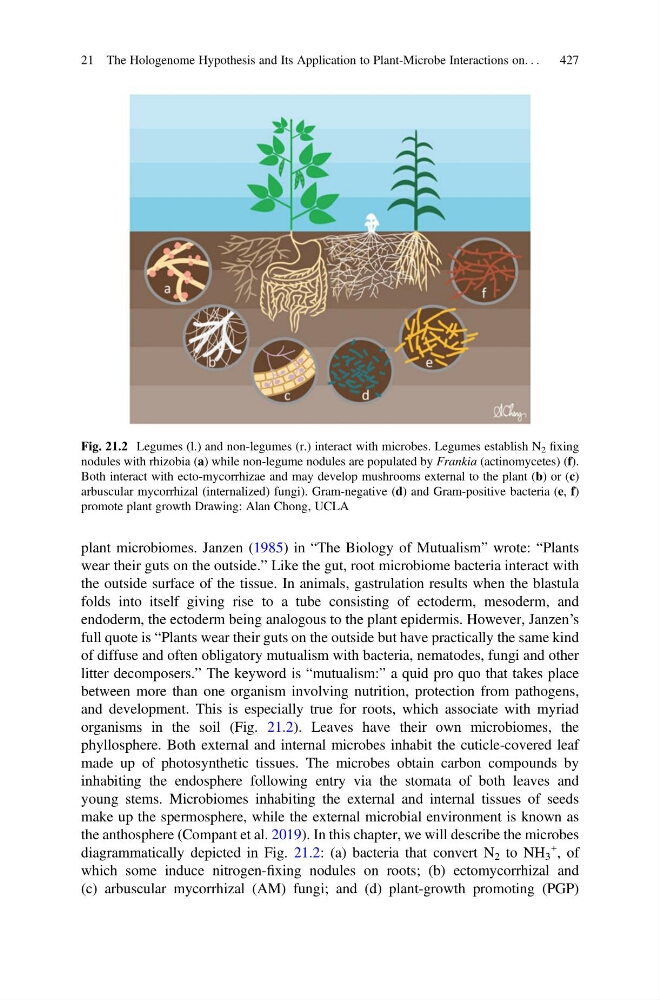
organisms in the soil (Fig. 21.2). Leaves have their own microbiomes, the
phyllosphere. Both external and internal microbes inhabit the cuticle-covered leaf
made up of photosynthetic tissues. The microbes obtain carbon compounds by
inhabiting the endosphere following entry via the stomata of both leaves and
young stems. Microbiomes inhabiting the external and internal tissues of seeds
make up the spermosphere, while the external microbial environment is known as
the anthosphere (Compant et al. 2019). In this chapter, we will describe the microbes
diagrammatically depicted in Fig. 21.2: (a) bacteria that convert N 2 to NH 3
+
, of
which some induce nitrogen-fixing nodules on roots; (b) ectomycorrhizal and
(c) arbuscular mycorrhizal (AM) fungi; and (d) plant-growth promoting (PGP)
Fig. 21.2 Legumes (l.) and non-legumes (r.) interact with microbes. Legumes establish N 2 fixing
nodules with rhizobia (a) while non-legume nodules are populated by Frankia (actinomycetes) (f).
Both interact with ecto-mycorrhizae and may develop mushrooms external to the plant (b) or (c)
arbuscular mycorrhizal (internalized) fungi). Gram-negative (d) and Gram-positive bacteria (e, f)
promote plant growth Drawing: Alan Chong, UCLA
21 The Hologenome Hypothesis and Its Application to Plant-Microbe Interactions on. . .
427
wear their guts on the outside.” Like the gut, root microbiome bacteria interact with
the outside surface of the tissue. In animals, gastrulation results when the blastula
folds into itself giving rise to a tube consisting of ectoderm, mesoderm, and
endoderm, the ectoderm being analogous to the plant epidermis. However, Janzen’s
full quote is “Plants wear their guts on the outside but have practically the same kind
of diffuse and often obligatory mutualism with bacteria, nematodes, fungi and other
litter decomposers.” The keyword is “mutualism:” a quid pro quo that takes place
between more than one organism involving nutrition, protection from pathogens,
and development. This is especially true for roots, which associate with myriad
organisms in the soil (Fig. 21.2). Leaves have their own microbiomes, the
phyllosphere. Both external and internal microbes inhabit the cuticle-covered leaf
made up of photosynthetic tissues. The microbes obtain carbon compounds by
inhabiting the endosphere following entry via the stomata of both leaves and
young stems. Microbiomes inhabiting the external and internal tissues of seeds
make up the spermosphere, while the external microbial environment is known as
the anthosphere (Compant et al. 2019). In this chapter, we will describe the microbes
diagrammatically depicted in Fig. 21.2: (a) bacteria that convert N 2 to NH 3
+
, of
which some induce nitrogen-fixing nodules on roots; (b) ectomycorrhizal and
(c) arbuscular mycorrhizal (AM) fungi; and (d) plant-growth promoting (PGP)
Fig. 21.2 Legumes (l.) and non-legumes (r.) interact with microbes. Legumes establish N 2 fixing
nodules with rhizobia (a) while non-legume nodules are populated by Frankia (actinomycetes) (f).
Both interact with ecto-mycorrhizae and may develop mushrooms external to the plant (b) or (c)
arbuscular mycorrhizal (internalized) fungi). Gram-negative (d) and Gram-positive bacteria (e, f)
promote plant growth Drawing: Alan Chong, UCLA
21 The Hologenome Hypothesis and Its Application to Plant-Microbe Interactions on. . .
427