

with CB-R05 compared with the untreated control. Under the confocal laser scanning microscope (CLSM), the gfp-tagged CB-R05 bacterial cells were observed to
penetrate the rhizoplane, especially in the elongation and differentiation zones of the
rice roots and colonize inside the root tissues (Ji et al. 2014b).
20.3.1 Genetics on the Interaction of Diazotrophs and Plants
At present, there are more than 800 complete microbial genomes in databases.
However, only nine are endophytes (Azoarcus sp. BH72, Burkholderia phytofirmans
PsJN, Enterobacter sp. 638, Methylobacterium populi BJ001, Pseudomonas putida
W619, Serratia proteamaculans 568, Klebsiella pneumoniae 342, Stenotrophomonas
maltophilia R551–3, and Gluconacetobacter diazotrophicus Pal5) (Bertalan et al.
2009).
The complete genomes of endophytic bacteria reveal remarkably few mobile
elements in their genome. Of these, the genomes exhibit a range in size from 3.9 to
7.6 Mb (Dent 2018), with G. diazotrophicus having the smallest genome (Miter et al.
2013) of 3.9 Mb (Bertalan et al. 2009). Gluconacetobacter diazotrophicus is firmly
in the facultative intracellular colonizer category (Cocking and Dent, 2019) and was
first demonstrated in 2006 (Cocking et al. 2006). Certain strains of G. diazotrophicus
are capable under the right conditions of intracellularly colonizing a range of crop
species. Similarly, this character of wide host range has been demonstrated for a
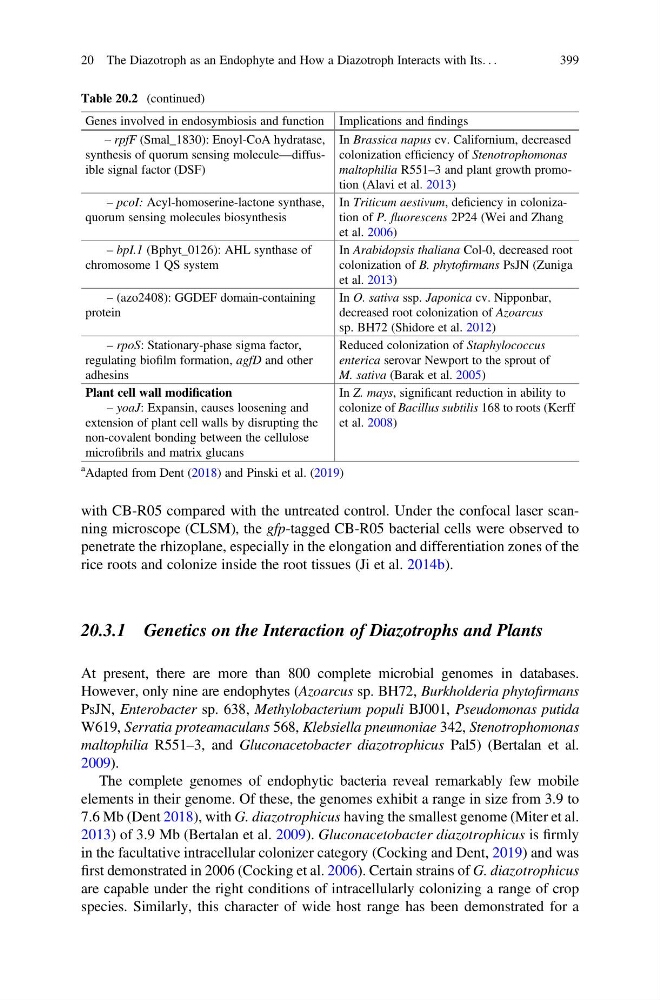
Table 20.2 (continued)
Genes involved in endosymbiosis and function Implications and findings
– rpfF (Smal_1830): Enoyl-CoA hydratase,
synthesis of quorum sensing molecule—diffusible signal factor (DSF)
In Brassica napus cv. Californium, decreased
colonization efficiency of Stenotrophomonas
maltophilia R551–3 and plant growth promotion (Alavi et al. 2013)
– pcoI: Acyl-homoserine-lactone synthase,
quorum sensing molecules biosynthesis
In Triticum aestivum, deficiency in colonization of P. fluorescens 2P24 (Wei and Zhang
et al. 2006)
– bpI.1 (Bphyt_0126): AHL synthase of
chromosome 1 QS system
In Arabidopsis thaliana Col-0, decreased root
colonization of B. phytofirmans PsJN (Zuniga
et al. 2013)
– (azo2408): GGDEF domain-containing
protein
In O. sativa ssp. Japonica cv. Nipponbar,
decreased root colonization of Azoarcus
sp. BH72 (Shidore et al. 2012)
– rpoS: Stationary-phase sigma factor,
regulating biofilm formation, agfD and other
adhesins
Reduced colonization of Staphylococcus
enterica serovar Newport to the sprout of
M. sativa (Barak et al. 2005)
Plant cell wall modification
– yoaJ: Expansin, causes loosening and
extension of plant cell walls by disrupting the
non-covalent bonding between the cellulose
microfibrils and matrix glucans
In Z. mays, significant reduction in ability to
colonize of Bacillus subtilis 168 to roots (Kerff
et al. 2008)
a Adapted from Dent (2018) and Pinski et al. (2019)
20 The Diazotroph as an Endophyte and How a Diazotroph Interacts with Its. . .
399
penetrate the rhizoplane, especially in the elongation and differentiation zones of the
rice roots and colonize inside the root tissues (Ji et al. 2014b).
20.3.1 Genetics on the Interaction of Diazotrophs and Plants
At present, there are more than 800 complete microbial genomes in databases.
However, only nine are endophytes (Azoarcus sp. BH72, Burkholderia phytofirmans
PsJN, Enterobacter sp. 638, Methylobacterium populi BJ001, Pseudomonas putida
W619, Serratia proteamaculans 568, Klebsiella pneumoniae 342, Stenotrophomonas
maltophilia R551–3, and Gluconacetobacter diazotrophicus Pal5) (Bertalan et al.
2009).
The complete genomes of endophytic bacteria reveal remarkably few mobile
elements in their genome. Of these, the genomes exhibit a range in size from 3.9 to
7.6 Mb (Dent 2018), with G. diazotrophicus having the smallest genome (Miter et al.
2013) of 3.9 Mb (Bertalan et al. 2009). Gluconacetobacter diazotrophicus is firmly
in the facultative intracellular colonizer category (Cocking and Dent, 2019) and was
first demonstrated in 2006 (Cocking et al. 2006). Certain strains of G. diazotrophicus
are capable under the right conditions of intracellularly colonizing a range of crop
species. Similarly, this character of wide host range has been demonstrated for a
Table 20.2 (continued)
Genes involved in endosymbiosis and function Implications and findings
– rpfF (Smal_1830): Enoyl-CoA hydratase,
synthesis of quorum sensing molecule—diffusible signal factor (DSF)
In Brassica napus cv. Californium, decreased
colonization efficiency of Stenotrophomonas
maltophilia R551–3 and plant growth promotion (Alavi et al. 2013)
– pcoI: Acyl-homoserine-lactone synthase,
quorum sensing molecules biosynthesis
In Triticum aestivum, deficiency in colonization of P. fluorescens 2P24 (Wei and Zhang
et al. 2006)
– bpI.1 (Bphyt_0126): AHL synthase of
chromosome 1 QS system
In Arabidopsis thaliana Col-0, decreased root
colonization of B. phytofirmans PsJN (Zuniga
et al. 2013)
– (azo2408): GGDEF domain-containing
protein
In O. sativa ssp. Japonica cv. Nipponbar,
decreased root colonization of Azoarcus
sp. BH72 (Shidore et al. 2012)
– rpoS: Stationary-phase sigma factor,
regulating biofilm formation, agfD and other
adhesins
Reduced colonization of Staphylococcus
enterica serovar Newport to the sprout of
M. sativa (Barak et al. 2005)
Plant cell wall modification
– yoaJ: Expansin, causes loosening and
extension of plant cell walls by disrupting the
non-covalent bonding between the cellulose
microfibrils and matrix glucans
In Z. mays, significant reduction in ability to
colonize of Bacillus subtilis 168 to roots (Kerff
et al. 2008)
a Adapted from Dent (2018) and Pinski et al. (2019)
20 The Diazotroph as an Endophyte and How a Diazotroph Interacts with Its. . .
399