

19.7 Transcriptional Regulation
A number of studies have described the cloning of genes encoding ACC deaminase,
and in all instances, the resulting clones have been shown to encode a functional
ACC deaminase (Van Loon and Glick 2004). The expression of ACC deaminase is a
highly regulated process and is affected by oxygen availability, substrate concentration, and product levels. Analysis of many bacterial genomes suggests that the
transcription of acdS genes is not controlled by a single factor, and different
phylogenetic groups may utilize different mechanisms to regulate the expression
of this gene (Nascimento et al. 2014). We suggest that the acdS gene is most likely
under the control of at least one of the following four factors: (a) a combination of
LRP (leucine-responsive regulatory protein), CRP (cyclic AMP receptor protein),
and FNR (fumarate–nitrate reduction regulatory protein), (b) nifA, (c) RpoS, or
(d) other mechanisms. Table 19.5 summarizes the mechanisms that have been to
date found to regulate acdS gene expression in different bacteria.
19.7.1 Factor a:
LRP, CRP, and FNR
ACC deaminase has been extensively studied in the Pseudomonas genus. The acdS
genes from Pseudomonas sp. strains 6G5, F17, and UW4, and Enterobacter cloacae
strain CAL2 have an open reading frame of 1014 nucleotides (Van Loon and Glick
2004). In Pseudomonas sp. UW4, which has been studied in great detail, several
regulatory factors have been identified on the DNA region upstream of the acdS
gene and include a CRP binding site (or box), an FNR binding site, an acdB gene
(not immediately upstream of acdS), an AcdR binding site, and also an open reading
frame encoding an acdR gene (Cheng et al. 2008; Grichko and Glick 2000; Li and
Glick 2001; Van Loon and Glick 2004). These factors work in a coordinated manner
and are actively involved in transcriptional regulation of the acdS gene (Fig. 19.1).
The acdR gene is transcribed in the opposite direction of the acdS gene and encodes
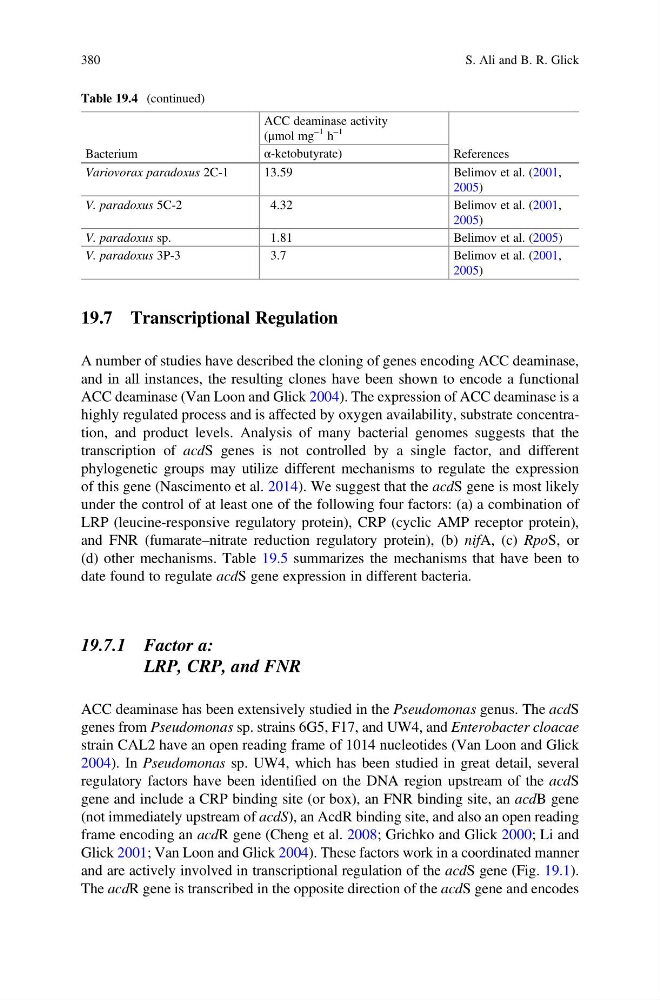
Table 19.4 (continued)
Bacterium
ACC deaminase activity
(μmol mg
–1 h
–1
References
α-ketobutyrate)
Variovorax paradoxus 2C-1
13.59
Belimov et al. (2001,
2005)
V. paradoxus 5C-2
4.32
Belimov et al. (2001,
2005)
V. paradoxus sp.
1.81
Belimov et al. (2005)
V. paradoxus 3P-3
3.7
Belimov et al. (2001,
2005)
380
S. Ali and B. R. Glick
A number of studies have described the cloning of genes encoding ACC deaminase,
and in all instances, the resulting clones have been shown to encode a functional
ACC deaminase (Van Loon and Glick 2004). The expression of ACC deaminase is a
highly regulated process and is affected by oxygen availability, substrate concentration, and product levels. Analysis of many bacterial genomes suggests that the
transcription of acdS genes is not controlled by a single factor, and different
phylogenetic groups may utilize different mechanisms to regulate the expression
of this gene (Nascimento et al. 2014). We suggest that the acdS gene is most likely
under the control of at least one of the following four factors: (a) a combination of
LRP (leucine-responsive regulatory protein), CRP (cyclic AMP receptor protein),
and FNR (fumarate–nitrate reduction regulatory protein), (b) nifA, (c) RpoS, or
(d) other mechanisms. Table 19.5 summarizes the mechanisms that have been to
date found to regulate acdS gene expression in different bacteria.
19.7.1 Factor a:
LRP, CRP, and FNR
ACC deaminase has been extensively studied in the Pseudomonas genus. The acdS
genes from Pseudomonas sp. strains 6G5, F17, and UW4, and Enterobacter cloacae
strain CAL2 have an open reading frame of 1014 nucleotides (Van Loon and Glick
2004). In Pseudomonas sp. UW4, which has been studied in great detail, several
regulatory factors have been identified on the DNA region upstream of the acdS
gene and include a CRP binding site (or box), an FNR binding site, an acdB gene
(not immediately upstream of acdS), an AcdR binding site, and also an open reading
frame encoding an acdR gene (Cheng et al. 2008; Grichko and Glick 2000; Li and
Glick 2001; Van Loon and Glick 2004). These factors work in a coordinated manner
and are actively involved in transcriptional regulation of the acdS gene (Fig. 19.1).
The acdR gene is transcribed in the opposite direction of the acdS gene and encodes
Table 19.4 (continued)
Bacterium
ACC deaminase activity
(μmol mg
–1 h
–1
References
α-ketobutyrate)
Variovorax paradoxus 2C-1
13.59
Belimov et al. (2001,
2005)
V. paradoxus 5C-2
4.32
Belimov et al. (2001,
2005)
V. paradoxus sp.
1.81
Belimov et al. (2005)
V. paradoxus 3P-3
3.7
Belimov et al. (2001,
2005)
380
S. Ali and B. R. Glick