

anything which their partnering species allows, and anything which competitions
with other species do not prevent.
I envision the limitating way in which habitats and also niches are restricted by
competitions with other species as being a theoretical multidimentional space.
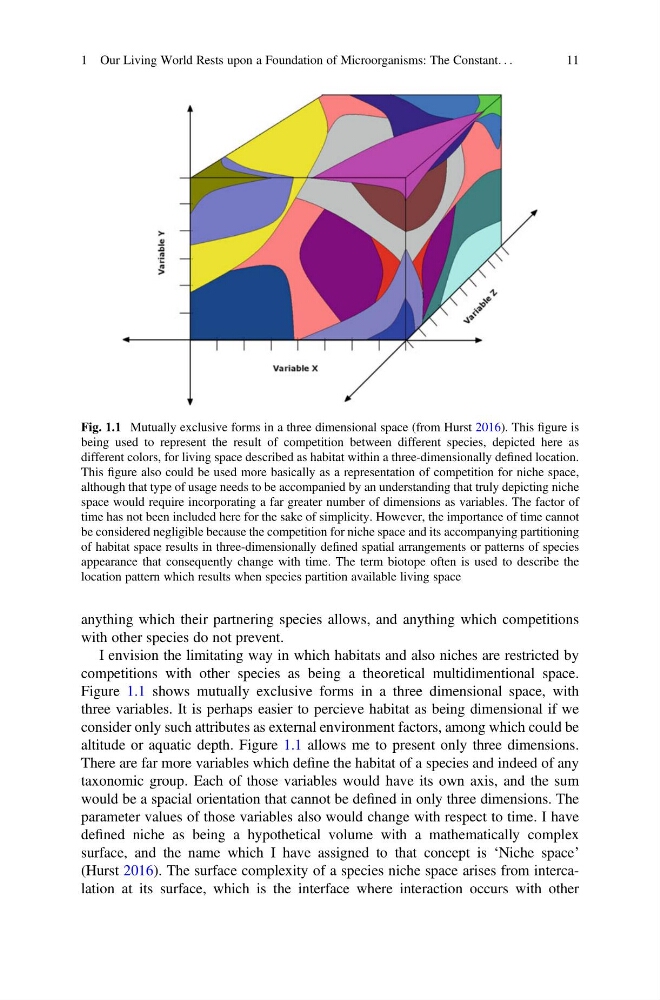
Figure 1.1 shows mutually exclusive forms in a three dimensional space, with
three variables. It is perhaps easier to percieve habitat as being dimensional if we
consider only such attributes as external environment factors, among which could be
altitude or aquatic depth. Figure 1.1 allows me to present only three dimensions.
There are far more variables which define the habitat of a species and indeed of any
taxonomic group. Each of those variables would have its own axis, and the sum
would be a spacial orientation that cannot be defined in only three dimensions. The
parameter values of those variables also would change with respect to time. I have
defined niche as being a hypothetical volume with a mathematically complex
surface, and the name which I have assigned to that concept is ‘Niche space’
(Hurst 2016). The surface complexity of a species niche space arises from intercalation at its surface, which is the interface where interaction occurs with other
Fig. 1.1 Mutually exclusive forms in a three dimensional space (from Hurst 2016). This figure is
being used to represent the result of competition between different species, depicted here as
different colors, for living space described as habitat within a three-dimensionally defined location.
This figure also could be used more basically as a representation of competition for niche space,
although that type of usage needs to be accompanied by an understanding that truly depicting niche
space would require incorporating a far greater number of dimensions as variables. The factor of
time has not been included here for the sake of simplicity. However, the importance of time cannot
be considered negligible because the competition for niche space and its accompanying partitioning
of habitat space results in three-dimensionally defined spatial arrangements or patterns of species
appearance that consequently change with time. The term biotope often is used to describe the
location pattern which results when species partition available living space
1 Our Living World Rests upon a Foundation of Microorganisms: The Constant. . .
11
with other species do not prevent.
I envision the limitating way in which habitats and also niches are restricted by
competitions with other species as being a theoretical multidimentional space.
Figure 1.1 shows mutually exclusive forms in a three dimensional space, with
three variables. It is perhaps easier to percieve habitat as being dimensional if we
consider only such attributes as external environment factors, among which could be
altitude or aquatic depth. Figure 1.1 allows me to present only three dimensions.
There are far more variables which define the habitat of a species and indeed of any
taxonomic group. Each of those variables would have its own axis, and the sum
would be a spacial orientation that cannot be defined in only three dimensions. The
parameter values of those variables also would change with respect to time. I have
defined niche as being a hypothetical volume with a mathematically complex
surface, and the name which I have assigned to that concept is ‘Niche space’
(Hurst 2016). The surface complexity of a species niche space arises from intercalation at its surface, which is the interface where interaction occurs with other
Fig. 1.1 Mutually exclusive forms in a three dimensional space (from Hurst 2016). This figure is
being used to represent the result of competition between different species, depicted here as
different colors, for living space described as habitat within a three-dimensionally defined location.
This figure also could be used more basically as a representation of competition for niche space,
although that type of usage needs to be accompanied by an understanding that truly depicting niche
space would require incorporating a far greater number of dimensions as variables. The factor of
time has not been included here for the sake of simplicity. However, the importance of time cannot
be considered negligible because the competition for niche space and its accompanying partitioning
of habitat space results in three-dimensionally defined spatial arrangements or patterns of species
appearance that consequently change with time. The term biotope often is used to describe the
location pattern which results when species partition available living space
1 Our Living World Rests upon a Foundation of Microorganisms: The Constant. . .
11