

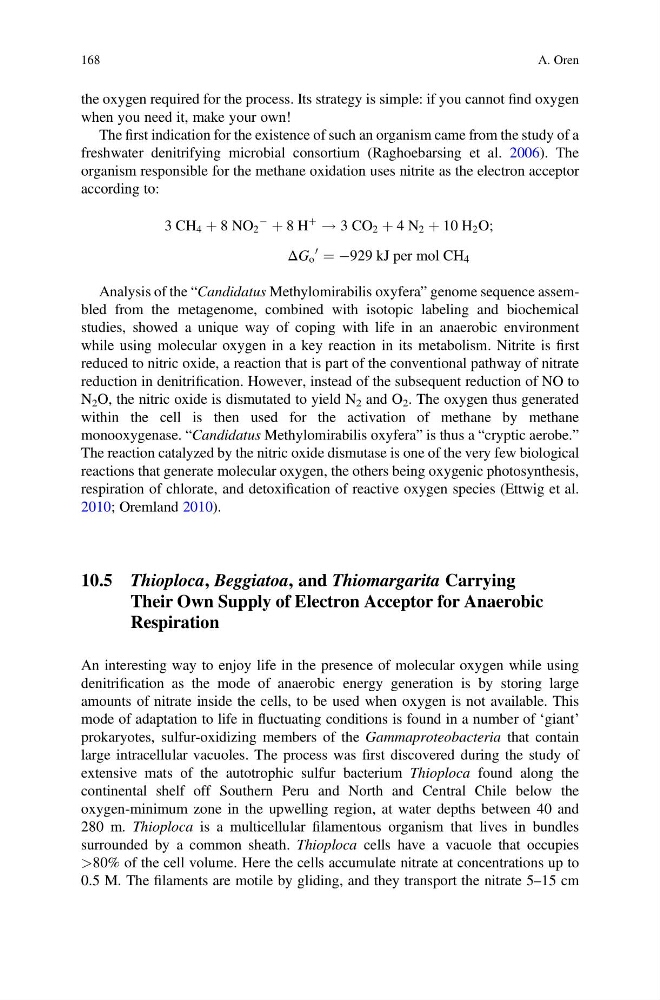
the oxygen required for the process. Its strategy is simple: if you cannot find oxygen
when you need it, make your own!
The first indication for the existence of such an organism came from the study of a
freshwater denitrifying microbial consortium (Raghoebarsing et al. 2006). The
organism responsible for the methane oxidation uses nitrite as the electron acceptor
according to:
3 CH 4 þ 8 NO 2
À
þ 8 H
þ
! 3 CO 2 þ 4 N 2 þ 10 H 2 O;
ΔG o
0
¼ À929 kJ per mol CH 4
Analysis of the “Candidatus Methylomirabilis oxyfera” genome sequence assembled from the metagenome, combined with isotopic labeling and biochemical
studies, showed a unique way of coping with life in an anaerobic environment
while using molecular oxygen in a key reaction in its metabolism. Nitrite is first
reduced to nitric oxide, a reaction that is part of the conventional pathway of nitrate
reduction in denitrification. However, instead of the subsequent reduction of NO to
N 2 O, the nitric oxide is dismutated to yield N 2 and O 2 . The oxygen thus generated
within the cell is then used for the activation of methane by methane
monooxygenase. “Candidatus Methylomirabilis oxyfera” is thus a “cryptic aerobe.”
The reaction catalyzed by the nitric oxide dismutase is one of the very few biological
reactions that generate molecular oxygen, the others being oxygenic photosynthesis,
respiration of chlorate, and detoxification of reactive oxygen species (Ettwig et al.
2010; Oremland 2010).
10.5 Thioploca, Beggiatoa, and Thiomargarita Carrying
Their Own Supply of Electron Acceptor for Anaerobic
Respiration
An interesting way to enjoy life in the presence of molecular oxygen while using
denitrification as the mode of anaerobic energy generation is by storing large
amounts of nitrate inside the cells, to be used when oxygen is not available. This
mode of adaptation to life in fluctuating conditions is found in a number of ‘giant’
prokaryotes, sulfur-oxidizing members of the Gammaproteobacteria that contain
large intracellular vacuoles. The process was first discovered during the study of
extensive mats of the autotrophic sulfur bacterium Thioploca found along the
continental shelf off Southern Peru and North and Central Chile below the
oxygen-minimum zone in the upwelling region, at water depths between 40 and
280 m. Thioploca is a multicellular filamentous organism that lives in bundles
surrounded by a common sheath. Thioploca cells have a vacuole that occupies
>80% of the cell volume. Here the cells accumulate nitrate at concentrations up to
0.5 M. The filaments are motile by gliding, and they transport the nitrate 5–15 cm
168
A. Oren
when you need it, make your own!
The first indication for the existence of such an organism came from the study of a
freshwater denitrifying microbial consortium (Raghoebarsing et al. 2006). The
organism responsible for the methane oxidation uses nitrite as the electron acceptor
according to:
3 CH 4 þ 8 NO 2
À
þ 8 H
þ
! 3 CO 2 þ 4 N 2 þ 10 H 2 O;
ΔG o
0
¼ À929 kJ per mol CH 4
Analysis of the “Candidatus Methylomirabilis oxyfera” genome sequence assembled from the metagenome, combined with isotopic labeling and biochemical
studies, showed a unique way of coping with life in an anaerobic environment
while using molecular oxygen in a key reaction in its metabolism. Nitrite is first
reduced to nitric oxide, a reaction that is part of the conventional pathway of nitrate
reduction in denitrification. However, instead of the subsequent reduction of NO to
N 2 O, the nitric oxide is dismutated to yield N 2 and O 2 . The oxygen thus generated
within the cell is then used for the activation of methane by methane
monooxygenase. “Candidatus Methylomirabilis oxyfera” is thus a “cryptic aerobe.”
The reaction catalyzed by the nitric oxide dismutase is one of the very few biological
reactions that generate molecular oxygen, the others being oxygenic photosynthesis,
respiration of chlorate, and detoxification of reactive oxygen species (Ettwig et al.
2010; Oremland 2010).
10.5 Thioploca, Beggiatoa, and Thiomargarita Carrying
Their Own Supply of Electron Acceptor for Anaerobic
Respiration
An interesting way to enjoy life in the presence of molecular oxygen while using
denitrification as the mode of anaerobic energy generation is by storing large
amounts of nitrate inside the cells, to be used when oxygen is not available. This
mode of adaptation to life in fluctuating conditions is found in a number of ‘giant’
prokaryotes, sulfur-oxidizing members of the Gammaproteobacteria that contain
large intracellular vacuoles. The process was first discovered during the study of
extensive mats of the autotrophic sulfur bacterium Thioploca found along the
continental shelf off Southern Peru and North and Central Chile below the
oxygen-minimum zone in the upwelling region, at water depths between 40 and
280 m. Thioploca is a multicellular filamentous organism that lives in bundles
surrounded by a common sheath. Thioploca cells have a vacuole that occupies
>80% of the cell volume. Here the cells accumulate nitrate at concentrations up to
0.5 M. The filaments are motile by gliding, and they transport the nitrate 5–15 cm
168
A. Oren