

atmosphere over both terrestrial and aquatic environments, including extreme altitudes (upper troposphere, tropopause, and stratosphere) (Smith et al. 2018; Amato
et al. 2017; Schuerger et al. 2018). In regard to the concentrations of atmospheric
microorganisms that may originate from various terrestrial or aquatic sources,
research conducted at several sites in Spain reported atmospheric deposition rates
of bacteria and viruses that ranged from 3.0 Â 10
6 to >8 Â 10
7 m
À2 and 2.6 Â 10
8 to
>7 Â 10
9 m
À2 per day, respectively (Reche et al. 2018). Over the last few years,
scientific investigations have demonstrated active microbial metabolism in atmospheric environments, and these atmospheric and microbial interactions may occur
on time scales of hours to weeks (Amato et al. 2017; Klein et al. 2016).
Some of the primary factors that affect microbial viability in the atmosphere are
UV exposure, water availability, nutrient availability, temperature, and genetic
capability to resist stresses caused by these (e.g., like the cold and radiation-resistant
extremophile Deinococcus radiodurans) (Smith et al. 2011b; Smith et al. 2011a).
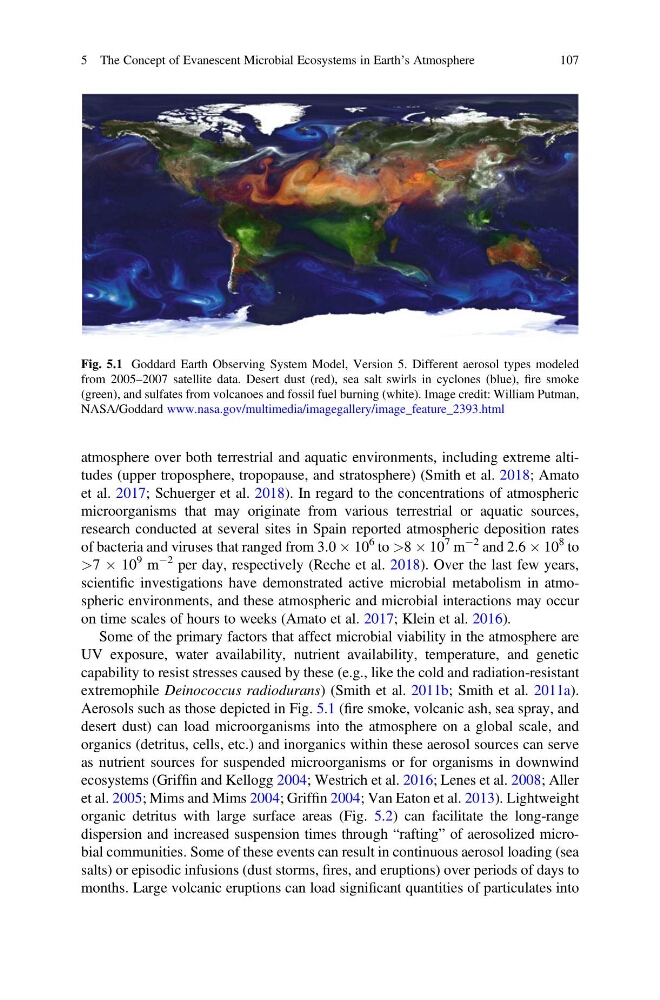
Aerosols such as those depicted in Fig. 5.1 (fire smoke, volcanic ash, sea spray, and
desert dust) can load microorganisms into the atmosphere on a global scale, and
organics (detritus, cells, etc.) and inorganics within these aerosol sources can serve
as nutrient sources for suspended microorganisms or for organisms in downwind
ecosystems (Griffin and Kellogg 2004; Westrich et al. 2016; Lenes et al. 2008; Aller
et al. 2005; Mims and Mims 2004; Griffin 2004; Van Eaton et al. 2013). Lightweight
organic detritus with large surface areas (Fig. 5.2) can facilitate the long-range
dispersion and increased suspension times through “rafting” of aerosolized microbial communities. Some of these events can result in continuous aerosol loading (sea
salts) or episodic infusions (dust storms, fires, and eruptions) over periods of days to
months. Large volcanic eruptions can load significant quantities of particulates into
Fig. 5.1 Goddard Earth Observing System Model, Version 5. Different aerosol types modeled
from 2005–2007 satellite data. Desert dust (red), sea salt swirls in cyclones (blue), fire smoke
(green), and sulfates from volcanoes and fossil fuel burning (white). Image credit: William Putman,
NASA/Goddard www.nasa.gov/multimedia/imagegallery/image_feature_2393.html
5 The Concept of Evanescent Microbial Ecosystems in Earth’s Atmosphere
107
et al. 2017; Schuerger et al. 2018). In regard to the concentrations of atmospheric
microorganisms that may originate from various terrestrial or aquatic sources,
research conducted at several sites in Spain reported atmospheric deposition rates
of bacteria and viruses that ranged from 3.0 Â 10
6 to >8 Â 10
7 m
À2 and 2.6 Â 10
8 to
>7 Â 10
9 m
À2 per day, respectively (Reche et al. 2018). Over the last few years,
scientific investigations have demonstrated active microbial metabolism in atmospheric environments, and these atmospheric and microbial interactions may occur
on time scales of hours to weeks (Amato et al. 2017; Klein et al. 2016).
Some of the primary factors that affect microbial viability in the atmosphere are
UV exposure, water availability, nutrient availability, temperature, and genetic
capability to resist stresses caused by these (e.g., like the cold and radiation-resistant
extremophile Deinococcus radiodurans) (Smith et al. 2011b; Smith et al. 2011a).
Aerosols such as those depicted in Fig. 5.1 (fire smoke, volcanic ash, sea spray, and
desert dust) can load microorganisms into the atmosphere on a global scale, and
organics (detritus, cells, etc.) and inorganics within these aerosol sources can serve
as nutrient sources for suspended microorganisms or for organisms in downwind
ecosystems (Griffin and Kellogg 2004; Westrich et al. 2016; Lenes et al. 2008; Aller
et al. 2005; Mims and Mims 2004; Griffin 2004; Van Eaton et al. 2013). Lightweight
organic detritus with large surface areas (Fig. 5.2) can facilitate the long-range
dispersion and increased suspension times through “rafting” of aerosolized microbial communities. Some of these events can result in continuous aerosol loading (sea
salts) or episodic infusions (dust storms, fires, and eruptions) over periods of days to
months. Large volcanic eruptions can load significant quantities of particulates into
Fig. 5.1 Goddard Earth Observing System Model, Version 5. Different aerosol types modeled
from 2005–2007 satellite data. Desert dust (red), sea salt swirls in cyclones (blue), fire smoke
(green), and sulfates from volcanoes and fossil fuel burning (white). Image credit: William Putman,
NASA/Goddard www.nasa.gov/multimedia/imagegallery/image_feature_2393.html
5 The Concept of Evanescent Microbial Ecosystems in Earth’s Atmosphere
107