

folding efficiency, i.e., a local descriptor that reflects a compromise
between several and somehow opposite requirements. Dimerization, in fact, provides a gain in stability in small size proteins, for
which a linear dependence has been found between the free energy
of folding and the chains length [4, 6, 7]: therefore it is not
surprising that class 1α and class 1β display the highest Q n values
(Table 2). On the other hand, large loops (Sll > 0.2; Q/R 0.3 in
Table 1) mean few contacts at interface, a condition that at the
expense of stability (low ΔG/N and low Q n , Table 2) provides the
dimer with an enhanced flexibility: this is a mandatory requisite for
the transmission of signals between the two subunits and thus for
cooperativity. While a large part of DNA binding and regulating
protein are included in class 1, it can be speculated that allosteric
proteins and enzymes mostly belong to class 2 or class 3, the
requirement of conformational flexibility being better guarantee
by the presence of loops. On the other hand, as recently pointed
out by Kim and co-workers [8], the transmission of mechanical
signals between the subunits of a dimeric enzyme might be a very
general thermodynamic mechanism to enable enzyme catalysis,
extending the concept of oligomeric cooperation well beyond the
“simple” and “trivial” allosteric regulation. The analysis of proteinprotein interfaces combined with experimental data on protein
conformational compressibility and flexibility will help to confirm
such hypothesis.
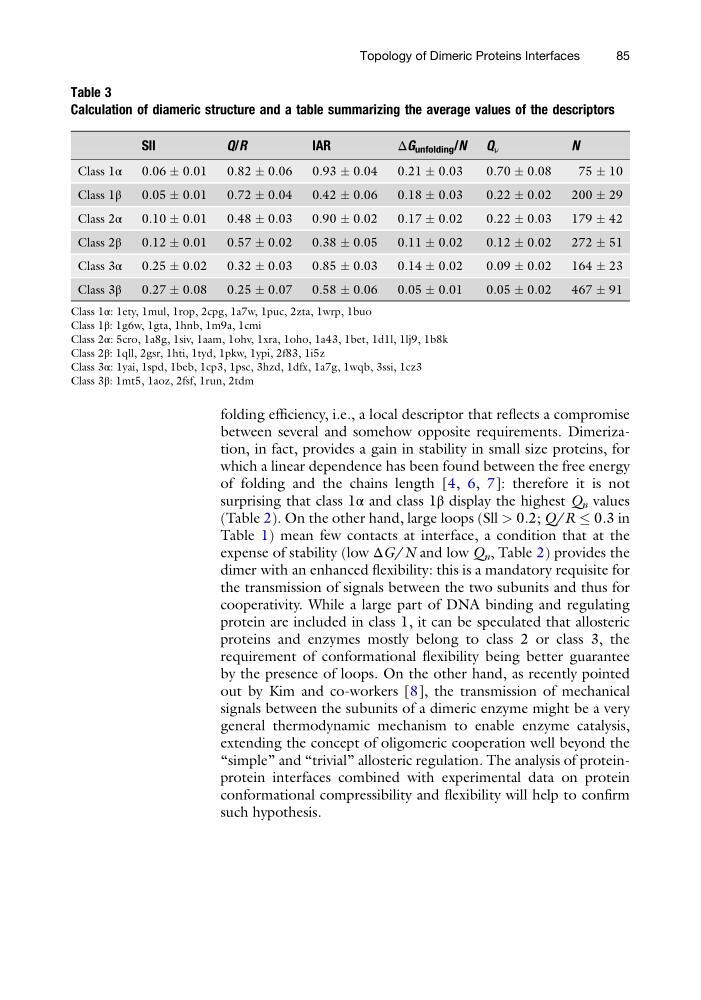
Table 3
Calculation of diameric structure and a table summarizing the average values of the descriptors
Sll
Q/R
IAR
ΔG unfolding /N Q ν
N
Class 1α
0.06 Æ 0.01
0.82 Æ 0.06
0.93 Æ 0.04
0.21 Æ 0.03
0.70 Æ 0.08
75 Æ 10
Class 1β
0.05 Æ 0.01
0.72 Æ 0.04
0.42 Æ 0.06
0.18 Æ 0.03
0.22 Æ 0.02
200 Æ 29
Class 2α
0.10 Æ 0.01
0.48 Æ 0.03
0.90 Æ 0.02
0.17 Æ 0.02
0.22 Æ 0.03
179 Æ 42
Class 2β
0.12 Æ 0.01
0.57 Æ 0.02
0.38 Æ 0.05
0.11 Æ 0.02
0.12 Æ 0.02
272 Æ 51
Class 3α
0.25 Æ 0.02
0.32 Æ 0.03
0.85 Æ 0.03
0.14 Æ 0.02
0.09 Æ 0.02
164 Æ 23
Class 3β
0.27 Æ 0.08
0.25 Æ 0.07
0.58 Æ 0.06
0.05 Æ 0.01
0.05 Æ 0.02
467 Æ 91
Class 1α: 1ety, 1mul, 1rop, 2cpg, 1a7w, 1puc, 2zta, 1wrp, 1buo
Class 1β: 1g6w, 1gta, 1hnb, 1m9a, 1cmi
Class 2α: 5cro, 1a8g, 1siv, 1aam, 1ohv, 1xra, 1oho, 1a43, 1bet, 1d1l, 1lj9, 1b8k
Class 2β: 1qll, 2gsr, 1hti, 1tyd, 1pkw, 1ypi, 2f83, 1i5z
Class 3α: 1yai, 1spd, 1beb, 1cp3, 1psc, 3hzd, 1dfx, 1a7g, 1wqb, 3ssi, 1cz3
Class 3β: 1mt5, 1aoz, 2fsf, 1run, 2tdm
Topology of Dimeric Proteins Interfaces
85
between several and somehow opposite requirements. Dimerization, in fact, provides a gain in stability in small size proteins, for
which a linear dependence has been found between the free energy
of folding and the chains length [4, 6, 7]: therefore it is not
surprising that class 1α and class 1β display the highest Q n values
(Table 2). On the other hand, large loops (Sll > 0.2; Q/R 0.3 in
Table 1) mean few contacts at interface, a condition that at the
expense of stability (low ΔG/N and low Q n , Table 2) provides the
dimer with an enhanced flexibility: this is a mandatory requisite for
the transmission of signals between the two subunits and thus for
cooperativity. While a large part of DNA binding and regulating
protein are included in class 1, it can be speculated that allosteric
proteins and enzymes mostly belong to class 2 or class 3, the
requirement of conformational flexibility being better guarantee
by the presence of loops. On the other hand, as recently pointed
out by Kim and co-workers [8], the transmission of mechanical
signals between the subunits of a dimeric enzyme might be a very
general thermodynamic mechanism to enable enzyme catalysis,
extending the concept of oligomeric cooperation well beyond the
“simple” and “trivial” allosteric regulation. The analysis of proteinprotein interfaces combined with experimental data on protein
conformational compressibility and flexibility will help to confirm
such hypothesis.
Table 3
Calculation of diameric structure and a table summarizing the average values of the descriptors
Sll
Q/R
IAR
ΔG unfolding /N Q ν
N
Class 1α
0.06 Æ 0.01
0.82 Æ 0.06
0.93 Æ 0.04
0.21 Æ 0.03
0.70 Æ 0.08
75 Æ 10
Class 1β
0.05 Æ 0.01
0.72 Æ 0.04
0.42 Æ 0.06
0.18 Æ 0.03
0.22 Æ 0.02
200 Æ 29
Class 2α
0.10 Æ 0.01
0.48 Æ 0.03
0.90 Æ 0.02
0.17 Æ 0.02
0.22 Æ 0.03
179 Æ 42
Class 2β
0.12 Æ 0.01
0.57 Æ 0.02
0.38 Æ 0.05
0.11 Æ 0.02
0.12 Æ 0.02
272 Æ 51
Class 3α
0.25 Æ 0.02
0.32 Æ 0.03
0.85 Æ 0.03
0.14 Æ 0.02
0.09 Æ 0.02
164 Æ 23
Class 3β
0.27 Æ 0.08
0.25 Æ 0.07
0.58 Æ 0.06
0.05 Æ 0.01
0.05 Æ 0.02
467 Æ 91
Class 1α: 1ety, 1mul, 1rop, 2cpg, 1a7w, 1puc, 2zta, 1wrp, 1buo
Class 1β: 1g6w, 1gta, 1hnb, 1m9a, 1cmi
Class 2α: 5cro, 1a8g, 1siv, 1aam, 1ohv, 1xra, 1oho, 1a43, 1bet, 1d1l, 1lj9, 1b8k
Class 2β: 1qll, 2gsr, 1hti, 1tyd, 1pkw, 1ypi, 2f83, 1i5z
Class 3α: 1yai, 1spd, 1beb, 1cp3, 1psc, 3hzd, 1dfx, 1a7g, 1wqb, 3ssi, 1cz3
Class 3β: 1mt5, 1aoz, 2fsf, 1run, 2tdm
Topology of Dimeric Proteins Interfaces
85