

2.2 Definition
and Calculation
of Characteristic
Parameters
The main parameters used in the present classification of dimeric
interfaces are:
l
N, the total number of a.a. in each chain;
l
R, the section (in number of a.a.) of the polypeptide chain
between the first and last residues involved in quaternary interactions. Thus, for monomers R ¼ 0, while in the special case in
which the first and last a.a. of each subunits are lying at the
interface, R N.
l
The Interface A.A. Range, IAR, defined as IAR ¼
R
N , so that
0 < IAR
1. This parameter indicates the percentage of
a.a. directly involved in quaternary interactions.
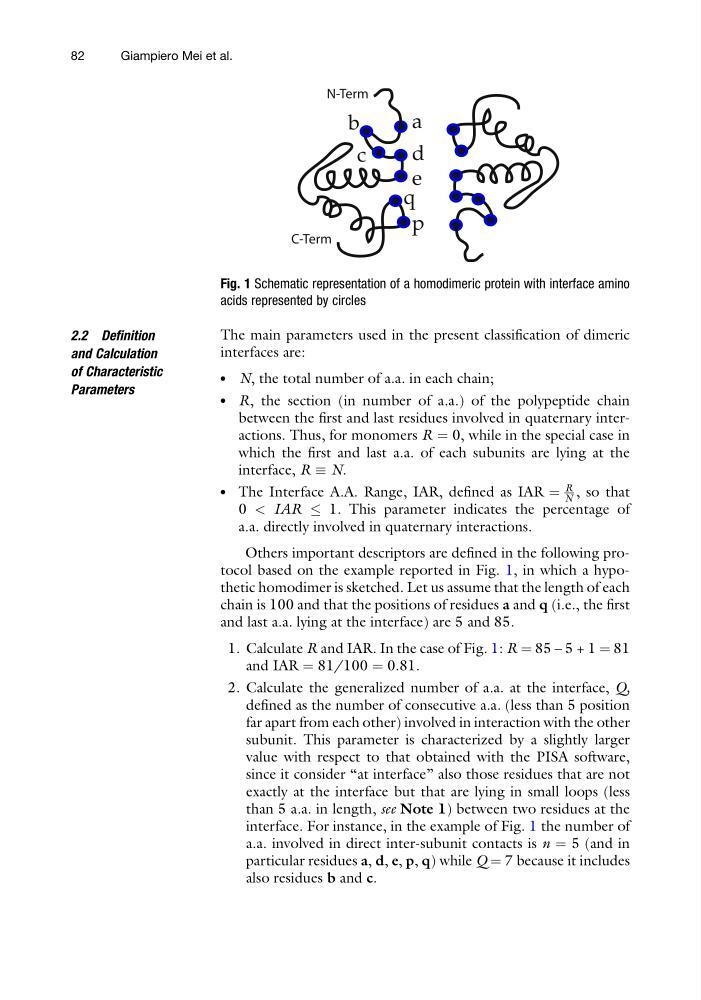
Others important descriptors are defined in the following protocol based on the example reported in Fig. 1, in which a hypothetic homodimer is sketched. Let us assume that the length of each
chain is 100 and that the positions of residues a and q (i.e., the first
and last a.a. lying at the interface) are 5 and 85.
1. Calculate R and IAR. In the case of Fig. 1: R ¼ 85 – 5 + 1 ¼ 81
and IAR ¼ 81/100 ¼ 0.81.
2. Calculate the generalized number of a.a. at the interface, Q,
defined as the number of consecutive a.a. (less than 5 position
far apart from each other) involved in interaction with the other
subunit. This parameter is characterized by a slightly larger
value with respect to that obtained with the PISA software,
since it consider “at interface” also those residues that are not
exactly at the interface but that are lying in small loops (less
than 5 a.a. in length, see Note 1) between two residues at the
interface. For instance, in the example of Fig. 1 the number of
a.a. involved in direct inter-subunit contacts is n ¼ 5 (and in
particular residues a, d, e, p, q) while Q ¼ 7 because it includes
also residues b and c.
a
b
c
e
d
p
q
N-Term
C-Term
Fig. 1 Schematic representation of a homodimeric protein with interface amino
acids represented by circles
82
Giampiero Mei et al.
and Calculation
of Characteristic
Parameters
The main parameters used in the present classification of dimeric
interfaces are:
l
N, the total number of a.a. in each chain;
l
R, the section (in number of a.a.) of the polypeptide chain
between the first and last residues involved in quaternary interactions. Thus, for monomers R ¼ 0, while in the special case in
which the first and last a.a. of each subunits are lying at the
interface, R N.
l
The Interface A.A. Range, IAR, defined as IAR ¼
R
N , so that
0 < IAR
1. This parameter indicates the percentage of
a.a. directly involved in quaternary interactions.
Others important descriptors are defined in the following protocol based on the example reported in Fig. 1, in which a hypothetic homodimer is sketched. Let us assume that the length of each
chain is 100 and that the positions of residues a and q (i.e., the first
and last a.a. lying at the interface) are 5 and 85.
1. Calculate R and IAR. In the case of Fig. 1: R ¼ 85 – 5 + 1 ¼ 81
and IAR ¼ 81/100 ¼ 0.81.
2. Calculate the generalized number of a.a. at the interface, Q,
defined as the number of consecutive a.a. (less than 5 position
far apart from each other) involved in interaction with the other
subunit. This parameter is characterized by a slightly larger
value with respect to that obtained with the PISA software,
since it consider “at interface” also those residues that are not
exactly at the interface but that are lying in small loops (less
than 5 a.a. in length, see Note 1) between two residues at the
interface. For instance, in the example of Fig. 1 the number of
a.a. involved in direct inter-subunit contacts is n ¼ 5 (and in
particular residues a, d, e, p, q) while Q ¼ 7 because it includes
also residues b and c.
a
b
c
e
d
p
q
N-Term
C-Term
Fig. 1 Schematic representation of a homodimeric protein with interface amino
acids represented by circles
82
Giampiero Mei et al.