

here and will appear in forthcoming papers. To predict if A and B
are in rigidity-transmission communication we apply the following
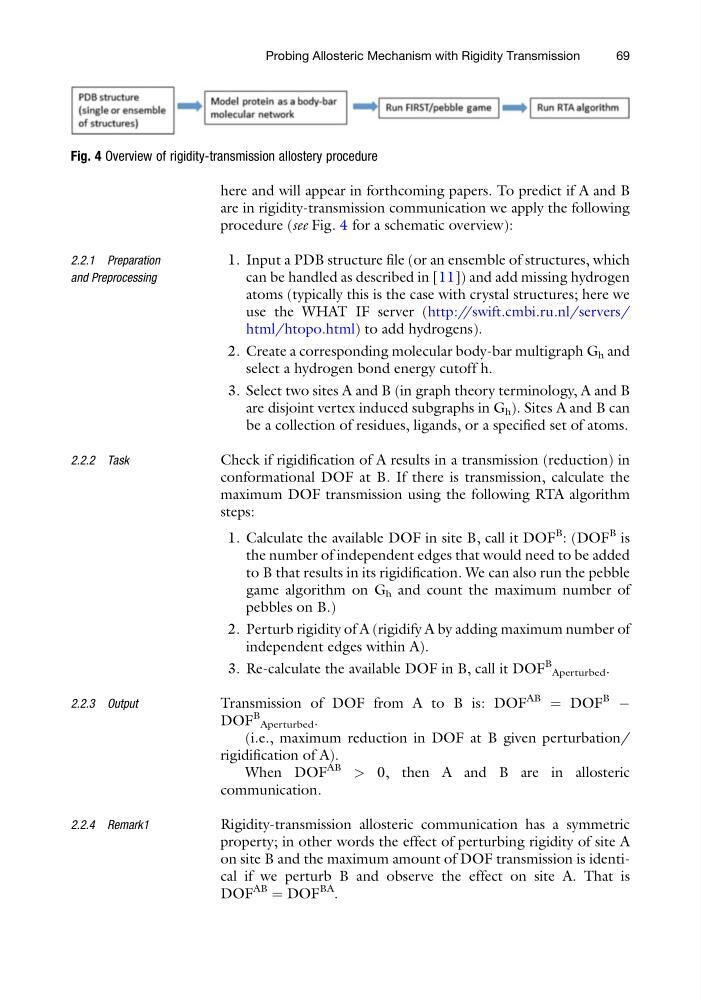
procedure (see Fig. 4 for a schematic overview):
2.2.1 Preparation
and Preprocessing
1. Input a PDB structure file (or an ensemble of structures, which
can be handled as described in [11]) and add missing hydrogen
atoms (typically this is the case with crystal structures; here we
use the WHAT IF server (http://swift.cmbi.ru.nl/servers/
html/htopo.html) to add hydrogens).
2. Create a corresponding molecular body-bar multigraph G h and
select a hydrogen bond energy cutoff h.
3. Select two sites A and B (in graph theory terminology, A and B
are disjoint vertex induced subgraphs in G h ). Sites A and B can
be a collection of residues, ligands, or a specified set of atoms.
2.2.2 Task
Check if rigidification of A results in a transmission (reduction) in
conformational DOF at B. If there is transmission, calculate the
maximum DOF transmission using the following RTA algorithm
steps:
1. Calculate the available DOF in site B, call it DOF
B
: (DOF
B is
the number of independent edges that would need to be added
to B that results in its rigidification. We can also run the pebble
game algorithm on G h and count the maximum number of
pebbles on B.)
2. Perturb rigidity of A (rigidify A by adding maximum number of
independent edges within A).
3. Re-calculate the available DOF in B, call it DOF
B
Aperturbed .
2.2.3 Output
Transmission of DOF from A to B is: DOF
AB
¼ DOF
B
À
DOF
B
Aperturbed .
(i.e., maximum reduction in DOF at B given perturbation/
rigidification of A).
When DOF
AB
> 0, then A and B are in allosteric
communication.
2.2.4 Remark1
Rigidity-transmission allosteric communication has a symmetric
property; in other words the effect of perturbing rigidity of site A
on site B and the maximum amount of DOF transmission is identical if we perturb B and observe the effect on site A. That is
DOF
AB
¼ DOF
BA
.
Fig. 4 Overview of rigidity-transmission allostery procedure
Probing Allosteric Mechanism with Rigidity Transmission
69
are in rigidity-transmission communication we apply the following
procedure (see Fig. 4 for a schematic overview):
2.2.1 Preparation
and Preprocessing
1. Input a PDB structure file (or an ensemble of structures, which
can be handled as described in [11]) and add missing hydrogen
atoms (typically this is the case with crystal structures; here we
use the WHAT IF server (http://swift.cmbi.ru.nl/servers/
html/htopo.html) to add hydrogens).
2. Create a corresponding molecular body-bar multigraph G h and
select a hydrogen bond energy cutoff h.
3. Select two sites A and B (in graph theory terminology, A and B
are disjoint vertex induced subgraphs in G h ). Sites A and B can
be a collection of residues, ligands, or a specified set of atoms.
2.2.2 Task
Check if rigidification of A results in a transmission (reduction) in
conformational DOF at B. If there is transmission, calculate the
maximum DOF transmission using the following RTA algorithm
steps:
1. Calculate the available DOF in site B, call it DOF
B
: (DOF
B is
the number of independent edges that would need to be added
to B that results in its rigidification. We can also run the pebble
game algorithm on G h and count the maximum number of
pebbles on B.)
2. Perturb rigidity of A (rigidify A by adding maximum number of
independent edges within A).
3. Re-calculate the available DOF in B, call it DOF
B
Aperturbed .
2.2.3 Output
Transmission of DOF from A to B is: DOF
AB
¼ DOF
B
À
DOF
B
Aperturbed .
(i.e., maximum reduction in DOF at B given perturbation/
rigidification of A).
When DOF
AB
> 0, then A and B are in allosteric
communication.
2.2.4 Remark1
Rigidity-transmission allosteric communication has a symmetric
property; in other words the effect of perturbing rigidity of site A
on site B and the maximum amount of DOF transmission is identical if we perturb B and observe the effect on site A. That is
DOF
AB
¼ DOF
BA
.
Fig. 4 Overview of rigidity-transmission allostery procedure
Probing Allosteric Mechanism with Rigidity Transmission
69