

In rigidity-transmission allostery model, once we have added
constraints in site A (up to its rigidification), the effect on B is one
of the following: (1) no-change in DOF is observed at B (i.e., A and
B are not in communication); (2) there is a reduction in DOF at B
but some internal DOF still remain in B, or (3) all internal DOF in
B are removed (i.e., B becomes rigid). The effect of a change in
DOF propagating across the network to reach site B, upon initial
perturbation at site A, forces the second site B to move in a different
conformational space than prior to perturbation. In terms of the
conformational ensemble view of protein structure, conformational
selection, and energy landscapes, presence of rigidity-transmission
allostery will lead to a change in shape, stabilizing certain conformations and biasing (restricting) of distribution of states that can be
sampled within the conformational ensemble [29].
We now describe the RTA procedure for allostery computation
in proteins.
2.2 RigidityTransmission Allostery
(RTA) Analysis
For simplicity, we assume we are given two sites A and B on the
protein of interest. It is possible that only one site is known (i.e.,
active site) and we test all other potential sites for allosteric communication with the active site; these details will not be discussed
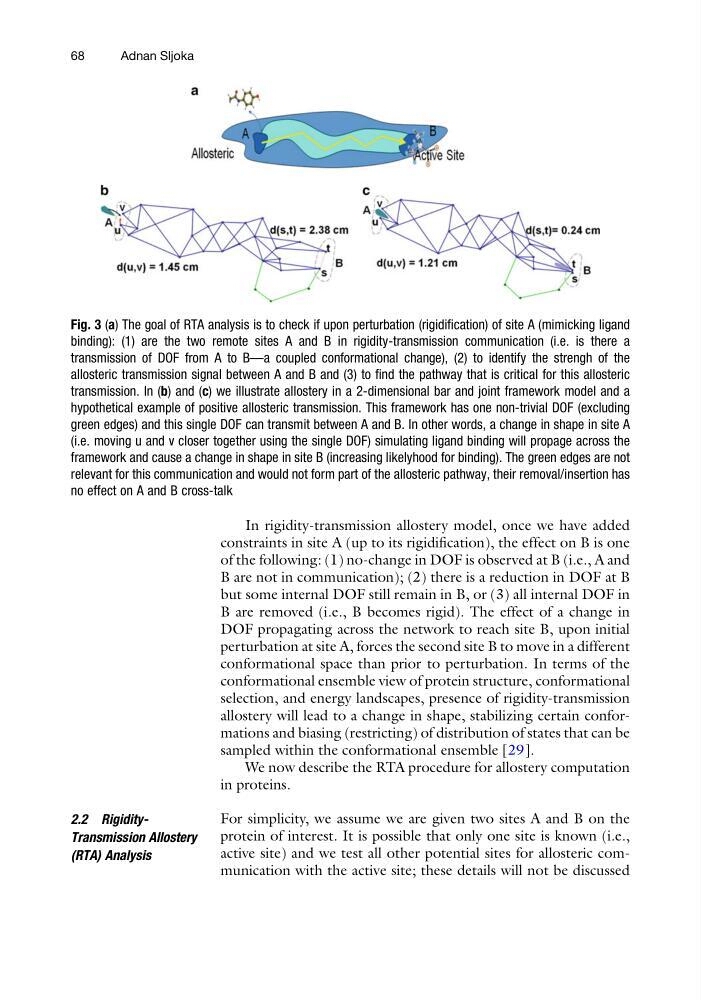
Fig. 3 (a) The goal of RTA analysis is to check if upon perturbation (rigidification) of site A (mimicking ligand
binding): (1) are the two remote sites A and B in rigidity-transmission communication (i.e. is there a
transmission of DOF from A to B—a coupled conformational change), (2) to identify the strengh of the
allosteric transmission signal between A and B and (3) to find the pathway that is critical for this allosteric
transmission. In (b) and (c) we illustrate allostery in a 2-dimensional bar and joint framework model and a
hypothetical example of positive allosteric transmission. This framework has one non-trivial DOF (excluding
green edges) and this single DOF can transmit between A and B. In other words, a change in shape in site A
(i.e. moving u and v closer together using the single DOF) simulating ligand binding will propage across the
framework and cause a change in shape in site B (increasing likelyhood for binding). The green edges are not
relevant for this communication and would not form part of the allosteric pathway, their removal/insertion has
no effect on A and B cross-talk
68
Adnan Sljoka
constraints in site A (up to its rigidification), the effect on B is one
of the following: (1) no-change in DOF is observed at B (i.e., A and
B are not in communication); (2) there is a reduction in DOF at B
but some internal DOF still remain in B, or (3) all internal DOF in
B are removed (i.e., B becomes rigid). The effect of a change in
DOF propagating across the network to reach site B, upon initial
perturbation at site A, forces the second site B to move in a different
conformational space than prior to perturbation. In terms of the
conformational ensemble view of protein structure, conformational
selection, and energy landscapes, presence of rigidity-transmission
allostery will lead to a change in shape, stabilizing certain conformations and biasing (restricting) of distribution of states that can be
sampled within the conformational ensemble [29].
We now describe the RTA procedure for allostery computation
in proteins.
2.2 RigidityTransmission Allostery
(RTA) Analysis
For simplicity, we assume we are given two sites A and B on the
protein of interest. It is possible that only one site is known (i.e.,
active site) and we test all other potential sites for allosteric communication with the active site; these details will not be discussed
Fig. 3 (a) The goal of RTA analysis is to check if upon perturbation (rigidification) of site A (mimicking ligand
binding): (1) are the two remote sites A and B in rigidity-transmission communication (i.e. is there a
transmission of DOF from A to B—a coupled conformational change), (2) to identify the strengh of the
allosteric transmission signal between A and B and (3) to find the pathway that is critical for this allosteric
transmission. In (b) and (c) we illustrate allostery in a 2-dimensional bar and joint framework model and a
hypothetical example of positive allosteric transmission. This framework has one non-trivial DOF (excluding
green edges) and this single DOF can transmit between A and B. In other words, a change in shape in site A
(i.e. moving u and v closer together using the single DOF) simulating ligand binding will propage across the
framework and cause a change in shape in site B (increasing likelyhood for binding). The green edges are not
relevant for this communication and would not form part of the allosteric pathway, their removal/insertion has
no effect on A and B cross-talk
68
Adnan Sljoka