

the protein. There are also indications that at least some of the rate
constants may be related to protein structural fluctuations, and can
thus be obtained from relatively short MD simulations. This was
originally pointed out in a computational study of energy flow in
the villin headpiece subdomain [23], HP36, and we have here
presented newer results exploring scaling relations between hydrogen bond dynamics and energy transfer along hydrogen bonds in
apomyoglobin.
Future work will explore connections between dynamics of
other kinds of nonbonded contacts and energy flow between
them. For instance, work on apomyoglobin indicates that ionic
contacts, which are less localized, exhibit much greater variability
than hydrogen bonds [143]. Moreover, less localized interactions
will couple dynamically to the hydration layer surrounding a protein. Protein and water dynamics are coupled, as revealed, e.g., by
THz measurements and molecular simulations [146–171]. Fluctuations of contacts closer to the surface will undoubtedly be influenced by the water dynamics as well. Despite these complicating
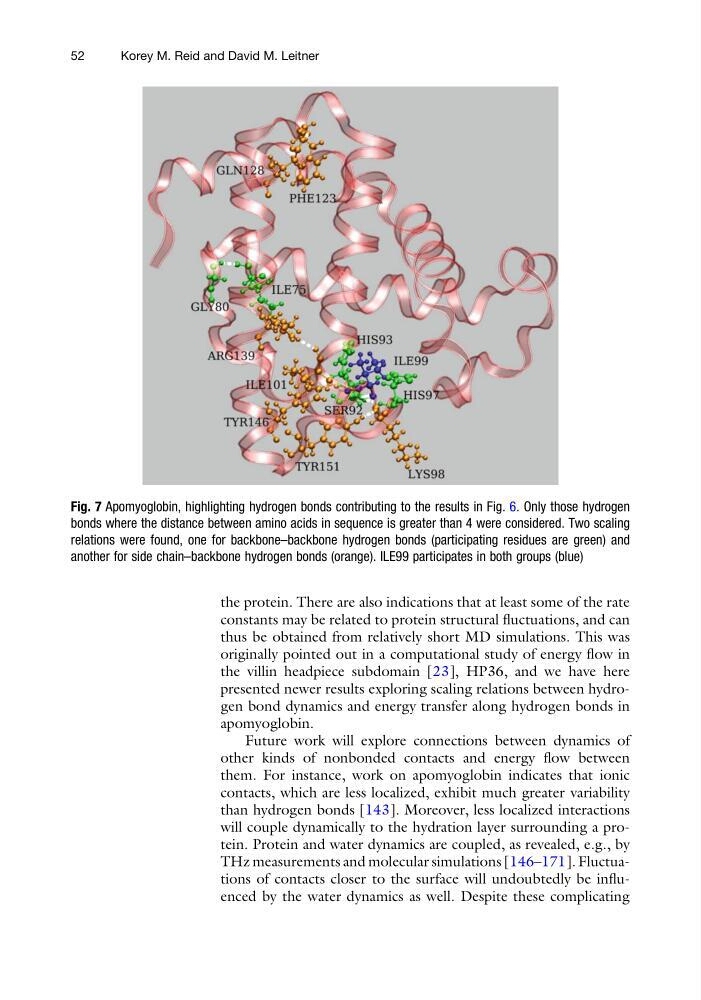
Fig. 7 Apomyoglobin, highlighting hydrogen bonds contributing to the results in Fig. 6. Only those hydrogen
bonds where the distance between amino acids in sequence is greater than 4 were considered. Two scaling
relations were found, one for backbone–backbone hydrogen bonds (participating residues are green) and
another for side chain–backbone hydrogen bonds (orange). ILE99 participates in both groups (blue)
52
Korey M. Reid and David M. Leitner
constants may be related to protein structural fluctuations, and can
thus be obtained from relatively short MD simulations. This was
originally pointed out in a computational study of energy flow in
the villin headpiece subdomain [23], HP36, and we have here
presented newer results exploring scaling relations between hydrogen bond dynamics and energy transfer along hydrogen bonds in
apomyoglobin.
Future work will explore connections between dynamics of
other kinds of nonbonded contacts and energy flow between
them. For instance, work on apomyoglobin indicates that ionic
contacts, which are less localized, exhibit much greater variability
than hydrogen bonds [143]. Moreover, less localized interactions
will couple dynamically to the hydration layer surrounding a protein. Protein and water dynamics are coupled, as revealed, e.g., by
THz measurements and molecular simulations [146–171]. Fluctuations of contacts closer to the surface will undoubtedly be influenced by the water dynamics as well. Despite these complicating
Fig. 7 Apomyoglobin, highlighting hydrogen bonds contributing to the results in Fig. 6. Only those hydrogen
bonds where the distance between amino acids in sequence is greater than 4 were considered. Two scaling
relations were found, one for backbone–backbone hydrogen bonds (participating residues are green) and
another for side chain–backbone hydrogen bonds (orange). ILE99 participates in both groups (blue)
52
Korey M. Reid and David M. Leitner