

the cluster of water molecules at the interface, which is smaller
(11 molecules) than in the unliganded protein (17 molecules).
The red NBN consists of the heme, His69, Leu73, Leu77, Ala98,
His101, and Arg104, as well as a few residues from the E and F
helix. At the longer time cutoff (lower right) there is again only one
NBN spanning both globules (purple), which includes the Lys30Asp89 salt bridge and water cluster, as well as the lower portion of
the B helix, the upper part of the D helix, and parts of the E and F
helices, including Phe97. The red network, which includes the
heme, grows only slightly beyond the NBN obtained with the
shorter cutoff. Three other NBNs appear each confined to one
globule. The yellow and blue NBNs partially overlap the NBNs of
the unliganded protein of the same color. Another network (silver)
does not overlap NBNs of deoxy HbI. The yellow NBN includes
the lower part of the B helix, the upper part of the E helix, and the
upper part of the H helix. The blue NBN includes the upper
portion of the B helix, the G helix, and the lower part of the H
helix. The silver NBN includes parts of the B, C, and E helices.
These NBNs constitute groups of residues that respond to local
strain via nonbonded interactions. Both unliganded and liganded
states contain an interglobule network with the Lys30-Asp89 salt
bridge at its core, while the unliganded protein also contains an
interglobule network that includes the hemes and nearby residues
bridged by the cluster of water molecules at the interface. For the
unliganded protein the more immediate response of the water
cluster to local strain at each heme is consistent with expulsion of
water molecules that accompanies the allosteric transition to the
liganded state, as discussed further below.
Of course, the more complete network also includes the main
chain, along which energy transport occurs readily. A more general
analysis must therefore include all interactions. One means to
quantify information flow along the entire network is calculation
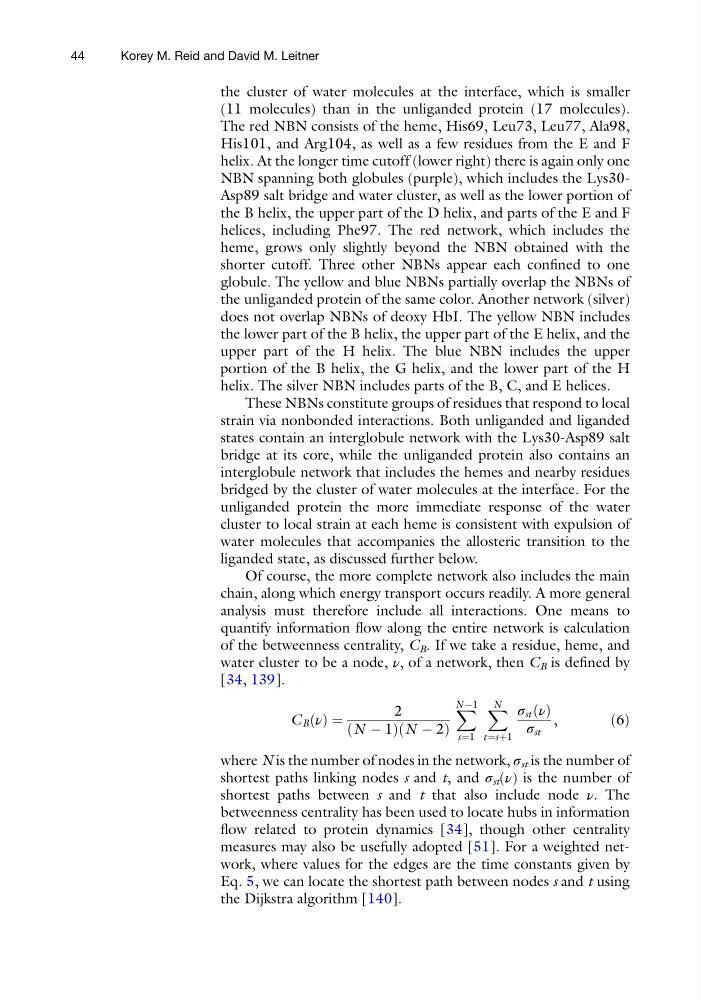
of the betweenness centrality, C B . If we take a residue, heme, and
water cluster to be a node, ν, of a network, then C B is defined by
[34, 139].
C B ν
ð Þ ¼
2
N À 1
ð
Þ N À 2
ð
Þ
X
N À1
s¼1
X N
t¼sþ1
σ st ν
ð Þ
σ st
,
ð6Þ
where N is the number of nodes in the network, σ st is the number of
shortest paths linking nodes s and t, and σ st (ν) is the number of
shortest paths between s and t that also include node ν. The
betweenness centrality has been used to locate hubs in information
flow related to protein dynamics [34], though other centrality
measures may also be usefully adopted [51]. For a weighted network, where values for the edges are the time constants given by
Eq. 5, we can locate the shortest path between nodes s and t using
the Dijkstra algorithm [140].
44
Korey M. Reid and David M. Leitner
(11 molecules) than in the unliganded protein (17 molecules).
The red NBN consists of the heme, His69, Leu73, Leu77, Ala98,
His101, and Arg104, as well as a few residues from the E and F
helix. At the longer time cutoff (lower right) there is again only one
NBN spanning both globules (purple), which includes the Lys30Asp89 salt bridge and water cluster, as well as the lower portion of
the B helix, the upper part of the D helix, and parts of the E and F
helices, including Phe97. The red network, which includes the
heme, grows only slightly beyond the NBN obtained with the
shorter cutoff. Three other NBNs appear each confined to one
globule. The yellow and blue NBNs partially overlap the NBNs of
the unliganded protein of the same color. Another network (silver)
does not overlap NBNs of deoxy HbI. The yellow NBN includes
the lower part of the B helix, the upper part of the E helix, and the
upper part of the H helix. The blue NBN includes the upper
portion of the B helix, the G helix, and the lower part of the H
helix. The silver NBN includes parts of the B, C, and E helices.
These NBNs constitute groups of residues that respond to local
strain via nonbonded interactions. Both unliganded and liganded
states contain an interglobule network with the Lys30-Asp89 salt
bridge at its core, while the unliganded protein also contains an
interglobule network that includes the hemes and nearby residues
bridged by the cluster of water molecules at the interface. For the
unliganded protein the more immediate response of the water
cluster to local strain at each heme is consistent with expulsion of
water molecules that accompanies the allosteric transition to the
liganded state, as discussed further below.
Of course, the more complete network also includes the main
chain, along which energy transport occurs readily. A more general
analysis must therefore include all interactions. One means to
quantify information flow along the entire network is calculation
of the betweenness centrality, C B . If we take a residue, heme, and
water cluster to be a node, ν, of a network, then C B is defined by
[34, 139].
C B ν
ð Þ ¼
2
N À 1
ð
Þ N À 2
ð
Þ
X
N À1
s¼1
X N
t¼sþ1
σ st ν
ð Þ
σ st
,
ð6Þ
where N is the number of nodes in the network, σ st is the number of
shortest paths linking nodes s and t, and σ st (ν) is the number of
shortest paths between s and t that also include node ν. The
betweenness centrality has been used to locate hubs in information
flow related to protein dynamics [34], though other centrality
measures may also be usefully adopted [51]. For a weighted network, where values for the edges are the time constants given by
Eq. 5, we can locate the shortest path between nodes s and t using
the Dijkstra algorithm [140].
44
Korey M. Reid and David M. Leitner