

D
AA0
f
g
α
is the mode-dependent energy diffusivity between
regions A and A
0 . For a local thermal diffusion coefficient to be
well defined we need to assume that thermalization occurs within
each residue. Thermalization in molecules has been the focus of
considerable attention [91–119], in part because it mediates chemical reaction kinetics [120–131], and it appears to largely hold on
the scale of peptides [132–138]. In practice a region, A, is a residue
or a cofactor such as a heme, or perhaps a cluster of water molecules
in the protein. We note that when A and A
0 span the molecule,
Eq. 2 gives the mode diffusivity [90], from which the coefficient of
thermal conductivity, κ, can be expressed for the whole system,
κ ¼
P
α
C α D α , where C α is the heat capacity per unit volume of the
molecule (V ¼ 1, as it is not relevant below) for mode α, given by
C α ¼ k B βℏω α
ð
Þ
2
e
βℏω α
e βℏω α À 1
ð
Þ
2
:
ð3Þ
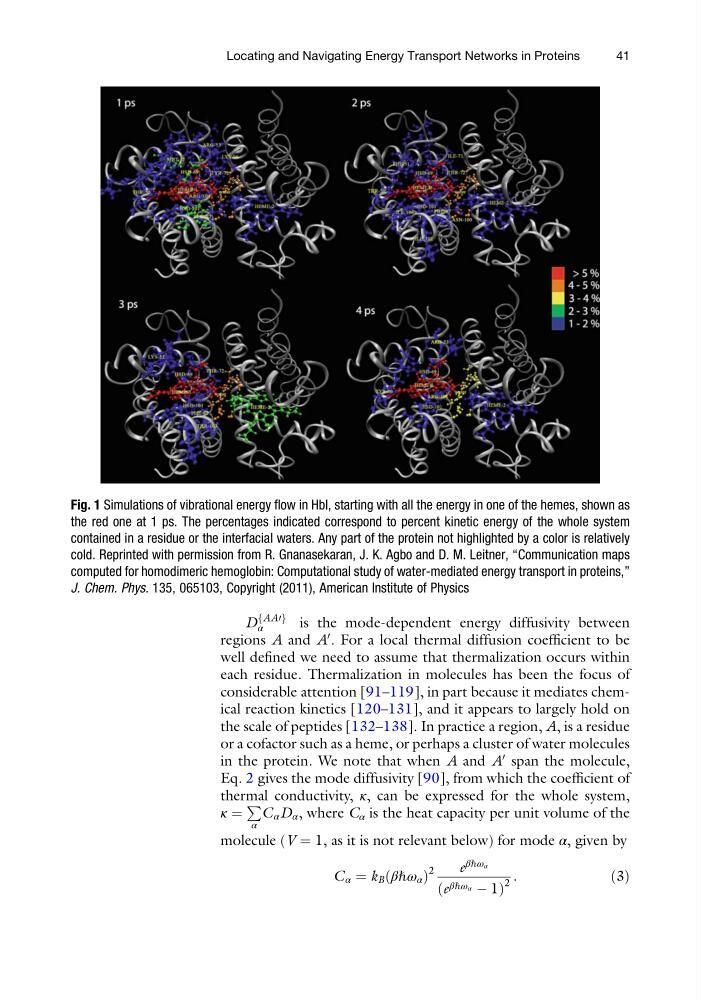
Fig. 1 Simulations of vibrational energy flow in HbI, starting with all the energy in one of the hemes, shown as
the red one at 1 ps. The percentages indicated correspond to percent kinetic energy of the whole system
contained in a residue or the interfacial waters. Any part of the protein not highlighted by a color is relatively
cold. Reprinted with permission from R. Gnanasekaran, J. K. Agbo and D. M. Leitner, “Communication maps
computed for homodimeric hemoglobin: Computational study of water-mediated energy transport in proteins,”
J. Chem. Phys. 135, 065103, Copyright (2011), American Institute of Physics
Locating and Navigating Energy Transport Networks in Proteins
41
AA0
f
g
α
is the mode-dependent energy diffusivity between
regions A and A
0 . For a local thermal diffusion coefficient to be
well defined we need to assume that thermalization occurs within
each residue. Thermalization in molecules has been the focus of
considerable attention [91–119], in part because it mediates chemical reaction kinetics [120–131], and it appears to largely hold on
the scale of peptides [132–138]. In practice a region, A, is a residue
or a cofactor such as a heme, or perhaps a cluster of water molecules
in the protein. We note that when A and A
0 span the molecule,
Eq. 2 gives the mode diffusivity [90], from which the coefficient of
thermal conductivity, κ, can be expressed for the whole system,
κ ¼
P
α
C α D α , where C α is the heat capacity per unit volume of the
molecule (V ¼ 1, as it is not relevant below) for mode α, given by
C α ¼ k B βℏω α
ð
Þ
2
e
βℏω α
e βℏω α À 1
ð
Þ
2
:
ð3Þ
Fig. 1 Simulations of vibrational energy flow in HbI, starting with all the energy in one of the hemes, shown as
the red one at 1 ps. The percentages indicated correspond to percent kinetic energy of the whole system
contained in a residue or the interfacial waters. Any part of the protein not highlighted by a color is relatively
cold. Reprinted with permission from R. Gnanasekaran, J. K. Agbo and D. M. Leitner, “Communication maps
computed for homodimeric hemoglobin: Computational study of water-mediated energy transport in proteins,”
J. Chem. Phys. 135, 065103, Copyright (2011), American Institute of Physics
Locating and Navigating Energy Transport Networks in Proteins
41