

3.2 Identifying Key
Sites
for Communications
3.2.1 Markov Stochastic
Model
The Markov stochastic model coupled with GNM was used for
exploring the signal transductions of perturbations in proteins.
The affinity matrix A describes the interactions between residue
pairs connected in GNM; its generic element a ij is defined as:
a ij ¼
N ij
ffiffiffiffiffiffiffiffiffiffiffiffiffi ffi
N i N j
p
ð4Þ
where N ij is the number of atom-atom contacts between residues
i and j based on a cutoff distance of 4 A ˚ , N i is the number of side
chain atoms in residue i. The density of contacts at each node i is
given by:
d i ¼
X N
j ¼1
a ij
ð5Þ
The Markov transition matrix M, whose element m ij ¼ d
À1
j a ij
determines the conditional probability of transmitting a signal from
residue j to residue i in one time step. Accordingly, the hitting time
for the transfer of a signal from residue j to i is given by
H i, j
ð Þ ¼
X N
k¼1
Γ
À1
Â
Ã
kj
À Γ
À1
Â
Ã
ij
À Γ
À1
Â
Ã
ki
À Γ
À1
Â
Ã
ii
n
o
˜
nd k ð6Þ
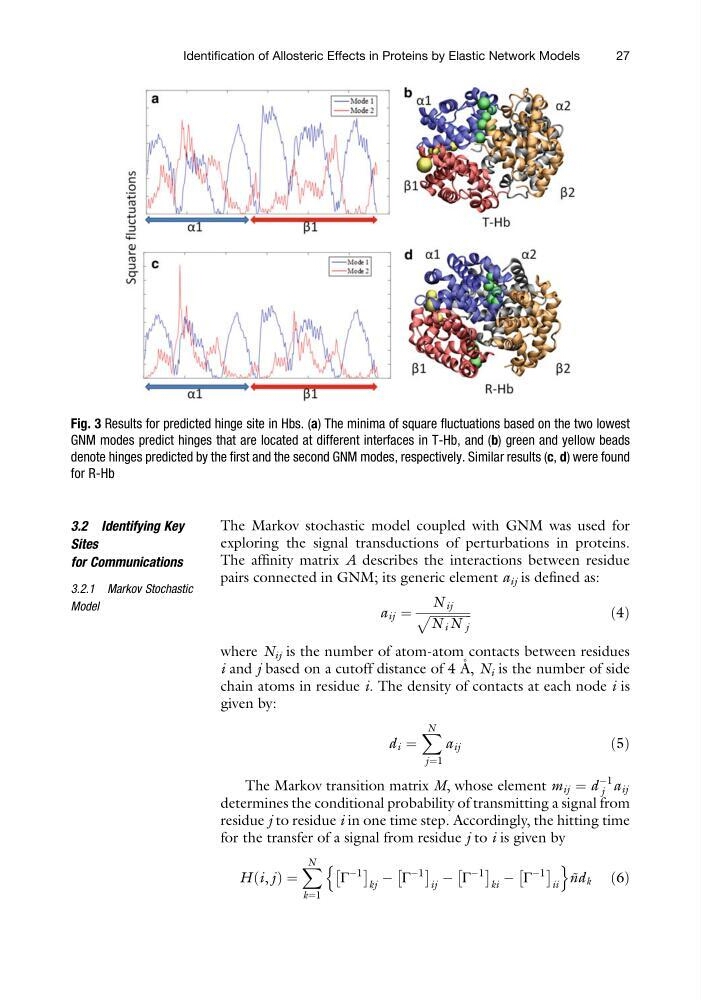
Fig. 3 Results for predicted hinge site in Hbs. (a) The minima of square fluctuations based on the two lowest
GNM modes predict hinges that are located at different interfaces in T-Hb, and (b) green and yellow beads
denote hinges predicted by the first and the second GNM modes, respectively. Similar results (c, d) were found
for R-Hb
Identification of Allosteric Effects in Proteins by Elastic Network Models
27
Sites
for Communications
3.2.1 Markov Stochastic
Model
The Markov stochastic model coupled with GNM was used for
exploring the signal transductions of perturbations in proteins.
The affinity matrix A describes the interactions between residue
pairs connected in GNM; its generic element a ij is defined as:
a ij ¼
N ij
ffiffiffiffiffiffiffiffiffiffiffiffiffi ffi
N i N j
p
ð4Þ
where N ij is the number of atom-atom contacts between residues
i and j based on a cutoff distance of 4 A ˚ , N i is the number of side
chain atoms in residue i. The density of contacts at each node i is
given by:
d i ¼
X N
j ¼1
a ij
ð5Þ
The Markov transition matrix M, whose element m ij ¼ d
À1
j a ij
determines the conditional probability of transmitting a signal from
residue j to residue i in one time step. Accordingly, the hitting time
for the transfer of a signal from residue j to i is given by
H i, j
ð Þ ¼
X N
k¼1
Γ
À1
Â
Ã
kj
À Γ
À1
Â
Ã
ij
À Γ
À1
Â
Ã
ki
À Γ
À1
Â
Ã
ii
n
o
˜
nd k ð6Þ
Fig. 3 Results for predicted hinge site in Hbs. (a) The minima of square fluctuations based on the two lowest
GNM modes predict hinges that are located at different interfaces in T-Hb, and (b) green and yellow beads
denote hinges predicted by the first and the second GNM modes, respectively. Similar results (c, d) were found
for R-Hb
Identification of Allosteric Effects in Proteins by Elastic Network Models
27