

3 Methods
Normal mode analysis has become a gold standard for studying
protein dynamics and allosteric regulation of protein systems. Here,
two ENMs are employed to perform normal mode analysis.
See Note 2 and Note 3 for their main advantages and limitations.
3.1 Predicting Hinge
Sites by GNM
3.1.1 Theory of GNM
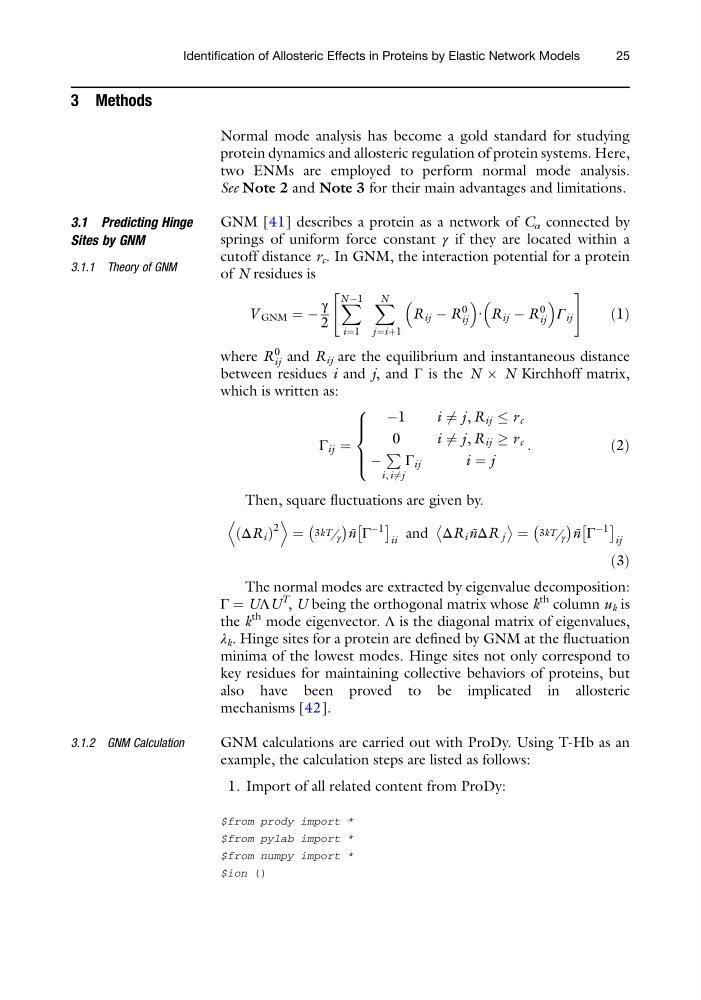
GNM [41] describes a protein as a network of C α connected by
springs of uniform force constant γ if they are located within a
cutoff distance r c . In GNM, the interaction potential for a protein
of N residues is
V GNM ¼ À
γ
2
X
N À1
i¼1
X N
j ¼iþ1
R ij À R
0
ij
∙ R ij À R
0
ij
Γ ij
"
#
ð1Þ
where R
0
ij and R ij are the equilibrium and instantaneous distance
between residues i and j, and Г is the N Â N Kirchhoff matrix,
which is written as:
Γ ij ¼
À1
i 6 ¼ j , R ij r c
0
i 6 ¼ j , R ij ! r c
À
P
i, i6 ¼j
Γ ij
i ¼ j
8
> > <
> > :
:
ð2Þ
Then, square fluctuations are given by.
ΔR i
ð
Þ
2
D
E
¼ 3kT = γ
À
Á ˜
n Γ
À1
Â
Ã
ii
and ΔR i ˜
nΔR j
¼ 3kT = γ
À
Á ˜
n Γ
À1
Â
Ã
ij
ð3Þ
The normal modes are extracted by eigenvalue decomposition:
Γ ¼ UΛU
T
, U being the orthogonal matrix whose k
th column u k is
the k
th mode eigenvector. Λ is the diagonal matrix of eigenvalues,
λ k . Hinge sites for a protein are defined by GNM at the fluctuation
minima of the lowest modes. Hinge sites not only correspond to
key residues for maintaining collective behaviors of proteins, but
also have been proved to be implicated in allosteric
mechanisms [42].
3.1.2 GNM Calculation
GNM calculations are carried out with ProDy. Using T-Hb as an
example, the calculation steps are listed as follows:
1. Import of all related content from ProDy:
$from prody import *
$from pylab import *
$from numpy import *
$ion ()
Identification of Allosteric Effects in Proteins by Elastic Network Models
25
Normal mode analysis has become a gold standard for studying
protein dynamics and allosteric regulation of protein systems. Here,
two ENMs are employed to perform normal mode analysis.
See Note 2 and Note 3 for their main advantages and limitations.
3.1 Predicting Hinge
Sites by GNM
3.1.1 Theory of GNM
GNM [41] describes a protein as a network of C α connected by
springs of uniform force constant γ if they are located within a
cutoff distance r c . In GNM, the interaction potential for a protein
of N residues is
V GNM ¼ À
γ
2
X
N À1
i¼1
X N
j ¼iþ1
R ij À R
0
ij
∙ R ij À R
0
ij
Γ ij
"
#
ð1Þ
where R
0
ij and R ij are the equilibrium and instantaneous distance
between residues i and j, and Г is the N Â N Kirchhoff matrix,
which is written as:
Γ ij ¼
À1
i 6 ¼ j , R ij r c
0
i 6 ¼ j , R ij ! r c
À
P
i, i6 ¼j
Γ ij
i ¼ j
8
> > <
> > :
:
ð2Þ
Then, square fluctuations are given by.
ΔR i
ð
Þ
2
D
E
¼ 3kT = γ
À
Á ˜
n Γ
À1
Â
Ã
ii
and ΔR i ˜
nΔR j
¼ 3kT = γ
À
Á ˜
n Γ
À1
Â
Ã
ij
ð3Þ
The normal modes are extracted by eigenvalue decomposition:
Γ ¼ UΛU
T
, U being the orthogonal matrix whose k
th column u k is
the k
th mode eigenvector. Λ is the diagonal matrix of eigenvalues,
λ k . Hinge sites for a protein are defined by GNM at the fluctuation
minima of the lowest modes. Hinge sites not only correspond to
key residues for maintaining collective behaviors of proteins, but
also have been proved to be implicated in allosteric
mechanisms [42].
3.1.2 GNM Calculation
GNM calculations are carried out with ProDy. Using T-Hb as an
example, the calculation steps are listed as follows:
1. Import of all related content from ProDy:
$from prody import *
$from pylab import *
$from numpy import *
$ion ()
Identification of Allosteric Effects in Proteins by Elastic Network Models
25