

It should be noted that introducing a Markovian process into
coarse-grained models (such as GNM) has offered opportunities to
assess signal propagation in proteins. In 2006 [34], Bahar’s group
proposed a novel GNM approach to elucidate allosteric communication pathways, by coupling Markov stochastic model based on
information theory and spectral graph methods. In this framework,
hitting and commute times were defined based on GNM fluctuations to measure the communication abilities of residues [35]. The
relationship between allosteric communication pathways and the
intrinsic structural dynamics of proteins was described by their
coupling and provides a new avenue for further examination of
protein allostery from local dynamical changes to global motions
[36]. Applying this method has found that metal-binding sites are
designed to achieve allosteric signaling properties [37]. In our
recent work, we have shown the ability of using GNM works with
Markovian model to study DNMT3A and highlighted the key role
of dimer interface in allosteric communication [38].
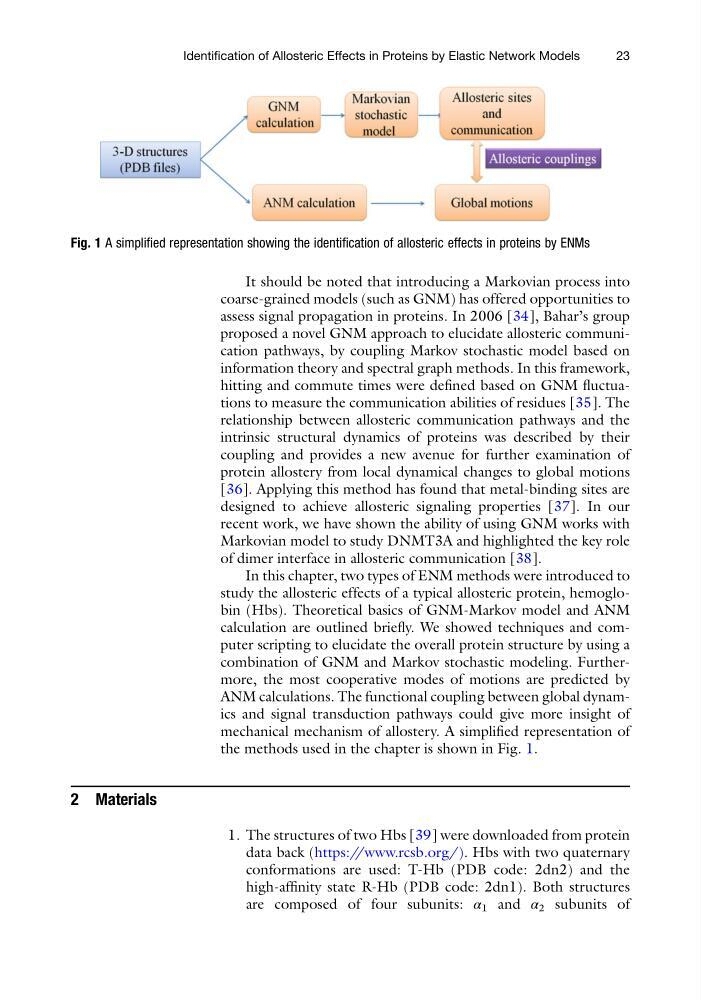
In this chapter, two types of ENM methods were introduced to
study the allosteric effects of a typical allosteric protein, hemoglobin (Hbs). Theoretical basics of GNM-Markov model and ANM
calculation are outlined briefly. We showed techniques and computer scripting to elucidate the overall protein structure by using a
combination of GNM and Markov stochastic modeling. Furthermore, the most cooperative modes of motions are predicted by
ANM calculations. The functional coupling between global dynamics and signal transduction pathways could give more insight of
mechanical mechanism of allostery. A simplified representation of
the methods used in the chapter is shown in Fig. 1.
2 Materials
1. The structures of two Hbs [39] were downloaded from protein
data back (https://www.rcsb.org/). Hbs with two quaternary
conformations are used: T-Hb (PDB code: 2dn2) and the
high-affinity state R-Hb (PDB code: 2dn1). Both structures
are composed of four subunits: α 1 and α 2 subunits of
Fig. 1 A simplified representation showing the identification of allosteric effects in proteins by ENMs
Identification of Allosteric Effects in Proteins by Elastic Network Models
23
coarse-grained models (such as GNM) has offered opportunities to
assess signal propagation in proteins. In 2006 [34], Bahar’s group
proposed a novel GNM approach to elucidate allosteric communication pathways, by coupling Markov stochastic model based on
information theory and spectral graph methods. In this framework,
hitting and commute times were defined based on GNM fluctuations to measure the communication abilities of residues [35]. The
relationship between allosteric communication pathways and the
intrinsic structural dynamics of proteins was described by their
coupling and provides a new avenue for further examination of
protein allostery from local dynamical changes to global motions
[36]. Applying this method has found that metal-binding sites are
designed to achieve allosteric signaling properties [37]. In our
recent work, we have shown the ability of using GNM works with
Markovian model to study DNMT3A and highlighted the key role
of dimer interface in allosteric communication [38].
In this chapter, two types of ENM methods were introduced to
study the allosteric effects of a typical allosteric protein, hemoglobin (Hbs). Theoretical basics of GNM-Markov model and ANM
calculation are outlined briefly. We showed techniques and computer scripting to elucidate the overall protein structure by using a
combination of GNM and Markov stochastic modeling. Furthermore, the most cooperative modes of motions are predicted by
ANM calculations. The functional coupling between global dynamics and signal transduction pathways could give more insight of
mechanical mechanism of allostery. A simplified representation of
the methods used in the chapter is shown in Fig. 1.
2 Materials
1. The structures of two Hbs [39] were downloaded from protein
data back (https://www.rcsb.org/). Hbs with two quaternary
conformations are used: T-Hb (PDB code: 2dn2) and the
high-affinity state R-Hb (PDB code: 2dn1). Both structures
are composed of four subunits: α 1 and α 2 subunits of
Fig. 1 A simplified representation showing the identification of allosteric effects in proteins by ENMs
Identification of Allosteric Effects in Proteins by Elastic Network Models
23