

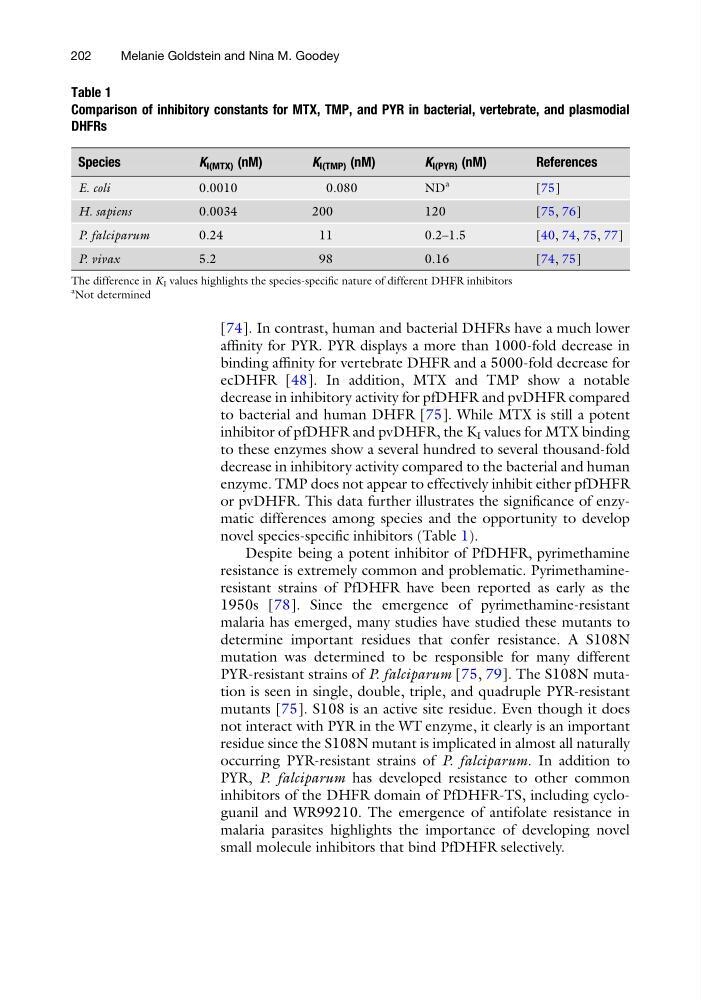
[74]. In contrast, human and bacterial DHFRs have a much lower
affinity for PYR. PYR displays a more than 1000-fold decrease in
binding affinity for vertebrate DHFR and a 5000-fold decrease for
ecDHFR [48]. In addition, MTX and TMP show a notable
decrease in inhibitory activity for pfDHFR and pvDHFR compared
to bacterial and human DHFR [75]. While MTX is still a potent
inhibitor of pfDHFR and pvDHFR, the K I values for MTX binding
to these enzymes show a several hundred to several thousand-fold
decrease in inhibitory activity compared to the bacterial and human
enzyme. TMP does not appear to effectively inhibit either pfDHFR
or pvDHFR. This data further illustrates the significance of enzymatic differences among species and the opportunity to develop
novel species-specific inhibitors (Table 1).
Despite being a potent inhibitor of PfDHFR, pyrimethamine
resistance is extremely common and problematic. Pyrimethamineresistant strains of PfDHFR have been reported as early as the
1950s [78]. Since the emergence of pyrimethamine-resistant
malaria has emerged, many studies have studied these mutants to
determine important residues that confer resistance. A S108N
mutation was determined to be responsible for many different
PYR-resistant strains of P. falciparum [75, 79]. The S108N mutation is seen in single, double, triple, and quadruple PYR-resistant
mutants [75]. S108 is an active site residue. Even though it does
not interact with PYR in the WT enzyme, it clearly is an important
residue since the S108N mutant is implicated in almost all naturally
occurring PYR-resistant strains of P. falciparum. In addition to
PYR, P. falciparum has developed resistance to other common
inhibitors of the DHFR domain of PfDHFR-TS, including cycloguanil and WR99210. The emergence of antifolate resistance in
malaria parasites highlights the importance of developing novel
small molecule inhibitors that bind PfDHFR selectively.
Table 1
Comparison of inhibitory constants for MTX, TMP, and PYR in bacterial, vertebrate, and plasmodial
DHFRs
Species
K I(MTX) (nM)
K I(TMP) (nM)
K I(PYR) (nM)
References
E. coli
0.0010
0.080
ND
a
[75]
H. sapiens
0.0034
200
120
[75, 76]
P. falciparum
0.24
11
0.2–1.5
[40, 74, 75, 77]
P. vivax
5.2
98
0.16
[74, 75]
The difference in K I values highlights the species-specific nature of different DHFR inhibitors
a
Not determined
202
Melanie Goldstein and Nina M. Goodey
affinity for PYR. PYR displays a more than 1000-fold decrease in
binding affinity for vertebrate DHFR and a 5000-fold decrease for
ecDHFR [48]. In addition, MTX and TMP show a notable
decrease in inhibitory activity for pfDHFR and pvDHFR compared
to bacterial and human DHFR [75]. While MTX is still a potent
inhibitor of pfDHFR and pvDHFR, the K I values for MTX binding
to these enzymes show a several hundred to several thousand-fold
decrease in inhibitory activity compared to the bacterial and human
enzyme. TMP does not appear to effectively inhibit either pfDHFR
or pvDHFR. This data further illustrates the significance of enzymatic differences among species and the opportunity to develop
novel species-specific inhibitors (Table 1).
Despite being a potent inhibitor of PfDHFR, pyrimethamine
resistance is extremely common and problematic. Pyrimethamineresistant strains of PfDHFR have been reported as early as the
1950s [78]. Since the emergence of pyrimethamine-resistant
malaria has emerged, many studies have studied these mutants to
determine important residues that confer resistance. A S108N
mutation was determined to be responsible for many different
PYR-resistant strains of P. falciparum [75, 79]. The S108N mutation is seen in single, double, triple, and quadruple PYR-resistant
mutants [75]. S108 is an active site residue. Even though it does
not interact with PYR in the WT enzyme, it clearly is an important
residue since the S108N mutant is implicated in almost all naturally
occurring PYR-resistant strains of P. falciparum. In addition to
PYR, P. falciparum has developed resistance to other common
inhibitors of the DHFR domain of PfDHFR-TS, including cycloguanil and WR99210. The emergence of antifolate resistance in
malaria parasites highlights the importance of developing novel
small molecule inhibitors that bind PfDHFR selectively.
Table 1
Comparison of inhibitory constants for MTX, TMP, and PYR in bacterial, vertebrate, and plasmodial
DHFRs
Species
K I(MTX) (nM)
K I(TMP) (nM)
K I(PYR) (nM)
References
E. coli
0.0010
0.080
ND
a
[75]
H. sapiens
0.0034
200
120
[75, 76]
P. falciparum
0.24
11
0.2–1.5
[40, 74, 75, 77]
P. vivax
5.2
98
0.16
[74, 75]
The difference in K I values highlights the species-specific nature of different DHFR inhibitors
a
Not determined
202
Melanie Goldstein and Nina M. Goodey