

[71]. Involvement of six of the seven His residues was observed, yet
only two of these are likely to be in close contact with the bound
ligands. This implies that residues distal to the active site are also
involved in establishing an equilibrium between the two interconverting conformers. In addition, the differences in protein structure
between the two conformations appear to determine the nature of
the difference in ligand environment between the two conformations. Complexes formed with various structural analogues of TMP
or NADP
+ clearly exist in the same two conformations, but the
equilibrium constant between the two varies from less than 0.1 to
2.3 in different complexes [71–73]. Another interesting observation regarding the conformational dynamics in TMP-bound
DHFR is that, while two conformers are observed for the L. casei
enzyme, only one conformation is observed for the E. coli DHFR
complex [70]. Thus, conformational equilibrium does not only
vary based on the ligands bound, but also varies among species.
4.3 Pyrimethamine
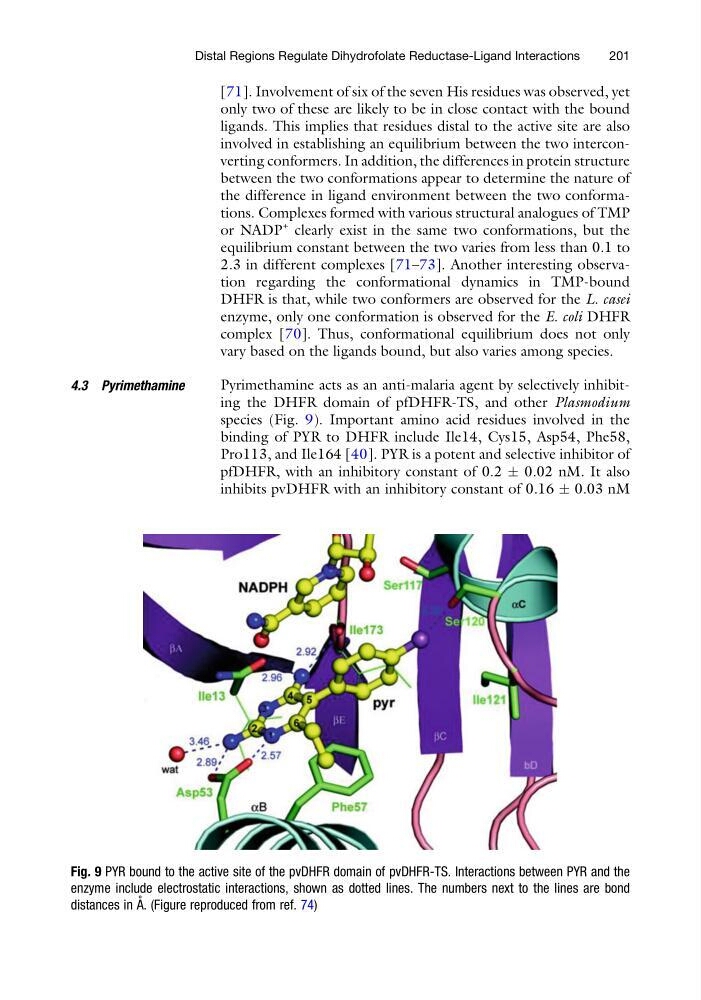
Pyrimethamine acts as an anti-malaria agent by selectively inhibiting the DHFR domain of pfDHFR-TS, and other Plasmodium
species (Fig. 9). Important amino acid residues involved in the
binding of PYR to DHFR include Ile14, Cys15, Asp54, Phe58,
Pro113, and Ile164 [40]. PYR is a potent and selective inhibitor of
pfDHFR, with an inhibitory constant of 0.2 Æ 0.02 nM. It also
inhibits pvDHFR with an inhibitory constant of 0.16 Æ 0.03 nM
Fig. 9 PYR bound to the active site of the pvDHFR domain of pvDHFR-TS. Interactions between PYR and the
enzyme include electrostatic interactions, shown as dotted lines. The numbers next to the lines are bond
distances in A ˚ . (Figure reproduced from ref. 74)
Distal Regions Regulate Dihydrofolate Reductase-Ligand Interactions
201
only two of these are likely to be in close contact with the bound
ligands. This implies that residues distal to the active site are also
involved in establishing an equilibrium between the two interconverting conformers. In addition, the differences in protein structure
between the two conformations appear to determine the nature of
the difference in ligand environment between the two conformations. Complexes formed with various structural analogues of TMP
or NADP
+ clearly exist in the same two conformations, but the
equilibrium constant between the two varies from less than 0.1 to
2.3 in different complexes [71–73]. Another interesting observation regarding the conformational dynamics in TMP-bound
DHFR is that, while two conformers are observed for the L. casei
enzyme, only one conformation is observed for the E. coli DHFR
complex [70]. Thus, conformational equilibrium does not only
vary based on the ligands bound, but also varies among species.
4.3 Pyrimethamine
Pyrimethamine acts as an anti-malaria agent by selectively inhibiting the DHFR domain of pfDHFR-TS, and other Plasmodium
species (Fig. 9). Important amino acid residues involved in the
binding of PYR to DHFR include Ile14, Cys15, Asp54, Phe58,
Pro113, and Ile164 [40]. PYR is a potent and selective inhibitor of
pfDHFR, with an inhibitory constant of 0.2 Æ 0.02 nM. It also
inhibits pvDHFR with an inhibitory constant of 0.16 Æ 0.03 nM
Fig. 9 PYR bound to the active site of the pvDHFR domain of pvDHFR-TS. Interactions between PYR and the
enzyme include electrostatic interactions, shown as dotted lines. The numbers next to the lines are bond
distances in A ˚ . (Figure reproduced from ref. 74)
Distal Regions Regulate Dihydrofolate Reductase-Ligand Interactions
201