

In addition, the conformation of MTX-bound DHFR has been
studied in numerous species. Using two-dimensional
1
H NMR
methods, Falzone et al. found that the binary ecDHFR:MTX complex exists as two slowly interconverting conformers and that this
interconversion does not take place in the DHF binary complex
[52]. Specifically, the authors observed that many of the resonances
in the DHFR-methotrexate complex were broadened or doubled.
The two distinct set of resonances were attributed to the presence
of two protein isomers. The authors collected NOESY spectra at
303 and 323 K and saw no interconversion between the isomers at
the lower temperature but did see exchange cross-peaks in a 700 ms
NOESY spectrum at 323 K, indicating interconversion between the
two isomers at the NMR timescale. These observations were supported by other crystallographic and NMR experiments [58]. It
was also observed that two conformers of DHFR exist in solution
and interconvert slowly prior to methotrexate binding. The existence of a conformational equilibrium prior to ligand binding may
be evidence to support the conformational selection model. In
addition, the population of each of the conformers of the MTX
complex appears to be pH dependent, with conformation 2 being
preferred at high pH [58]. Interestingly, the opposite situation
appears to exist for the Lactobacillus casei enzyme (lcDHFR). In
contrast to ecDHFR, lcDHFR exists in at least two conformations
in its binary complex with DHF and three conformations in its
ternary complex with DHF and NADP
+ , but only exists as a single
conformation in the MTX complex [59–61]. The different conformational equilibriums among bacterial species provide insight into
structural differences between the complexes and such information
may eventually assist in the design of more species-specific
inhibitors [59].
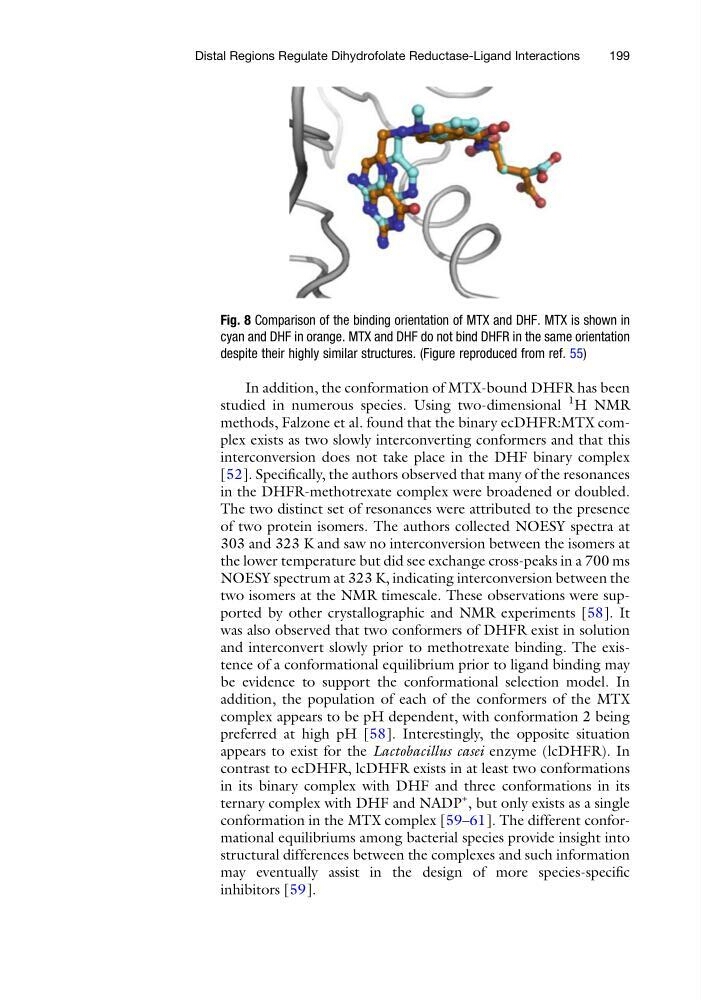
Fig. 8 Comparison of the binding orientation of MTX and DHF. MTX is shown in
cyan and DHF in orange. MTX and DHF do not bind DHFR in the same orientation
despite their highly similar structures. (Figure reproduced from ref. 55)
Distal Regions Regulate Dihydrofolate Reductase-Ligand Interactions
199
studied in numerous species. Using two-dimensional
1
H NMR
methods, Falzone et al. found that the binary ecDHFR:MTX complex exists as two slowly interconverting conformers and that this
interconversion does not take place in the DHF binary complex
[52]. Specifically, the authors observed that many of the resonances
in the DHFR-methotrexate complex were broadened or doubled.
The two distinct set of resonances were attributed to the presence
of two protein isomers. The authors collected NOESY spectra at
303 and 323 K and saw no interconversion between the isomers at
the lower temperature but did see exchange cross-peaks in a 700 ms
NOESY spectrum at 323 K, indicating interconversion between the
two isomers at the NMR timescale. These observations were supported by other crystallographic and NMR experiments [58]. It
was also observed that two conformers of DHFR exist in solution
and interconvert slowly prior to methotrexate binding. The existence of a conformational equilibrium prior to ligand binding may
be evidence to support the conformational selection model. In
addition, the population of each of the conformers of the MTX
complex appears to be pH dependent, with conformation 2 being
preferred at high pH [58]. Interestingly, the opposite situation
appears to exist for the Lactobacillus casei enzyme (lcDHFR). In
contrast to ecDHFR, lcDHFR exists in at least two conformations
in its binary complex with DHF and three conformations in its
ternary complex with DHF and NADP
+ , but only exists as a single
conformation in the MTX complex [59–61]. The different conformational equilibriums among bacterial species provide insight into
structural differences between the complexes and such information
may eventually assist in the design of more species-specific
inhibitors [59].
Fig. 8 Comparison of the binding orientation of MTX and DHF. MTX is shown in
cyan and DHF in orange. MTX and DHF do not bind DHFR in the same orientation
despite their highly similar structures. (Figure reproduced from ref. 55)
Distal Regions Regulate Dihydrofolate Reductase-Ligand Interactions
199