

opted for the generalized correlation coefficient r MI proposed by
Lange et al. [44] and defined as
r MI x i , x j
Â
à ¼ 1 À exp À2I x i , x j
Â
à =d
À
Á
È
É
ð2Þ
where d is the dimensionality of the variables x i and x j , and I[x i ,x j ] is
the mutual information (MI) between the two variables (see Note
3), which is associated to the expected value of the information
content of a discrete random variable, i.e., to its Shannon entropy
[43]. The information content is calculated using the C α atomic
positions fluctuations derived from the MD simulations, upon
removal of translational and rotational motions by alignment of
C α atoms along an MD trajectory, by means of the k-nearest
neighbor distances algorithm [45] as implemented in the “g_correlation” code [44] of the GROMACS software [38], which can be
also used to compute the Pearson correlation coefficient. The
r MI [x i ,x j ] coefficient will be zero for fully uncorrelated motions
and it will assume values up to 1 for fully correlated motions, so it
can be compared with the absolute value of the r[x i ,x j ] Pearson
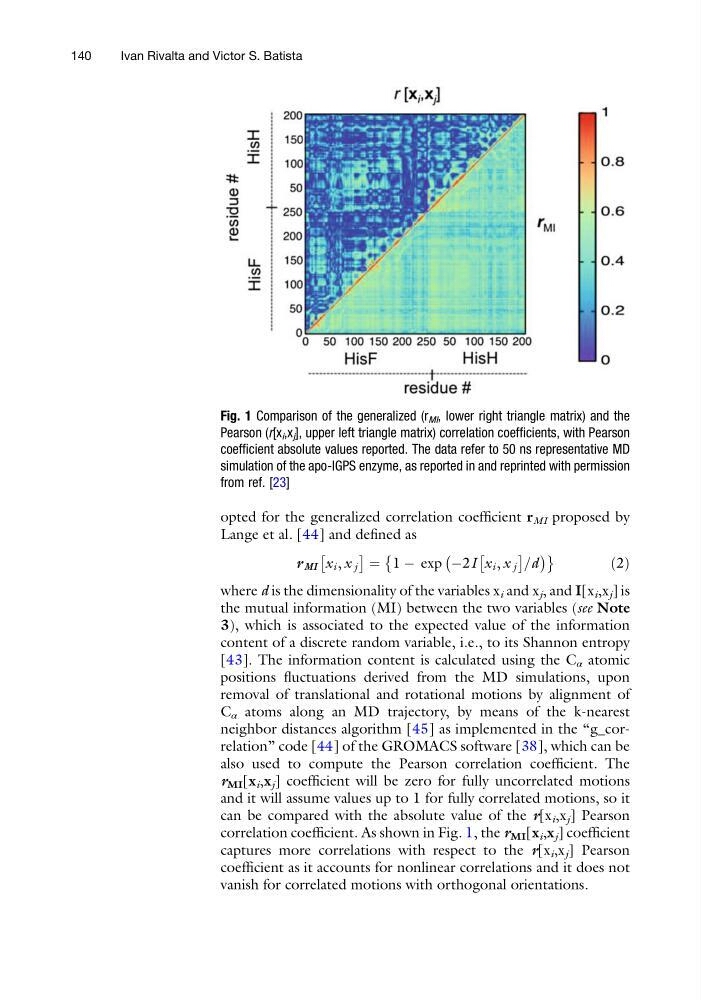
correlation coefficient. As shown in Fig. 1, the r MI [x i ,x j ] coefficient
captures more correlations with respect to the r[x i ,x j ] Pearson
coefficient as it accounts for nonlinear correlations and it does not
vanish for correlated motions with orthogonal orientations.
Fig. 1 Comparison of the generalized (r MI , lower right triangle matrix) and the
Pearson (r[x i ,x j ], upper left triangle matrix) correlation coefficients, with Pearson
coefficient absolute values reported. The data refer to 50 ns representative MD
simulation of the apo-IGPS enzyme, as reported in and reprinted with permission
from ref. [23]
140
Ivan Rivalta and Victor S. Batista
Lange et al. [44] and defined as
r MI x i , x j
Â
à ¼ 1 À exp À2I x i , x j
Â
à =d
À
Á
È
É
ð2Þ
where d is the dimensionality of the variables x i and x j , and I[x i ,x j ] is
the mutual information (MI) between the two variables (see Note
3), which is associated to the expected value of the information
content of a discrete random variable, i.e., to its Shannon entropy
[43]. The information content is calculated using the C α atomic
positions fluctuations derived from the MD simulations, upon
removal of translational and rotational motions by alignment of
C α atoms along an MD trajectory, by means of the k-nearest
neighbor distances algorithm [45] as implemented in the “g_correlation” code [44] of the GROMACS software [38], which can be
also used to compute the Pearson correlation coefficient. The
r MI [x i ,x j ] coefficient will be zero for fully uncorrelated motions
and it will assume values up to 1 for fully correlated motions, so it
can be compared with the absolute value of the r[x i ,x j ] Pearson
correlation coefficient. As shown in Fig. 1, the r MI [x i ,x j ] coefficient
captures more correlations with respect to the r[x i ,x j ] Pearson
coefficient as it accounts for nonlinear correlations and it does not
vanish for correlated motions with orthogonal orientations.
Fig. 1 Comparison of the generalized (r MI , lower right triangle matrix) and the
Pearson (r[x i ,x j ], upper left triangle matrix) correlation coefficients, with Pearson
coefficient absolute values reported. The data refer to 50 ns representative MD
simulation of the apo-IGPS enzyme, as reported in and reprinted with permission
from ref. [23]
140
Ivan Rivalta and Victor S. Batista