

all contacts, the amino acids adopt a characteristic moderate degree
right with a mode (degree with highest frequency in the distribution) and a mean around 12. This means that many links are added
to the Hot Spots outside of the Hot Spot Network to reach the
PCN degree distribution. This mechanism is crucial to mask the
position of the Hot Spots.
5.3 Degree
Distribution in Induced
Hot Spot Network
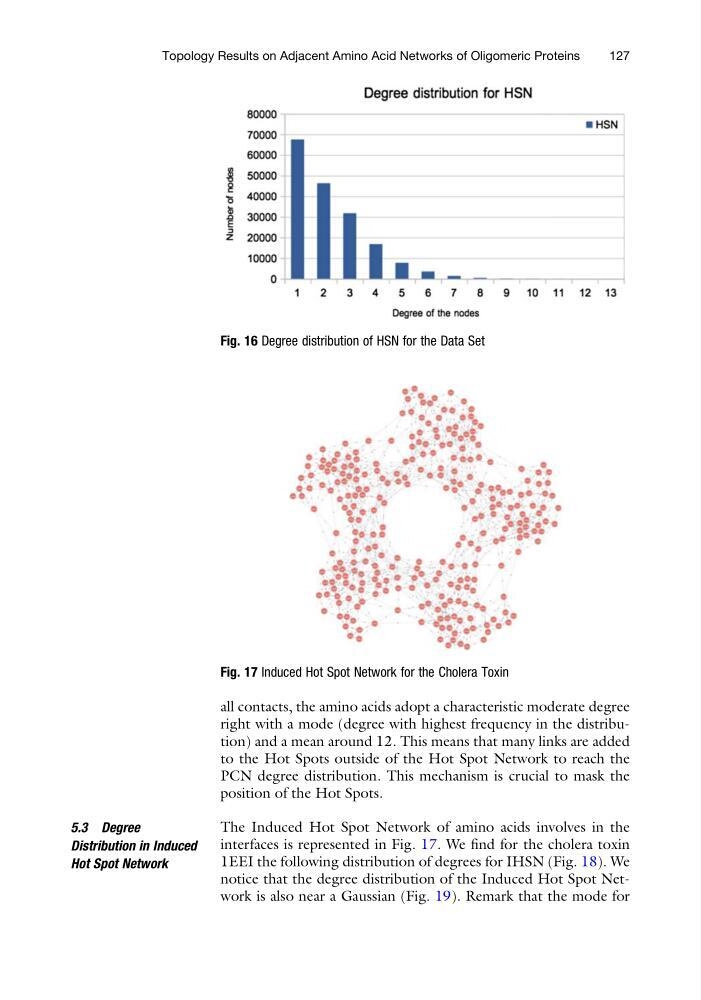
The Induced Hot Spot Network of amino acids involves in the
interfaces is represented in Fig. 17. We find for the cholera toxin
1EEI the following distribution of degrees for IHSN (Fig. 18). We
notice that the degree distribution of the Induced Hot Spot Network is also near a Gaussian (Fig. 19). Remark that the mode for
Fig. 16 Degree distribution of HSN for the Data Set
Fig. 17 Induced Hot Spot Network for the Cholera Toxin
Topology Results on Adjacent Amino Acid Networks of Oligomeric Proteins
127
right with a mode (degree with highest frequency in the distribution) and a mean around 12. This means that many links are added
to the Hot Spots outside of the Hot Spot Network to reach the
PCN degree distribution. This mechanism is crucial to mask the
position of the Hot Spots.
5.3 Degree
Distribution in Induced
Hot Spot Network
The Induced Hot Spot Network of amino acids involves in the
interfaces is represented in Fig. 17. We find for the cholera toxin
1EEI the following distribution of degrees for IHSN (Fig. 18). We
notice that the degree distribution of the Induced Hot Spot Network is also near a Gaussian (Fig. 19). Remark that the mode for
Fig. 16 Degree distribution of HSN for the Data Set
Fig. 17 Induced Hot Spot Network for the Cholera Toxin
Topology Results on Adjacent Amino Acid Networks of Oligomeric Proteins
127