

88
6.5 Fungal Bioremediation
Continuous resistance toward excessive metals exhibits the fungal potential to
degrade metals. Although the components of this resistance are not completely
comprehended, the technique utilizes a specific procedure of concealment on
collective processes of a plant breeding framework toward mercury by the fungus
Trichoderma harzianum, which displays a potential role for hydrophobin, which
can separate nonpolar particles in liquid medium. Therefore, resistance was communicated through a comparative development on control culture rate (Puglisi
et al. 2012). For the most part, two components have been proposed for substantial metal resilience in parasites. The first component contains an extracellular
(chelation and cell wall-binding) sequestration, and the second has a direct
sequestration of metal in which the proteins are completely different than those
binding to the ligands to defend against harming the target-sensitive metal cell. In
this manner, extracellular components are basically suggested in the evasion of
metal passage, whereas intracellular frameworks decrease the metal weight in the
cytosol. In the primary system, distinctive natural atoms that have no place with
the network of the cell divider are discharged by the parasitic cell to chelate metal
particles. The nearness of different anionic structures, for example, glucan and
chitin, gives a contrary charge to the cell surface of microorganisms, which
enables microorganisms to attach to cations of the metals. In the living instrument, the transport of metal proteins could be fashioned with flexibility, either by
removing particles of metal on the cytoplasm or via permitting sequestration onto
the vacuolar section (Jain and Arnepalli 2016).
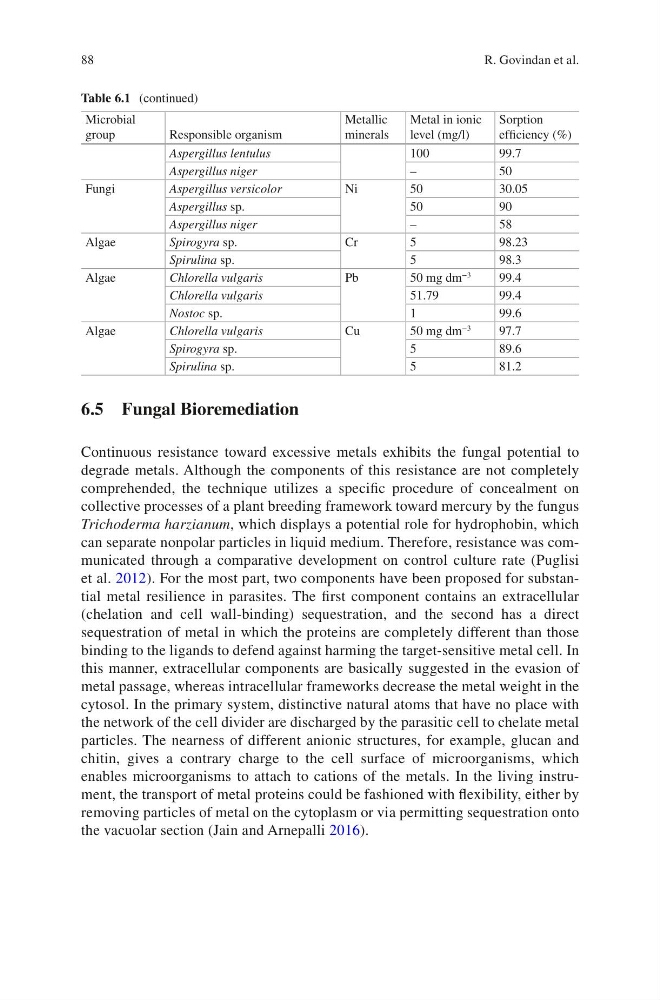
Table 6.1 (continued)
Microbial
group
Responsible organism
Metallic
minerals
Metal in ionic
level (mg/l)
Sorption
efficiency (%)
Aspergillus lentulus
100
99.7
Aspergillus niger
–
50
Fungi
Aspergillus versicolor
Ni
50
30.05
Aspergillus sp.
50
90
Aspergillus niger
–
58
Algae
Spirogyra sp.
Cr
5
98.23
Spirulina sp.
5
98.3
Algae
Chlorella vulgaris
Pb
50 mg dm
−3
99.4
Chlorella vulgaris
51.79
99.4
Nostoc sp.
1
99.6
Algae
Chlorella vulgaris
Cu
50 mg dm
−3
97.7
Spirogyra sp.
5
89.6
Spirulina sp.
5
81.2
R. Govindan et al.
6.5 Fungal Bioremediation
Continuous resistance toward excessive metals exhibits the fungal potential to
degrade metals. Although the components of this resistance are not completely
comprehended, the technique utilizes a specific procedure of concealment on
collective processes of a plant breeding framework toward mercury by the fungus
Trichoderma harzianum, which displays a potential role for hydrophobin, which
can separate nonpolar particles in liquid medium. Therefore, resistance was communicated through a comparative development on control culture rate (Puglisi
et al. 2012). For the most part, two components have been proposed for substantial metal resilience in parasites. The first component contains an extracellular
(chelation and cell wall-binding) sequestration, and the second has a direct
sequestration of metal in which the proteins are completely different than those
binding to the ligands to defend against harming the target-sensitive metal cell. In
this manner, extracellular components are basically suggested in the evasion of
metal passage, whereas intracellular frameworks decrease the metal weight in the
cytosol. In the primary system, distinctive natural atoms that have no place with
the network of the cell divider are discharged by the parasitic cell to chelate metal
particles. The nearness of different anionic structures, for example, glucan and
chitin, gives a contrary charge to the cell surface of microorganisms, which
enables microorganisms to attach to cations of the metals. In the living instrument, the transport of metal proteins could be fashioned with flexibility, either by
removing particles of metal on the cytoplasm or via permitting sequestration onto
the vacuolar section (Jain and Arnepalli 2016).
Table 6.1 (continued)
Microbial
group
Responsible organism
Metallic
minerals
Metal in ionic
level (mg/l)
Sorption
efficiency (%)
Aspergillus lentulus
100
99.7
Aspergillus niger
–
50
Fungi
Aspergillus versicolor
Ni
50
30.05
Aspergillus sp.
50
90
Aspergillus niger
–
58
Algae
Spirogyra sp.
Cr
5
98.23
Spirulina sp.
5
98.3
Algae
Chlorella vulgaris
Pb
50 mg dm
−3
99.4
Chlorella vulgaris
51.79
99.4
Nostoc sp.
1
99.6
Algae
Chlorella vulgaris
Cu
50 mg dm
−3
97.7
Spirogyra sp.
5
89.6
Spirulina sp.
5
81.2
R. Govindan et al.