

16
tone (autoinducers) and, thus, chances of their possible identification and isolation increase to many folds by adopting such strategy (Kanoh and Kamino 2001).
The most life-threatening human fungal pathogens like Aspergillus, Candida, and
Cryptococcus utilize the siderophore-mediated iron uptake mechanism either for
their survival or virulence (Steinbach 2010; Park et al. 2009). Moreover, the risk of
infection increases too many folds in immunocompromised patients which easily
gained opportunistic infections. Thus, interfering with the iron acquisition mechanism and developing nutritional deficiency by blocking siderophore production leads
to the development of new class of antifungals which are safer for mammalian host.
2.2 Nature of Siderophores and Their Production
Blocking of siderophore production in fungal pathogens is considered as a novel
approach for developing antifungals based on fungal-specific target. There are
numerous enzymes found in a microorganism which synthesizes siderophores.
These enzymes can be targeted to achieve bacteriostatic or bactericidal action by
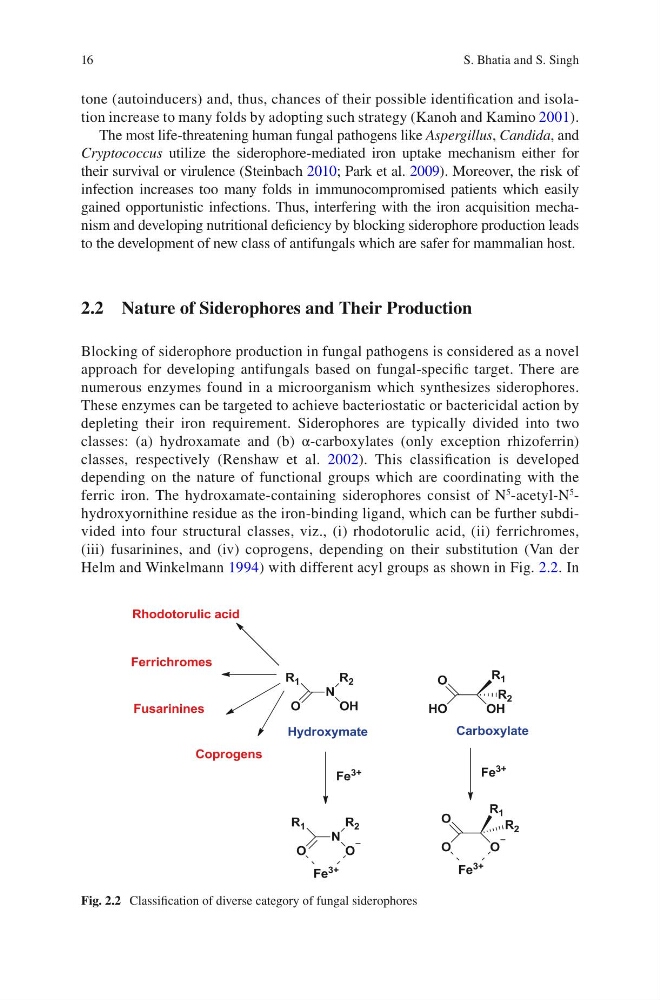
depleting their iron requirement. Siderophores are typically divided into two
classes: (a) hydroxamate and (b) α-carboxylates (only exception rhizoferrin)
classes, respectively (Renshaw et al. 2002). This classification is developed
depending on the nature of functional groups which are coordinating with the
ferric iron. The hydroxamate- containing siderophores consist of N
5
-acetyl-N
5
-
hydroxyornithine residue as the iron-binding ligand, which can be further subdivided into four structural classes, viz., (i) rhodotorulic acid, (ii) ferrichromes,
(iii) fusarinines, and (iv) coprogens, depending on their substitution (Van der
Helm and Winkelmann 1994) with different acyl groups as shown in Fig. 2.2. In
Fig. 2.2 Classification of diverse category of fungal siderophores
S. Bhatia and S. Singh
tone (autoinducers) and, thus, chances of their possible identification and isolation increase to many folds by adopting such strategy (Kanoh and Kamino 2001).
The most life-threatening human fungal pathogens like Aspergillus, Candida, and
Cryptococcus utilize the siderophore-mediated iron uptake mechanism either for
their survival or virulence (Steinbach 2010; Park et al. 2009). Moreover, the risk of
infection increases too many folds in immunocompromised patients which easily
gained opportunistic infections. Thus, interfering with the iron acquisition mechanism and developing nutritional deficiency by blocking siderophore production leads
to the development of new class of antifungals which are safer for mammalian host.
2.2 Nature of Siderophores and Their Production
Blocking of siderophore production in fungal pathogens is considered as a novel
approach for developing antifungals based on fungal-specific target. There are
numerous enzymes found in a microorganism which synthesizes siderophores.
These enzymes can be targeted to achieve bacteriostatic or bactericidal action by
depleting their iron requirement. Siderophores are typically divided into two
classes: (a) hydroxamate and (b) α-carboxylates (only exception rhizoferrin)
classes, respectively (Renshaw et al. 2002). This classification is developed
depending on the nature of functional groups which are coordinating with the
ferric iron. The hydroxamate- containing siderophores consist of N
5
-acetyl-N
5
-
hydroxyornithine residue as the iron-binding ligand, which can be further subdivided into four structural classes, viz., (i) rhodotorulic acid, (ii) ferrichromes,
(iii) fusarinines, and (iv) coprogens, depending on their substitution (Van der
Helm and Winkelmann 1994) with different acyl groups as shown in Fig. 2.2. In
Fig. 2.2 Classification of diverse category of fungal siderophores
S. Bhatia and S. Singh