

120
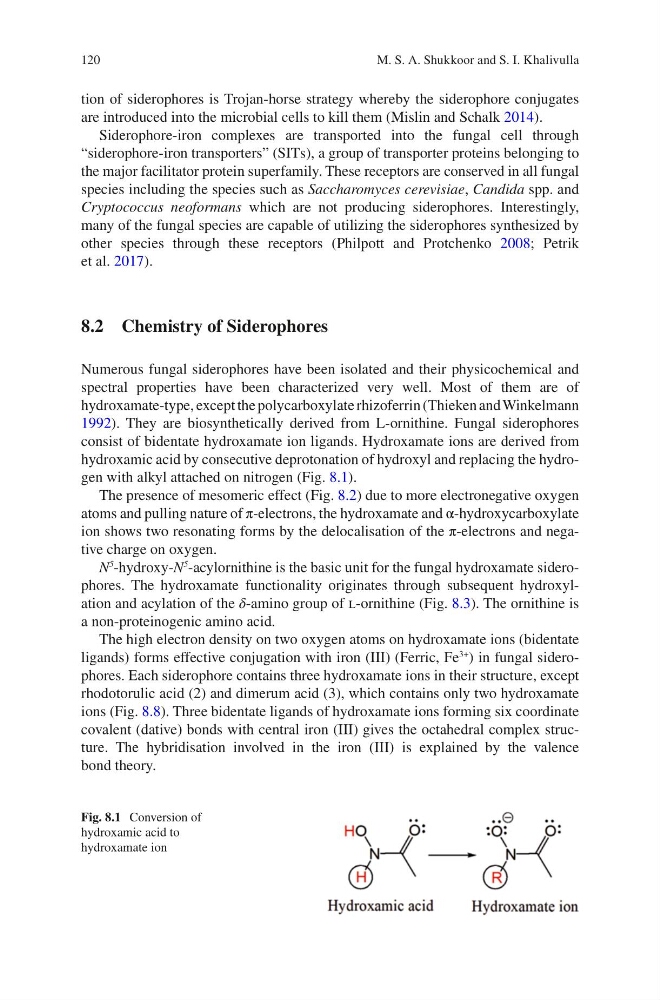
Fig. 8.1 Conversion of
hydroxamic acid to
hydroxamate ion
tion of siderophores is Trojan-horse strategy whereby the siderophore conjugates
are introduced into the microbial cells to kill them (Mislin and Schalk 2014).
Siderophore-iron complexes are transported into the fungal cell through
“siderophore- iron transporters” (SITs), a group of transporter proteins belonging to
the major facilitator protein superfamily. These receptors are conserved in all fungal
species including the species such as Saccharomyces cerevisiae, Candida spp. and
Cryptococcus neoformans which are not producing siderophores. Interestingly,
many of the fungal species are capable of utilizing the siderophores synthesized by
other species through these receptors (Philpott and Protchenko 2008; Petrik
et al. 2017).
8.2 Chemistry of Siderophores
Numerous fungal siderophores have been isolated and their physicochemical and
spectral properties have been characterized very well. Most of them are of
hydroxamate- type, except the polycarboxylate rhizoferrin (Thieken and Winkelmann
1992). They are biosynthetically derived from L-ornithine. Fungal siderophores
consist of bidentate hydroxamate ion ligands. Hydroxamate ions are derived from
hydroxamic acid by consecutive deprotonation of hydroxyl and replacing the hydrogen with alkyl attached on nitrogen (Fig. 8.1).
The presence of mesomeric effect (Fig. 8.2) due to more electronegative oxygen
atoms and pulling nature of π-electrons, the hydroxamate and α-hydroxycarboxylate
ion shows two resonating forms by the delocalisation of the π-electrons and negative charge on oxygen.
N
5
-hydroxy-N
5
-acylornithine is the basic unit for the fungal hydroxamate siderophores. The hydroxamate functionality originates through subsequent hydroxylation and acylation of the δ-amino group of l-ornithine (Fig. 8.3). The ornithine is
a non-proteinogenic amino acid.
The high electron density on two oxygen atoms on hydroxamate ions (bidentate
ligands) forms effective conjugation with iron (III) (Ferric, Fe
3+
) in fungal siderophores. Each siderophore contains three hydroxamate ions in their structure, except
rhodotorulic acid (2) and dimerum acid (3), which contains only two hydroxamate
ions (Fig. 8.8). Three bidentate ligands of hydroxamate ions forming six coordinate
covalent (dative) bonds with central iron (III) gives the octahedral complex structure. The hybridisation involved in the iron (III) is explained by the valence
bond theory.
M. S. A. Shukkoor and S. I. Khalivulla
Fig. 8.1 Conversion of
hydroxamic acid to
hydroxamate ion
tion of siderophores is Trojan-horse strategy whereby the siderophore conjugates
are introduced into the microbial cells to kill them (Mislin and Schalk 2014).
Siderophore-iron complexes are transported into the fungal cell through
“siderophore- iron transporters” (SITs), a group of transporter proteins belonging to
the major facilitator protein superfamily. These receptors are conserved in all fungal
species including the species such as Saccharomyces cerevisiae, Candida spp. and
Cryptococcus neoformans which are not producing siderophores. Interestingly,
many of the fungal species are capable of utilizing the siderophores synthesized by
other species through these receptors (Philpott and Protchenko 2008; Petrik
et al. 2017).
8.2 Chemistry of Siderophores
Numerous fungal siderophores have been isolated and their physicochemical and
spectral properties have been characterized very well. Most of them are of
hydroxamate- type, except the polycarboxylate rhizoferrin (Thieken and Winkelmann
1992). They are biosynthetically derived from L-ornithine. Fungal siderophores
consist of bidentate hydroxamate ion ligands. Hydroxamate ions are derived from
hydroxamic acid by consecutive deprotonation of hydroxyl and replacing the hydrogen with alkyl attached on nitrogen (Fig. 8.1).
The presence of mesomeric effect (Fig. 8.2) due to more electronegative oxygen
atoms and pulling nature of π-electrons, the hydroxamate and α-hydroxycarboxylate
ion shows two resonating forms by the delocalisation of the π-electrons and negative charge on oxygen.
N
5
-hydroxy-N
5
-acylornithine is the basic unit for the fungal hydroxamate siderophores. The hydroxamate functionality originates through subsequent hydroxylation and acylation of the δ-amino group of l-ornithine (Fig. 8.3). The ornithine is
a non-proteinogenic amino acid.
The high electron density on two oxygen atoms on hydroxamate ions (bidentate
ligands) forms effective conjugation with iron (III) (Ferric, Fe
3+
) in fungal siderophores. Each siderophore contains three hydroxamate ions in their structure, except
rhodotorulic acid (2) and dimerum acid (3), which contains only two hydroxamate
ions (Fig. 8.8). Three bidentate ligands of hydroxamate ions forming six coordinate
covalent (dative) bonds with central iron (III) gives the octahedral complex structure. The hybridisation involved in the iron (III) is explained by the valence
bond theory.
M. S. A. Shukkoor and S. I. Khalivulla