

112
7.8.3 Intracellular Iron Storage
Apart from solubilizing and transporting iron, siderophore also facilitates intracellular iron acquisition in mycelia and spores that effect germination. In case of
Neurospora crassa, several intercellular siderophores produced by the species such
as excretory coprogen and intracellular ferricrocin found in both hyphae and conidia
are essential for its germination and iron storage. It is also well established that ironsiderophore complexes maintained in hyphae for the incorporation of spores help in
sporulation and also transport iron to mycelial mitochondria. Several fungal species
have both types of inter- and intracellular siderophores such examples Penicillium
chrysogenum, Aspergillus nidulans, Rhodotorula minuta and Ustilago sphaerogena
(Renshaw et al. 2002).
7.9 Applications of Siderophore
Siderophore and its different derivatives have broad scope in medical sciences and
offer several applications in the field of biotechnology, microbial ecology and biomedical science. Various studies demonstrate the effective role of some siderophore
in the management or treatment of human diseases and infections (Popat et al. 2017;
Nagoba and Vedpathak 2011; Ahmed and Holmstrom 2014; Saha et al. 2016;
De-Serrano 2017; Dimkpa 2016; Fine 2000; Banner and Woolf 2004). These are as
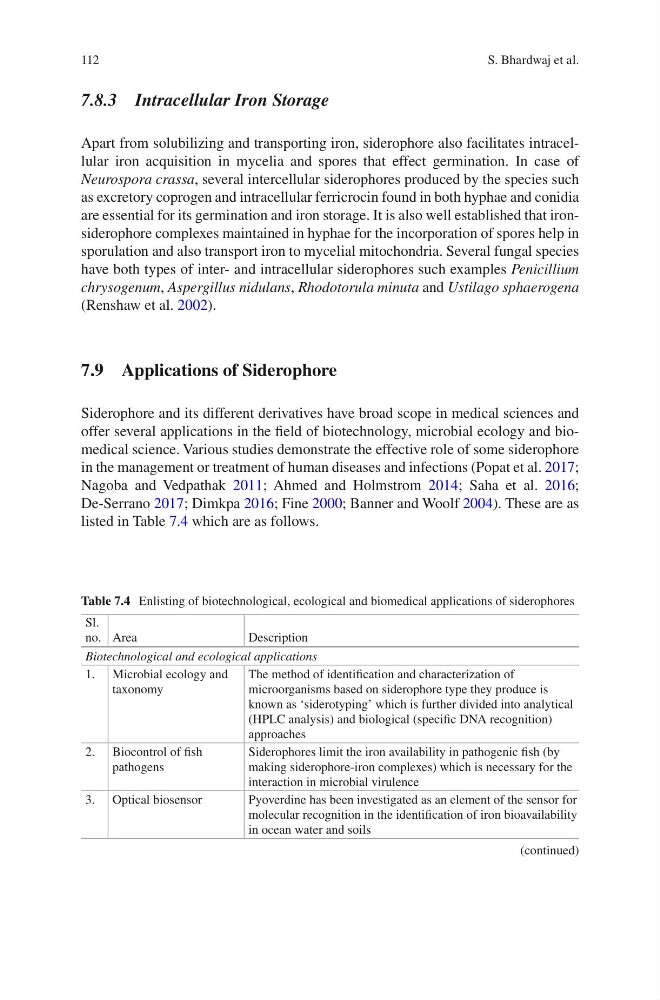
listed in Table 7.4 which are as follows.
Table 7.4 Enlisting of biotechnological, ecological and biomedical applications of siderophores
Sl.
no. Area
Description
Biotechnological and ecological applications
1. Microbial ecology and
taxonomy
The method of identification and characterization of
microorganisms based on siderophore type they produce is
known as ‘siderotyping’ which is further divided into analytical
(HPLC analysis) and biological (specific DNA recognition)
approaches
2. Biocontrol of fish
pathogens
Siderophores limit the iron availability in pathogenic fish (by
making siderophore-iron complexes) which is necessary for the
interaction in microbial virulence
3. Optical biosensor
Pyoverdine has been investigated as an element of the sensor for
molecular recognition in the identification of iron bioavailability
in ocean water and soils
(continued)
S. Bhardwaj et al.
7.8.3 Intracellular Iron Storage
Apart from solubilizing and transporting iron, siderophore also facilitates intracellular iron acquisition in mycelia and spores that effect germination. In case of
Neurospora crassa, several intercellular siderophores produced by the species such
as excretory coprogen and intracellular ferricrocin found in both hyphae and conidia
are essential for its germination and iron storage. It is also well established that ironsiderophore complexes maintained in hyphae for the incorporation of spores help in
sporulation and also transport iron to mycelial mitochondria. Several fungal species
have both types of inter- and intracellular siderophores such examples Penicillium
chrysogenum, Aspergillus nidulans, Rhodotorula minuta and Ustilago sphaerogena
(Renshaw et al. 2002).
7.9 Applications of Siderophore
Siderophore and its different derivatives have broad scope in medical sciences and
offer several applications in the field of biotechnology, microbial ecology and biomedical science. Various studies demonstrate the effective role of some siderophore
in the management or treatment of human diseases and infections (Popat et al. 2017;
Nagoba and Vedpathak 2011; Ahmed and Holmstrom 2014; Saha et al. 2016;
De-Serrano 2017; Dimkpa 2016; Fine 2000; Banner and Woolf 2004). These are as
listed in Table 7.4 which are as follows.
Table 7.4 Enlisting of biotechnological, ecological and biomedical applications of siderophores
Sl.
no. Area
Description
Biotechnological and ecological applications
1. Microbial ecology and
taxonomy
The method of identification and characterization of
microorganisms based on siderophore type they produce is
known as ‘siderotyping’ which is further divided into analytical
(HPLC analysis) and biological (specific DNA recognition)
approaches
2. Biocontrol of fish
pathogens
Siderophores limit the iron availability in pathogenic fish (by
making siderophore-iron complexes) which is necessary for the
interaction in microbial virulence
3. Optical biosensor
Pyoverdine has been investigated as an element of the sensor for
molecular recognition in the identification of iron bioavailability
in ocean water and soils
(continued)
S. Bhardwaj et al.