

109
from more toxic to less toxic form. The metals such as iron, zinc, copper, chromium,
gallium and manganese interact with the siderophore produced by different fungi to
make stable siderophore-metal complexes resulting in homeostasis regulation.
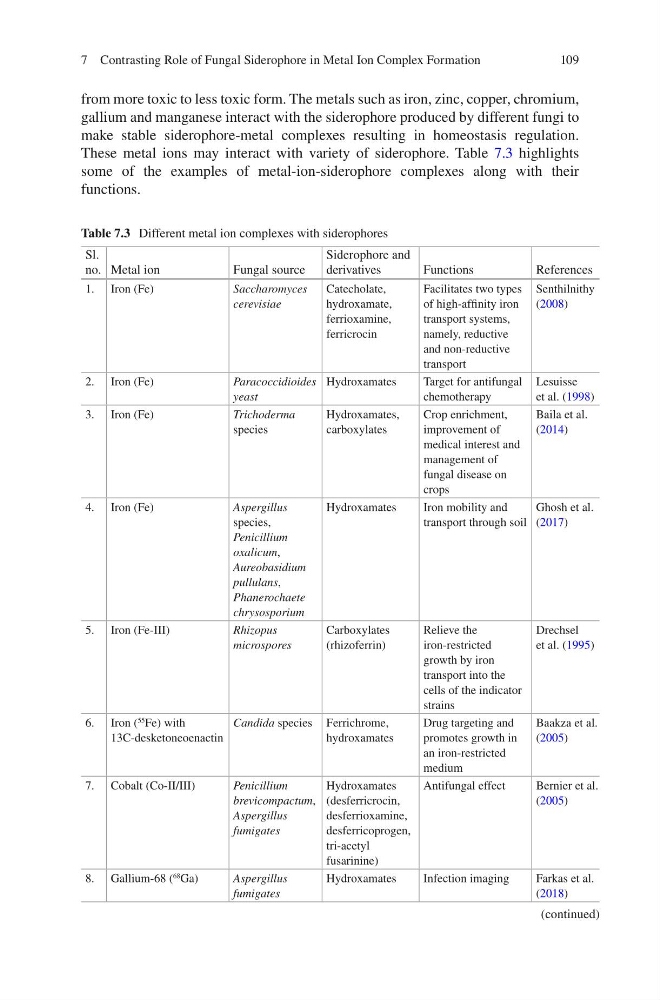
These metal ions may interact with variety of siderophore. Table 7.3 highlights
some of the examples of metal-ion-siderophore complexes along with their
functions.
Table 7.3 Different metal ion complexes with siderophores
Sl.
no. Metal ion
Fungal source
Siderophore and
derivatives
Functions
References
1. Iron (Fe)
Saccharomyces
cerevisiae
Catecholate,
hydroxamate,
ferrioxamine,
ferricrocin
Facilitates two types
of high-affinity iron
transport systems,
namely, reductive
and non-reductive
transport
Senthilnithy
(2008)
2. Iron (Fe)
Paracoccidioides
yeast
Hydroxamates
Target for antifungal
chemotherapy
Lesuisse
et al. (1998)
3. Iron (Fe)
Trichoderma
species
Hydroxamates,
carboxylates
Crop enrichment,
improvement of
medical interest and
management of
fungal disease on
crops
Baila et al.
(2014)
4. Iron (Fe)
Aspergillus
species,
Penicillium
oxalicum,
Aureobasidium
pullulans,
Phanerochaete
chrysosporium
Hydroxamates
Iron mobility and
transport through soil
Ghosh et al.
(2017)
5. Iron (Fe-III)
Rhizopus
microspores
Carboxylates
(rhizoferrin)
Relieve the
iron- restricted
growth by iron
transport into the
cells of the indicator
strains
Drechsel
et al. (1995)
6. Iron (
55 Fe) with
13C-desketoneoenactin
Candida species Ferrichrome,
hydroxamates
Drug targeting and
promotes growth in
an iron-restricted
medium
Baakza et al.
(2005)
7. Cobalt (Co-II/III)
Penicillium
brevicompactum,
Aspergillus
fumigates
Hydroxamates
(desferricrocin,
desferrioxamine,
desferricoprogen,
tri-acetyl
fusarinine)
Antifungal effect
Bernier et al.
(2005)
8. Gallium-68 (
68
Ga)
Aspergillus
fumigates
Hydroxamates
Infection imaging
Farkas et al.
(2018)
(continued)
7 Contrasting Role of Fungal Siderophore in Metal Ion Complex Formation
from more toxic to less toxic form. The metals such as iron, zinc, copper, chromium,
gallium and manganese interact with the siderophore produced by different fungi to
make stable siderophore-metal complexes resulting in homeostasis regulation.
These metal ions may interact with variety of siderophore. Table 7.3 highlights
some of the examples of metal-ion-siderophore complexes along with their
functions.
Table 7.3 Different metal ion complexes with siderophores
Sl.
no. Metal ion
Fungal source
Siderophore and
derivatives
Functions
References
1. Iron (Fe)
Saccharomyces
cerevisiae
Catecholate,
hydroxamate,
ferrioxamine,
ferricrocin
Facilitates two types
of high-affinity iron
transport systems,
namely, reductive
and non-reductive
transport
Senthilnithy
(2008)
2. Iron (Fe)
Paracoccidioides
yeast
Hydroxamates
Target for antifungal
chemotherapy
Lesuisse
et al. (1998)
3. Iron (Fe)
Trichoderma
species
Hydroxamates,
carboxylates
Crop enrichment,
improvement of
medical interest and
management of
fungal disease on
crops
Baila et al.
(2014)
4. Iron (Fe)
Aspergillus
species,
Penicillium
oxalicum,
Aureobasidium
pullulans,
Phanerochaete
chrysosporium
Hydroxamates
Iron mobility and
transport through soil
Ghosh et al.
(2017)
5. Iron (Fe-III)
Rhizopus
microspores
Carboxylates
(rhizoferrin)
Relieve the
iron- restricted
growth by iron
transport into the
cells of the indicator
strains
Drechsel
et al. (1995)
6. Iron (
55 Fe) with
13C-desketoneoenactin
Candida species Ferrichrome,
hydroxamates
Drug targeting and
promotes growth in
an iron-restricted
medium
Baakza et al.
(2005)
7. Cobalt (Co-II/III)
Penicillium
brevicompactum,
Aspergillus
fumigates
Hydroxamates
(desferricrocin,
desferrioxamine,
desferricoprogen,
tri-acetyl
fusarinine)
Antifungal effect
Bernier et al.
(2005)
8. Gallium-68 (
68
Ga)
Aspergillus
fumigates
Hydroxamates
Infection imaging
Farkas et al.
(2018)
(continued)
7 Contrasting Role of Fungal Siderophore in Metal Ion Complex Formation