

107
7.6 Binding Sites in Siderophores
The stability of iron-siderophore complex strongly depends on the nature of binding
sites present in varied siderophore structure with different functional motifs. All the
different types of siderophores reported till date form extremely stable, highly specific complex containing high-spin ferric iron. The different moieties that explain
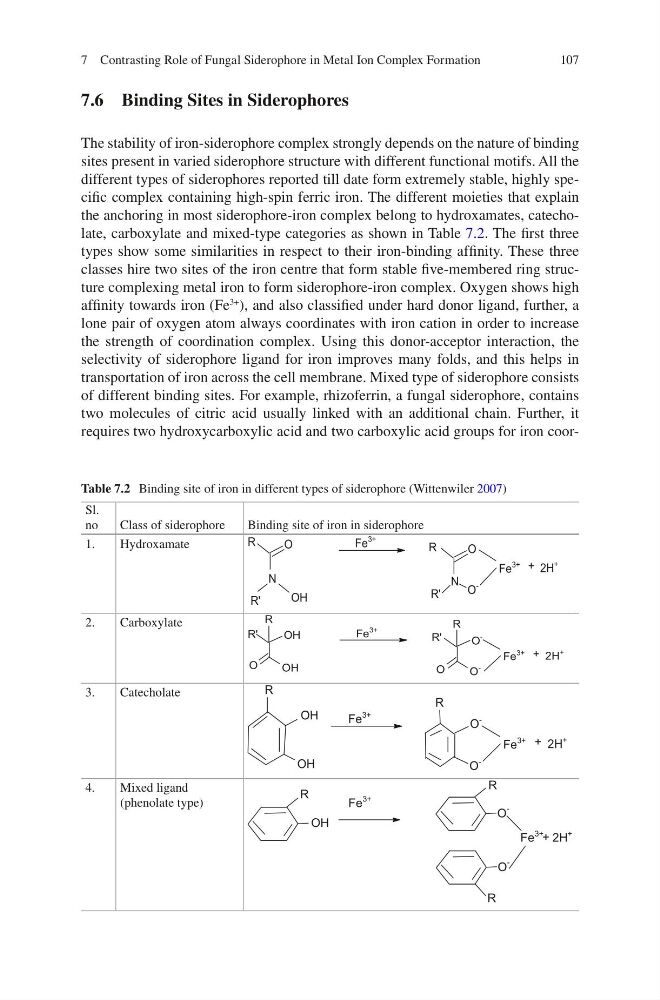
the anchoring in most siderophore-iron complex belong to hydroxamates, catecholate, carboxylate and mixed-type categories as shown in Table 7.2. The first three
types show some similarities in respect to their iron-binding affinity. These three
classes hire two sites of the iron centre that form stable five-membered ring structure complexing metal iron to form siderophore-iron complex. Oxygen shows high
affinity towards iron (Fe
3+
), and also classified under hard donor ligand, further, a
lone pair of oxygen atom always coordinates with iron cation in order to increase
the strength of coordination complex. Using this donor-acceptor interaction, the
selectivity of siderophore ligand for iron improves many folds, and this helps in
transportation of iron across the cell membrane. Mixed type of siderophore consists
of different binding sites. For example, rhizoferrin, a fungal siderophore, contains
two molecules of citric acid usually linked with an additional chain. Further, it
requires two hydroxycarboxylic acid and two carboxylic acid groups for iron coorTable 7.2 Binding site of iron in different types of siderophore (Wittenwiler 2007)
Sl.
no
Class of siderophore
Binding site of iron in siderophore
1.
Hydroxamate
R
Fe
3+
R
Fe
3+ + 2H
+
O
N
OH
R'
N
R'
O
-
O
2.
Carboxylate
OH
O
OH
R
R'
Fe
3+
R
R'
O
O
-
O
-
Fe
3+ + 2H
+
3.
Catecholate
Fe
3+
Fe
3+ + 2H
+
O
-
R
OH
OH
O
-
R
4.
Mixed ligand
(phenolate type)
R
OH
Fe
3+
R
R
O
-
O
-
Fe
3+
+ 2H
+
7 Contrasting Role of Fungal Siderophore in Metal Ion Complex Formation
7.6 Binding Sites in Siderophores
The stability of iron-siderophore complex strongly depends on the nature of binding
sites present in varied siderophore structure with different functional motifs. All the
different types of siderophores reported till date form extremely stable, highly specific complex containing high-spin ferric iron. The different moieties that explain
the anchoring in most siderophore-iron complex belong to hydroxamates, catecholate, carboxylate and mixed-type categories as shown in Table 7.2. The first three
types show some similarities in respect to their iron-binding affinity. These three
classes hire two sites of the iron centre that form stable five-membered ring structure complexing metal iron to form siderophore-iron complex. Oxygen shows high
affinity towards iron (Fe
3+
), and also classified under hard donor ligand, further, a
lone pair of oxygen atom always coordinates with iron cation in order to increase
the strength of coordination complex. Using this donor-acceptor interaction, the
selectivity of siderophore ligand for iron improves many folds, and this helps in
transportation of iron across the cell membrane. Mixed type of siderophore consists
of different binding sites. For example, rhizoferrin, a fungal siderophore, contains
two molecules of citric acid usually linked with an additional chain. Further, it
requires two hydroxycarboxylic acid and two carboxylic acid groups for iron coorTable 7.2 Binding site of iron in different types of siderophore (Wittenwiler 2007)
Sl.
no
Class of siderophore
Binding site of iron in siderophore
1.
Hydroxamate
R
Fe
3+
R
Fe
3+ + 2H
+
O
N
OH
R'
N
R'
O
-
O
2.
Carboxylate
OH
O
OH
R
R'
Fe
3+
R
R'
O
O
-
O
-
Fe
3+ + 2H
+
3.
Catecholate
Fe
3+
Fe
3+ + 2H
+
O
-
R
OH
OH
O
-
R
4.
Mixed ligand
(phenolate type)
R
OH
Fe
3+
R
R
O
-
O
-
Fe
3+
+ 2H
+
7 Contrasting Role of Fungal Siderophore in Metal Ion Complex Formation