

106
the cell that lead to the reduction of iron from ferric (Fe
3+
) to ferrous (Fe
2+
) form and
also the cleavage of ester bonds in siderophore (triacetyl fusarinine C) in the presence of specific esterase resulting in monomeric fusarinines which are further
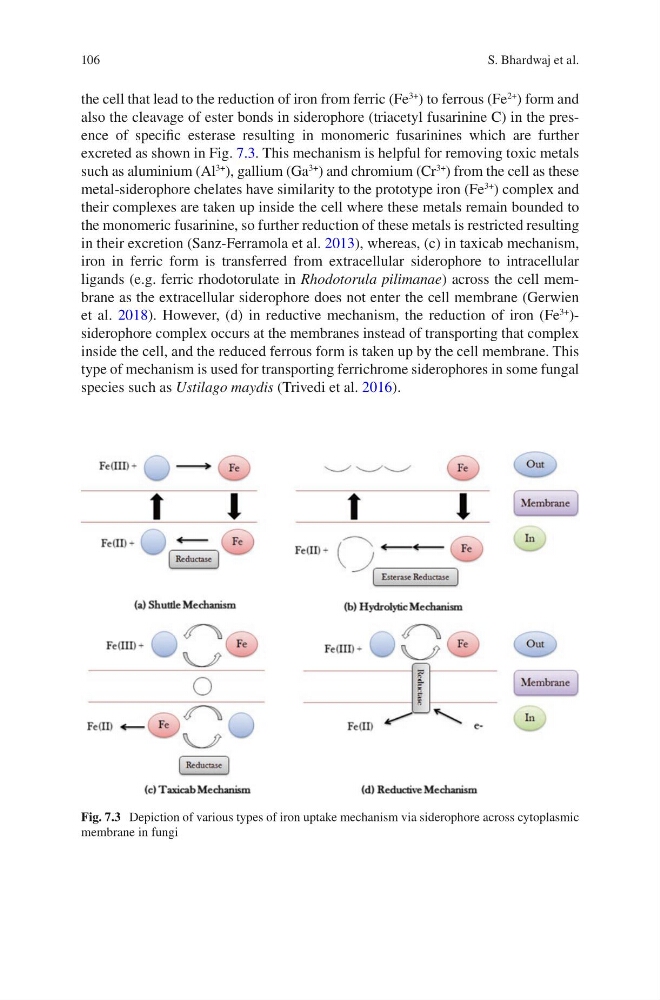
excreted as shown in Fig. 7.3. This mechanism is helpful for removing toxic metals
such as aluminium (Al
3+
), gallium (Ga
3+
) and chromium (Cr
3+
) from the cell as these
metal-siderophore chelates have similarity to the prototype iron (Fe
3+
) complex and
their complexes are taken up inside the cell where these metals remain bounded to
the monomeric fusarinine, so further reduction of these metals is restricted resulting
in their excretion (Sanz-Ferramola et al. 2013), whereas, (c) in taxicab mechanism,
iron in ferric form is transferred from extracellular siderophore to intracellular
ligands (e.g. ferric rhodotorulate in Rhodotorula pilimanae) across the cell membrane as the extracellular siderophore does not enter the cell membrane (Gerwien
et al. 2018). However, (d) in reductive mechanism, the reduction of iron (Fe
3+
)siderophore complex occurs at the membranes instead of transporting that complex
inside the cell, and the reduced ferrous form is taken up by the cell membrane. This
type of mechanism is used for transporting ferrichrome siderophores in some fungal
species such as Ustilago maydis (Trivedi et al. 2016).
Fig. 7.3 Depiction of various types of iron uptake mechanism via siderophore across cytoplasmic
membrane in fungi
S. Bhardwaj et al.
the cell that lead to the reduction of iron from ferric (Fe
3+
) to ferrous (Fe
2+
) form and
also the cleavage of ester bonds in siderophore (triacetyl fusarinine C) in the presence of specific esterase resulting in monomeric fusarinines which are further
excreted as shown in Fig. 7.3. This mechanism is helpful for removing toxic metals
such as aluminium (Al
3+
), gallium (Ga
3+
) and chromium (Cr
3+
) from the cell as these
metal-siderophore chelates have similarity to the prototype iron (Fe
3+
) complex and
their complexes are taken up inside the cell where these metals remain bounded to
the monomeric fusarinine, so further reduction of these metals is restricted resulting
in their excretion (Sanz-Ferramola et al. 2013), whereas, (c) in taxicab mechanism,
iron in ferric form is transferred from extracellular siderophore to intracellular
ligands (e.g. ferric rhodotorulate in Rhodotorula pilimanae) across the cell membrane as the extracellular siderophore does not enter the cell membrane (Gerwien
et al. 2018). However, (d) in reductive mechanism, the reduction of iron (Fe
3+
)siderophore complex occurs at the membranes instead of transporting that complex
inside the cell, and the reduced ferrous form is taken up by the cell membrane. This
type of mechanism is used for transporting ferrichrome siderophores in some fungal
species such as Ustilago maydis (Trivedi et al. 2016).
Fig. 7.3 Depiction of various types of iron uptake mechanism via siderophore across cytoplasmic
membrane in fungi
S. Bhardwaj et al.