

104
7.4.1 Hydroxamate Siderophores
Chemically, these are specifically tri-hydroxamate type of siderophores reportedly
found in fungi and majorly produced by fungal species that belongs to Zygomycotina
(Mucorales), Ascomycotina (Aspergillus spp., N. crassa) and Deuteromycotina
(Fusarium dimerum) subdivision of fungi. Hydroxamate siderophores have strong
correlation among their hydroxamate groups and bound ligands as they known to
form hexadentate, tetradentate and bidentate complexes. In hydroxamate class
mainly, ferrichromes are of main concern with respect to ecological importance due
to their potential to chelate iron from soil and supply to plant species, whereas other
naturally occurring siderophores are not as effective because of their affinity towards
other metal ions too. From the literature reports, ferrichrome derivative such as ferrioxamines also exhibits antibiotic activity (named as ferrimycines). In addition,
rhodotorulic acid, dimerium acid, alkaligens and putrebactin also belong to
hydroxamate- type siderophore family (Garnerin et al. 2017).
7.4.2 Carboxylate Siderophores
A new class of siderophore was identified by Winkelmann from fungi Rhizopus
microspores belonging to zygomycetes, which contain ‘hydroxyl’ and ‘carboxyl’
moieties as donor groups to iron (Fe
3+
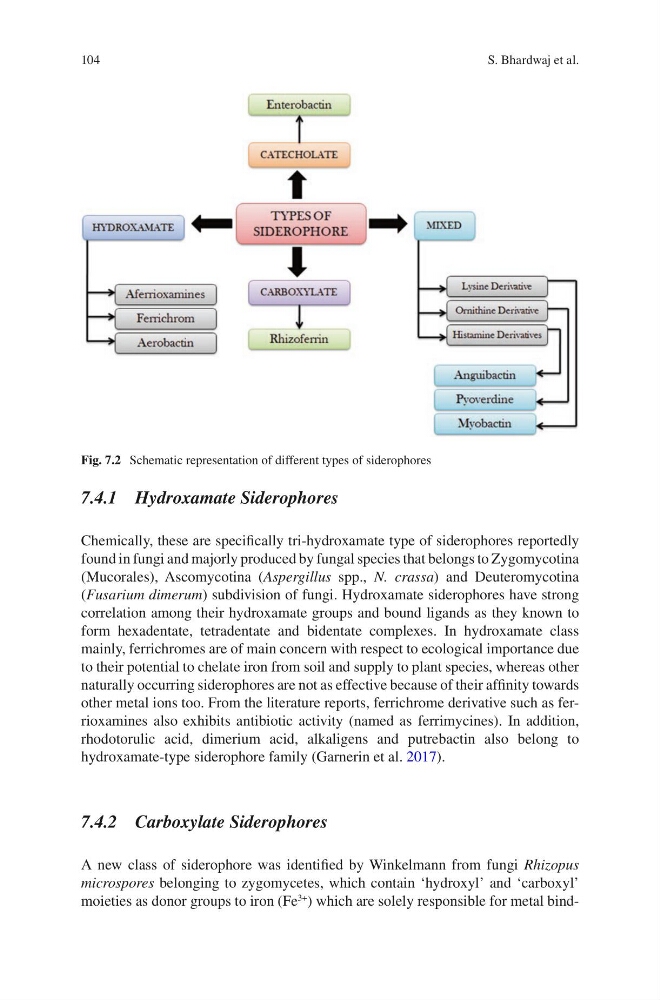
) which are solely responsible for metal bindFig. 7.2 Schematic representation of different types of siderophores
S. Bhardwaj et al.
7.4.1 Hydroxamate Siderophores
Chemically, these are specifically tri-hydroxamate type of siderophores reportedly
found in fungi and majorly produced by fungal species that belongs to Zygomycotina
(Mucorales), Ascomycotina (Aspergillus spp., N. crassa) and Deuteromycotina
(Fusarium dimerum) subdivision of fungi. Hydroxamate siderophores have strong
correlation among their hydroxamate groups and bound ligands as they known to
form hexadentate, tetradentate and bidentate complexes. In hydroxamate class
mainly, ferrichromes are of main concern with respect to ecological importance due
to their potential to chelate iron from soil and supply to plant species, whereas other
naturally occurring siderophores are not as effective because of their affinity towards
other metal ions too. From the literature reports, ferrichrome derivative such as ferrioxamines also exhibits antibiotic activity (named as ferrimycines). In addition,
rhodotorulic acid, dimerium acid, alkaligens and putrebactin also belong to
hydroxamate- type siderophore family (Garnerin et al. 2017).
7.4.2 Carboxylate Siderophores
A new class of siderophore was identified by Winkelmann from fungi Rhizopus
microspores belonging to zygomycetes, which contain ‘hydroxyl’ and ‘carboxyl’
moieties as donor groups to iron (Fe
3+
) which are solely responsible for metal bindFig. 7.2 Schematic representation of different types of siderophores
S. Bhardwaj et al.