

103
7.3.4 Low-Affinity Iron Uptake
The iron in the form of ferrous (Fe
2+
) is taken up by permease Fet4p. The system is
non-specific for Fe
2+
form of iron as it also transports other metals such as zinc and
copper. In Saccharomyces cerevisiae, the iron supply is associated with mobilization of iron from vacuole which is facilitated by fluid-phase endocytosis and Smf1p
protein belonging to natural resistance-associated macrophage protein (NRAMP)
family (Kosman 2003).
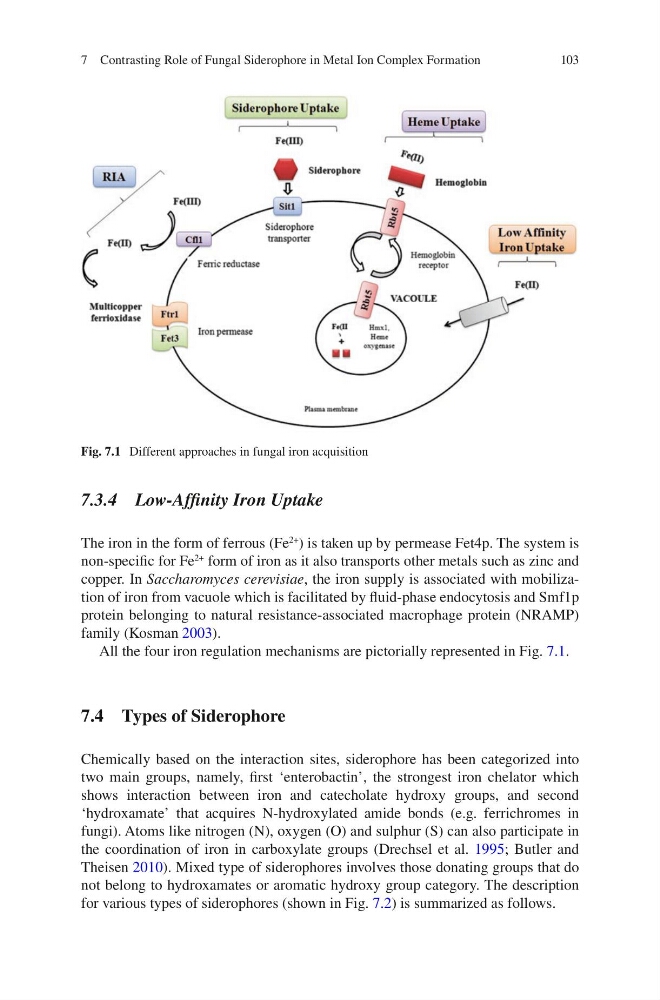
All the four iron regulation mechanisms are pictorially represented in Fig. 7.1.
7.4 Types of Siderophore
Chemically based on the interaction sites, siderophore has been categorized into
two main groups, namely, first ‘enterobactin’, the strongest iron chelator which
shows interaction between iron and catecholate hydroxy groups, and second
‘hydroxamate’ that acquires N-hydroxylated amide bonds (e.g. ferrichromes in
fungi). Atoms like nitrogen (N), oxygen (O) and sulphur (S) can also participate in
the coordination of iron in carboxylate groups (Drechsel et al. 1995; Butler and
Theisen 2010). Mixed type of siderophores involves those donating groups that do
not belong to hydroxamates or aromatic hydroxy group category. The description
for various types of siderophores (shown in Fig. 7.2) is summarized as follows.
Fig. 7.1 Different approaches in fungal iron acquisition
7 Contrasting Role of Fungal Siderophore in Metal Ion Complex Formation
7.3.4 Low-Affinity Iron Uptake
The iron in the form of ferrous (Fe
2+
) is taken up by permease Fet4p. The system is
non-specific for Fe
2+
form of iron as it also transports other metals such as zinc and
copper. In Saccharomyces cerevisiae, the iron supply is associated with mobilization of iron from vacuole which is facilitated by fluid-phase endocytosis and Smf1p
protein belonging to natural resistance-associated macrophage protein (NRAMP)
family (Kosman 2003).
All the four iron regulation mechanisms are pictorially represented in Fig. 7.1.
7.4 Types of Siderophore
Chemically based on the interaction sites, siderophore has been categorized into
two main groups, namely, first ‘enterobactin’, the strongest iron chelator which
shows interaction between iron and catecholate hydroxy groups, and second
‘hydroxamate’ that acquires N-hydroxylated amide bonds (e.g. ferrichromes in
fungi). Atoms like nitrogen (N), oxygen (O) and sulphur (S) can also participate in
the coordination of iron in carboxylate groups (Drechsel et al. 1995; Butler and
Theisen 2010). Mixed type of siderophores involves those donating groups that do
not belong to hydroxamates or aromatic hydroxy group category. The description
for various types of siderophores (shown in Fig. 7.2) is summarized as follows.
Fig. 7.1 Different approaches in fungal iron acquisition
7 Contrasting Role of Fungal Siderophore in Metal Ion Complex Formation