

81
3
Through comparing leading discourses on various topics in environment and
development, we have identified four discourse types (Svarstad et al. 2008). We
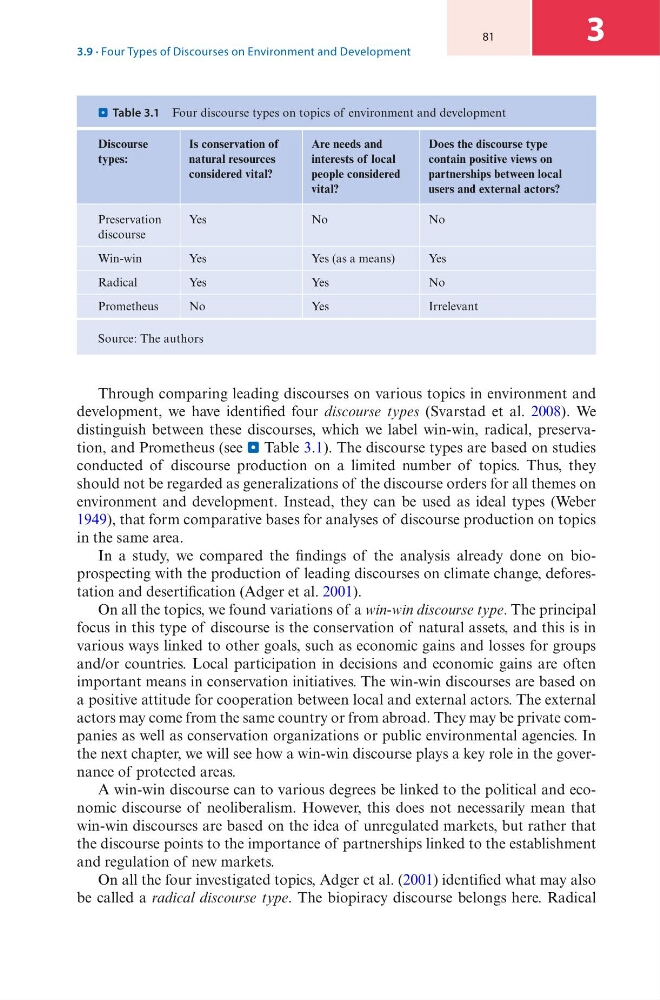
distinguish between these discourses, which we label win-win, radical, preservation, and Prometheus (see . Table 3.1). The discourse types are based on studies
conducted of discourse production on a limited number of topics. Thus, they
should not be regarded as generalizations of the discourse orders for all themes on
environment and development. Instead, they can be used as ideal types (Weber
1949), that form comparative bases for analyses of discourse production on topics
in the same area.
In a study, we compared the findings of the analysis already done on bioprospecting with the production of leading discourses on climate change, deforestation and desertification (Adger et al. 2001).
On all the topics, we found variations of a win-win discourse type. The principal
focus in this type of discourse is the conservation of natural assets, and this is in
various ways linked to other goals, such as economic gains and losses for groups
and/or countries. Local participation in decisions and economic gains are often
important means in conservation initiatives. The win-win discourses are based on
a positive attitude for cooperation between local and external actors. The external
actors may come from the same country or from abroad. They may be private companies as well as conservation organizations or public environmental agencies. In
the next chapter, we will see how a win-win discourse plays a key role in the governance of protected areas.
A win-win discourse can to various degrees be linked to the political and economic discourse of neoliberalism. However, this does not necessarily mean that
win-win discourses are based on the idea of unregulated markets, but rather that
the discourse points to the importance of partnerships linked to the establishment
and regulation of new markets.
On all the four investigated topics, Adger et al. (2001) identified what may also
be called a radical discourse type. The biopiracy discourse belongs here. Radical
. Table 3.1 Four discourse types on topics of environment and development
Discourse
types:
Is conservation of
natural resources
considered vital?
Are needs and
interests of local
people considered
vital?
Does the discourse type
contain positive views on
partnerships between local
users and external actors?
Preservation
discourse
Yes
No
No
Win-win
Yes
Yes (as a means)
Yes
Radical
Yes
Yes
No
Prometheus
No
Yes
Irrelevant
Source: The authors
3.9 · Four Types of Discourses on Environment and Development
3
Through comparing leading discourses on various topics in environment and
development, we have identified four discourse types (Svarstad et al. 2008). We
distinguish between these discourses, which we label win-win, radical, preservation, and Prometheus (see . Table 3.1). The discourse types are based on studies
conducted of discourse production on a limited number of topics. Thus, they
should not be regarded as generalizations of the discourse orders for all themes on
environment and development. Instead, they can be used as ideal types (Weber
1949), that form comparative bases for analyses of discourse production on topics
in the same area.
In a study, we compared the findings of the analysis already done on bioprospecting with the production of leading discourses on climate change, deforestation and desertification (Adger et al. 2001).
On all the topics, we found variations of a win-win discourse type. The principal
focus in this type of discourse is the conservation of natural assets, and this is in
various ways linked to other goals, such as economic gains and losses for groups
and/or countries. Local participation in decisions and economic gains are often
important means in conservation initiatives. The win-win discourses are based on
a positive attitude for cooperation between local and external actors. The external
actors may come from the same country or from abroad. They may be private companies as well as conservation organizations or public environmental agencies. In
the next chapter, we will see how a win-win discourse plays a key role in the governance of protected areas.
A win-win discourse can to various degrees be linked to the political and economic discourse of neoliberalism. However, this does not necessarily mean that
win-win discourses are based on the idea of unregulated markets, but rather that
the discourse points to the importance of partnerships linked to the establishment
and regulation of new markets.
On all the four investigated topics, Adger et al. (2001) identified what may also
be called a radical discourse type. The biopiracy discourse belongs here. Radical
. Table 3.1 Four discourse types on topics of environment and development
Discourse
types:
Is conservation of
natural resources
considered vital?
Are needs and
interests of local
people considered
vital?
Does the discourse type
contain positive views on
partnerships between local
users and external actors?
Preservation
discourse
Yes
No
No
Win-win
Yes
Yes (as a means)
Yes
Radical
Yes
Yes
No
Prometheus
No
Yes
Irrelevant
Source: The authors
3.9 · Four Types of Discourses on Environment and Development